The Cañón del Río Lobos, a fault line in Castile
Between Soria and Burgos, the Castilian plateau opens without warning onto a limestone canyon where griffon vultures nest. You drive little, you walk a lot, and on weekdays you meet few people.
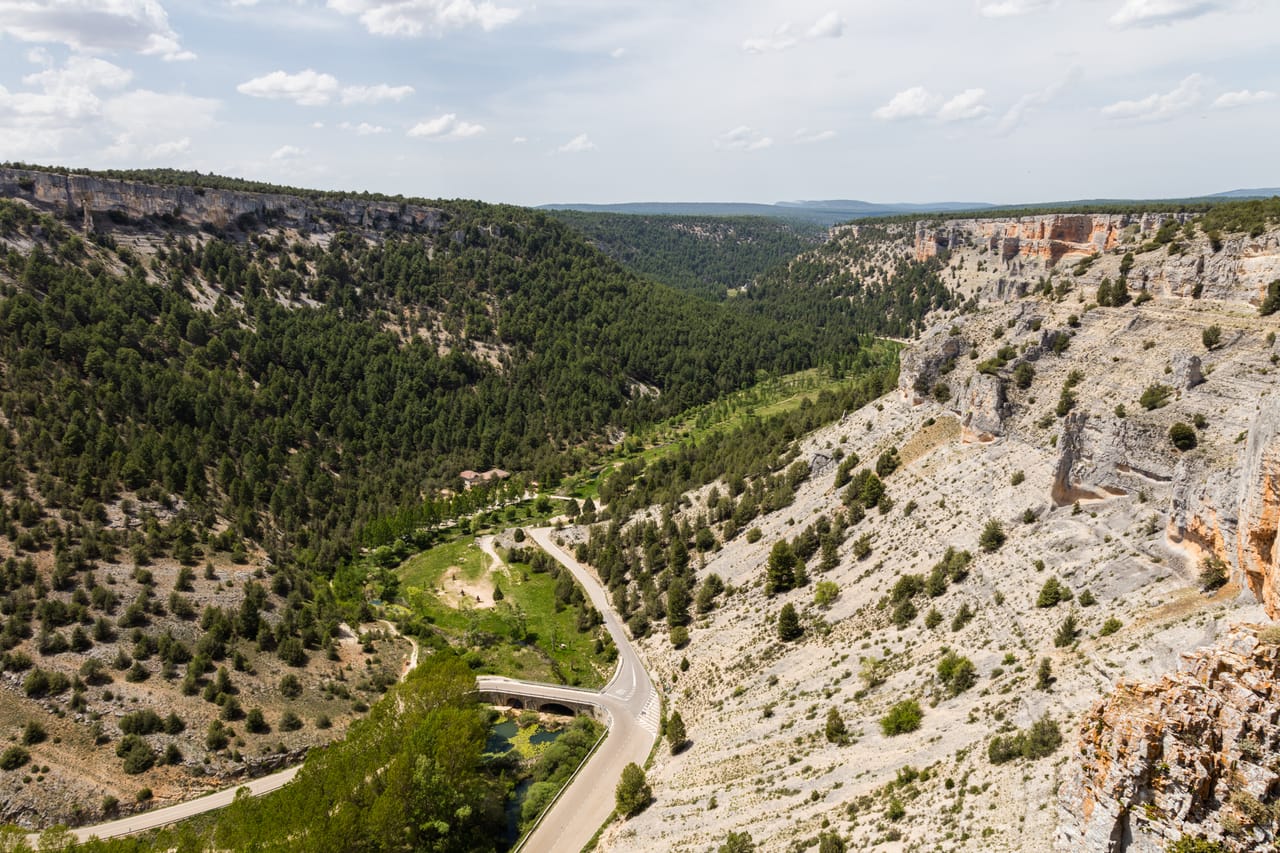
The canyon, Soria and the Urbión
You drive across a cereal plateau, flat and dry, between Soria and Burgos. Near Ucero, the road drops into the Cañón del Río Lobos: twenty-five kilometres of limestone gorge, protected as a nature park. Paths follow the river under the pines, at the foot of cliffs several tens of metres high. To see the canyon from above, you climb to the Mirador de la Galiana.
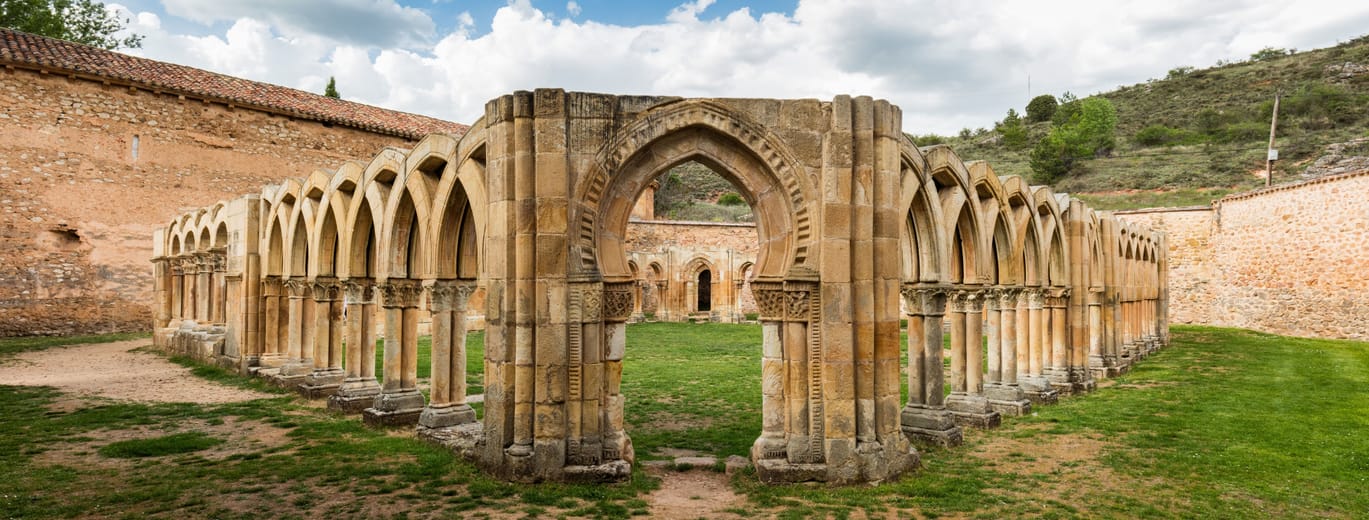
Three quarters of an hour away, Soria is one of the smallest provincial capitals in Spain. The Duero skirts it to the east, lined with poplars. In the evening, you can walk from the cloister of San Juan de Duero, with its interlaced arches, to the hermitage of San Saturio, clinging to the cliff. The poet Antonio Machado taught French in Soria in the early 20th century and wrote part of Campos de Castilla there. The town remembers him on every street corner.
North of Soria, the ruins of Numantia recall a Celtiberian town taken by Rome in 133 BC. North-west of Soria, the road climbs into the Sierra de Urbión, where the Duero rises. The Laguna Negra is a dark glacial lake at the foot of a cliff. Machado set his poem The Land of Alvargonzález there.
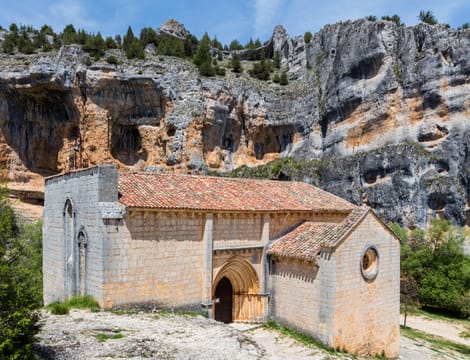
The hermitage of San Bartolomé
On the canyon floor, the hermitage of San Bartolomé is a 13th-century church, between Romanesque and Gothic, set at the foot of the cliff. It was long attributed to the Templars, without solid proof. The legend holds firm, helped by the star-shaped rose windows in its gables. Another tradition places it exactly halfway between the two ends of the peninsula. You reach it on foot, in a little under half an hour from the nearest car park, following the river.
Just in front of the hermitage, the Cueva Grande opens in the rock face. The path then carries on along the river. At the bottom of the gorge, the car stays in the car park: you do everything on foot.
Griffon vultures nest in colonies on the ledges. You see them circling above the gorge, carried by the warm air. During the breeding season, some areas are restricted. Climbing is banned throughout the park.
At the bottom of the gorge, the car stays in the car park: you do everything on foot.
The castles of the Duero
South of the canyon, the Duero was for almost two centuries the frontier between al-Andalus and the Christian kingdoms. Gormaz Castle, built in the 10th century by the caliphs, stands above the river. Its walls run more than a kilometre round: it was one of the largest fortresses in Europe.
At Calatañazor, a saying has it that Almanzor ‘lost his drum’ there in 1002 — his glory, in other words. He died soon afterwards at Medinaceli. At El Burgo de Osma, a Gothic cathedral towers over an arcaded town. Near Berlanga, the Mozarabic hermitage of San Baudelio hides, under the plainest of roofs, a vault that springs from a central pillar like the fronds of a palm tree.
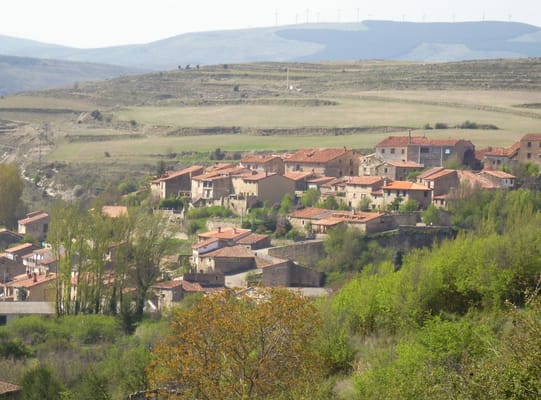
Yanguas
A medieval village of stone and timber on the banks of the Cidacos, beneath the ruins of its castle, in Tierras Altas all but emptied of their people. Across the whole area, the rock still holds dinosaur footprints.
Practical notes
- When to go
- April to June, then September. The Castilian plateau is harsh in winter as in high summer.
- Getting there
- Soria 45 minutes away, Burgos an hour and a half, Madrid two and a half.
- Access
- Main entrance at Ucero, south of the park. The gorge floor is walked, not driven.
- Sleeping in a van
- A campsite on the road from Ucero to San Leonardo, a motorhome aire at San Leonardo de Yagüe. Wild camping is forbidden in the nature park.
- Worth knowing
- Some areas are restricted while the raptors are nesting: ask at the Casa del Parque in Ucero.
- Allow
- Two days for the canyon, five for the loop by way of Soria, the Urbión and the Duero valley.
What not to miss
- 1The hermitage of San BartoloméA lone thirteenth-century church on the gorge floor, which a stubborn legend calls Templar.
- 2The Cueva GrandeA cave opening at the foot of the cliff, just opposite the hermitage.
- 3SoriaA provincial town without mass tourism, three quarters of an hour away.
- 4The Mirador de la GalianaThe canyon from above, from a balcony hanging over the cliffs, near Ucero.
- 5Gormaz CastleA caliphal fortress whose walls run more than a kilometre round, above the Duero.
- 6San Baudelio de BerlangaA small Mozarabic hermitage whose vault opens out like a palm tree.
The Cañón del Río Lobos in pictures
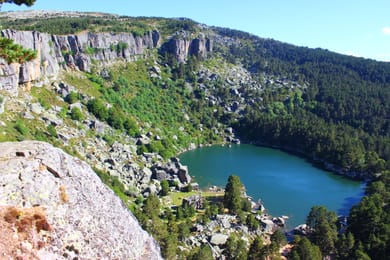
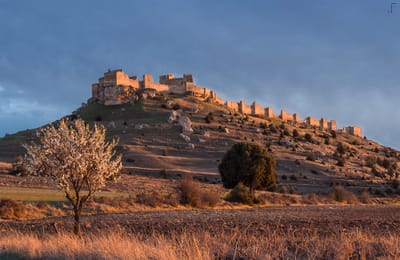
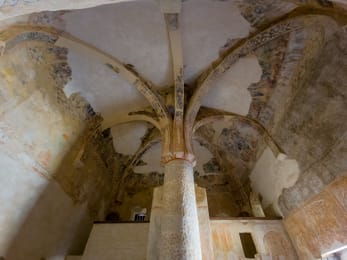
The Laguna Negra, in the Sierra de Urbión.
Soria’s table
The province lives off its pinewoods and its flocks. Soria butter, with its protected designation of origin, is eaten on toast; torreznos, crisp-fried pork belly, come with the aperitif in every bar.
In autumn the pine forests fill with foragers: mushrooms make a season all of their own. And in Burgos, the speciality to take home is the rice black pudding, the morcilla.
Loop from Soria


 +10stops
- 1Monasterio de San Juan de Duero · Ermita de San Saturio · Numancia
- 2Laguna Negra de Urbión · Monumento natural de La Fuentona
- 3Castillo de Calatañazor · Castillo de Ucero · Ermita de San Bartolomé
Free, no account needed — start from its places and make it yours.
Also worth reading
Wide open spaces
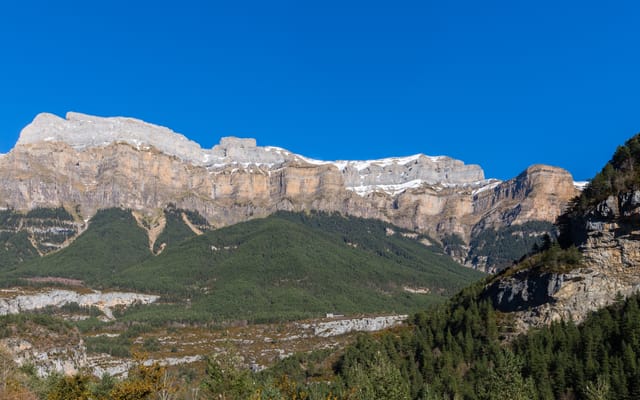
The Aragonese Pyrenees, from Ordesa to Loarre
The Ordesa canyon beneath Monte Perdido, Romanesque monasteries tucked under cliffs, an outsized international railway station and stone villages with conical chimneys. Six days on a loop from Huesca, on the dry, sunny side of the Pyrenees.
Wide open spaces
Bardenas Reales, the desert that starts past the last orchard
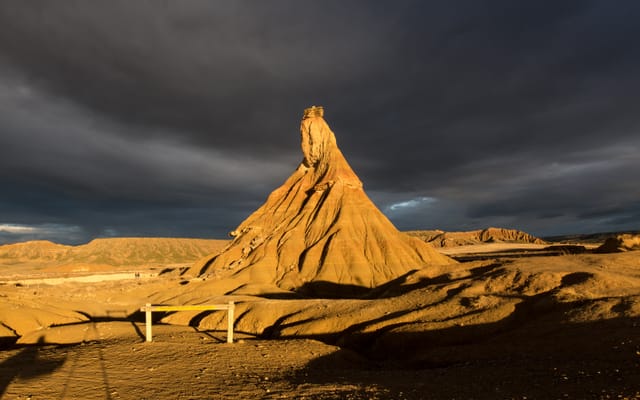
An hour south of Pamplona, green Navarre gives way to a semi-desert of clay and gypsum, shaped by rain more than by wind. Two days are enough for the Bardena Blanca, five to circle the desert by way of Olite and the Cinco Villas.
Wide open spaces
The Pacific Northwest, from the Olympic Peninsula to the Cascade volcanoes
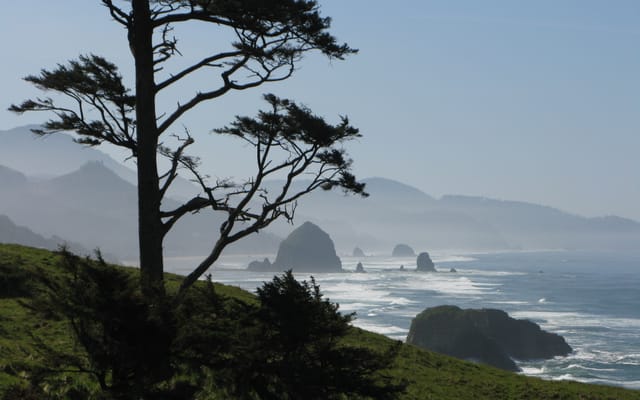
Rainforests, a coast of headlands and lighthouses, redwoods and two active volcanoes. A two-week loop from Seattle, by way of the Olympic Peninsula, the Oregon coast and Mount Rainier.
A starting point, a few wishes — ViaLooma builds the trip day by day, map, stops and roadbook included.