The Aragonese Pyrenees, from Ordesa to Loarre
The Ordesa canyon beneath Monte Perdido, Romanesque monasteries tucked under cliffs, an outsized international railway station and stone villages with conical chimneys. Six days on a loop from Huesca, on the dry, sunny side of the Pyrenees.
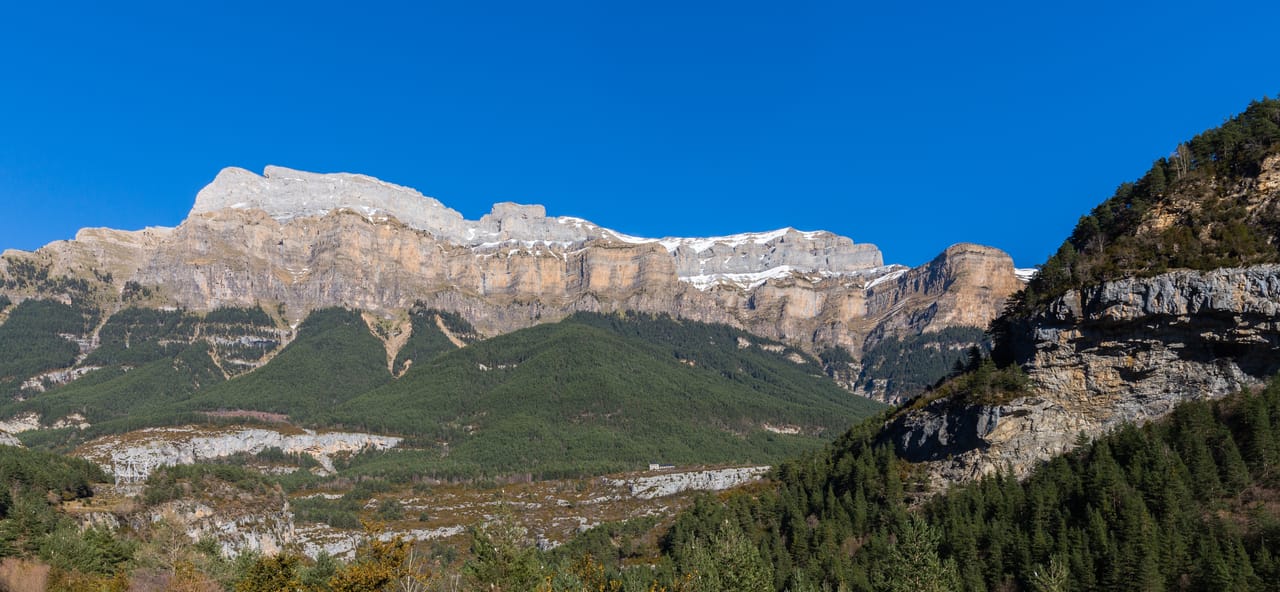
The southern side of the Pyrenees
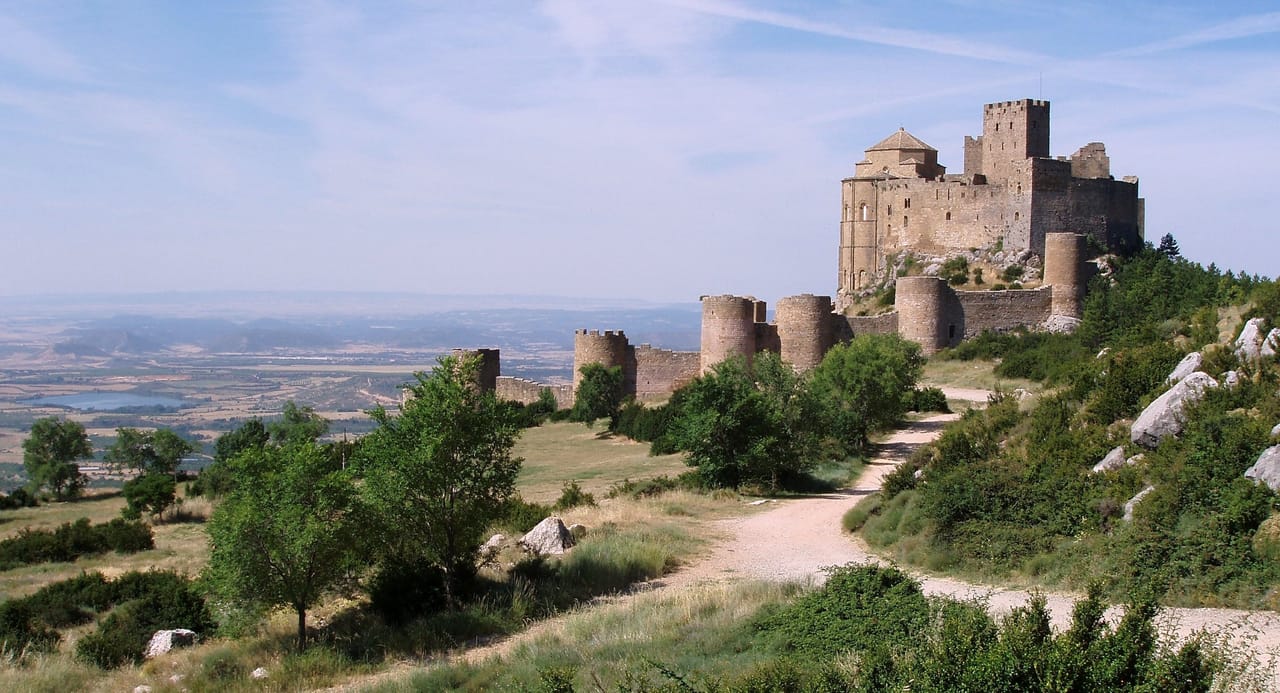
On the Spanish side, the Pyrenees are drier and sunnier. The road leaves Huesca and the plain, then climbs towards valleys cut into limestone canyons. The first cliffs rise right from the edge of the plain. Loarre castle, built in the 11th century, is one of the best-preserved Romanesque fortresses in Europe; Ridley Scott filmed Kingdom of Heaven here. Half an hour away, the Mallos de Riglos are towers of red conglomerate nearly three hundred metres high. They draw climbers, and vultures nest there.
The villages change from one valley to the next. In the Hecho and Ansó valleys, to the west, the conical chimneys carry the espantabrujas, a stone or small figure meant to keep witches away. Aragonese, the Romance language of these valleys, lives on here in local dialects. To the east, Aínsa keeps a large arcaded square and a castle, where the Ara meets the Cinca.
Further south, Alquézar stands on a spur above the canyons of the río Vero, one of Europe’s great canyoning spots. North-east of Aínsa, outside this loop, the Benasque valley leads to the foot of Aneto, the highest peak in the Pyrenees, at 3,404 metres.
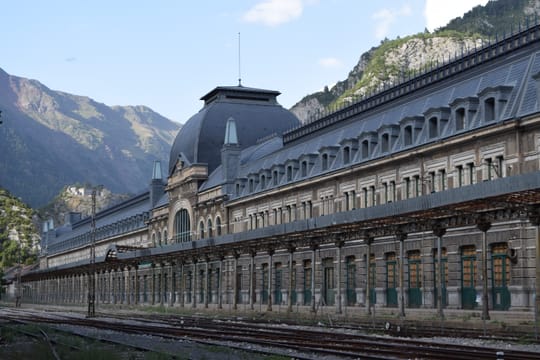
Canfranc, Jaca and the first kings of Aragon
Canfranc international station was opened in 1928 at the foot of the Somport pass. It was meant to link Spain and France by rail. The building is 241 metres long. It had, so they say, more windows than passengers. In 1970, a train accident cut the line on the French side. Restored, the station has housed a hotel since 2023.
Heading down the valley, you reach Jaca. The kingdom of Aragon was born in these valleys in the 11th century, before spreading as far as the Mediterranean and Naples. Jaca was its first capital.
South-west of Jaca, the monastery of San Juan de la Peña is built beneath a huge overhanging slab of rock. It shelters a Romanesque cloister with carved capitals and the pantheon of the first kings of Aragon. According to tradition, the Holy Grail was kept here; Valencia Cathedral now claims to hold it.
It had, so they say, more windows than passengers.
Ordesa and Monte Perdido
Monte Perdido, at 3,355 metres, is reckoned the highest limestone massif in Europe. Together with the Cirque de Gavarnie, across the border, it forms a single World Heritage Site. On the Spanish side, it is protected by Ordesa National Park, created in 1918, one of the two oldest in Spain.
The Ordesa valley is glacial in origin. Its cliffs, several hundred metres high, tower over the beech woods. From La Pradera, at the end of the road, a path leads to the Cola de Caballo waterfall in about three hours. In summer and during the holidays, the road to La Pradera is closed to cars: you go up by shuttle bus from Torla, a village with slate roofs. Further east, the Añisclo canyon is followed by a narrow road cut into the rock face.
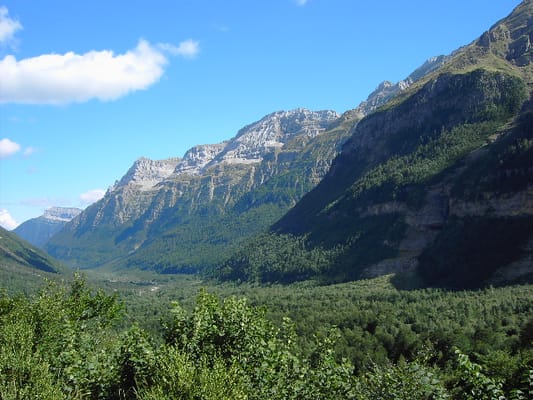
Valle de Pineta
A glacial dead-end valley, closed off by the rock walls and waterfalls of the Monte Perdido massif, at the end of a road some fifteen kilometres long. One of the most spectacular corners of the national park, and one of the least visited.
Practical notes
- When to go
- June to September for the mountains; May and October are superb and quieter. In summer, afternoon storms are frequent.
- Getting there
- Huesca is an hour from Zaragoza, which has an airport and a high-speed rail station. From France, through the Somport or Bielsa tunnel.
- Access
- All tarmac. The road to La Pradera in Ordesa is closed to cars in season; the very narrow Añisclo road then runs one way from Escalona.
- Sleeping in a van
- Campsites at Torla, Aínsa, Jaca and Alquézar. Overnight parking is banned in the national park and policed around it.
- Worth knowing
- The Ordesa shuttle leaves from Torla in season and during the holidays; its dates change every year, so check before you go.
- Allow
- Six days for the loop, a week to walk to the Cola de Caballo and into Añisclo.
What not to miss
- 1The Ordesa valleyThe waterfall trail to the Cola de Caballo, beneath the cliffs.
- 2The Añisclo canyonA road carved out of the rock, above the pools of the río Bellós.
- 3San Juan de la PeñaA Romanesque cloister nestled under a slab of rock.
- 4Canfranc stationA railway palace at the head of a mountain valley.
- 5Loarre castleAn intact Romanesque fortress on the edge of the plain.
- 6AínsaAn arcaded medieval square facing the peaks of the Sobrarbe.
The Aragonese Pyrenees in pictures
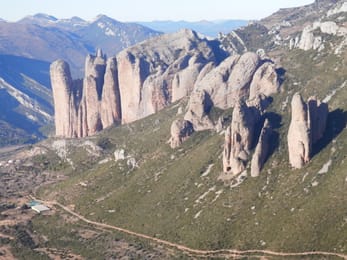
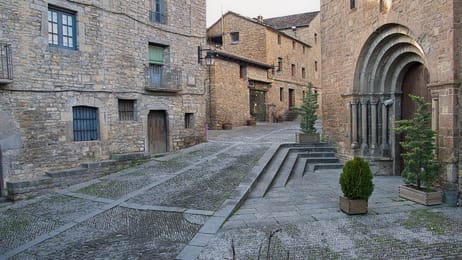
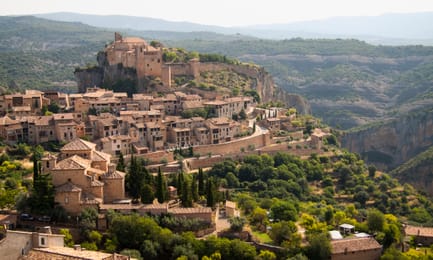
The Mallos de Riglos.
The Upper Aragon table
Valley cooking is mountain food: ternasco de Aragón, young lamb raised on milk and then cereals, protected by a geographical indication; migas, breadcrumbs fried with garlic and bacon; and in autumn, mushrooms from the pine forests.
At the foot of the mountains, the Somontano wine region, around Barbastro, makes well-regarded wines. From Huesca, take home a pastel ruso: two thin almond meringue biscuits filled with a praline cream.
Loop from Huesca


 +9stops
- 1Castillo de Loarre · Mallos de Riglos
- 2Real Monasterio de San Juan de la Peña · Ciudadela de Jaca
- 3Estación Internacional de Canfranc · Monasterio de San Pedro de Siresa · Ansó
Free, no account needed — start from its places and make it yours.
Also worth reading
Wide open spaces
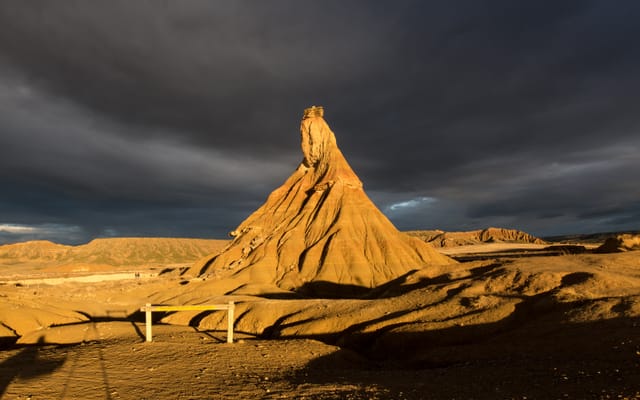
Bardenas Reales, the desert that starts past the last orchard
An hour south of Pamplona, green Navarre gives way to a semi-desert of clay and gypsum, shaped by rain more than by wind. Two days are enough for the Bardena Blanca, five to circle the desert by way of Olite and the Cinco Villas.
Wide open spaces
The Cañón del Río Lobos, a fault line in Castile
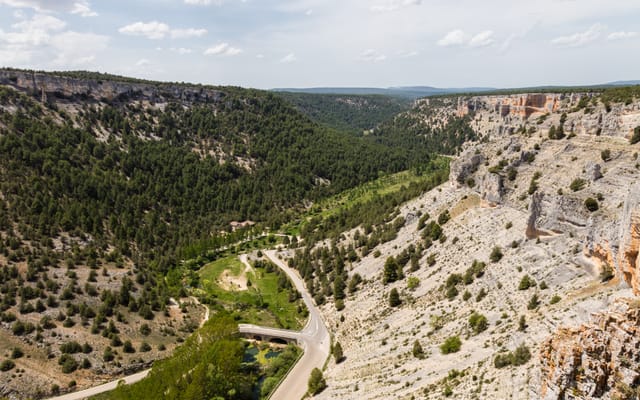
Between Soria and Burgos, the Castilian plateau opens without warning onto a limestone canyon where griffon vultures nest. You drive little, you walk a lot, and on weekdays you meet few people.
Wide open spaces
The Pacific Northwest, from the Olympic Peninsula to the Cascade volcanoes
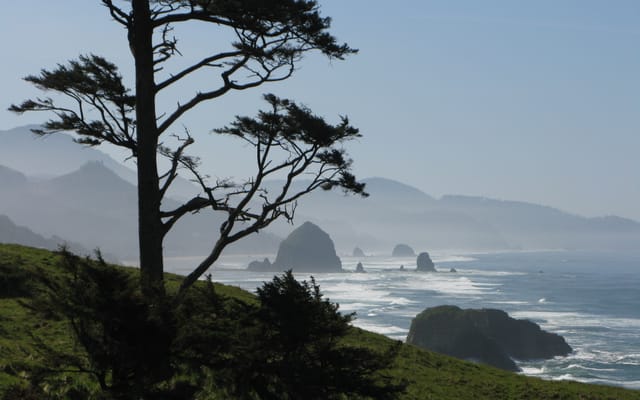
Rainforests, a coast of headlands and lighthouses, redwoods and two active volcanoes. A two-week loop from Seattle, by way of the Olympic Peninsula, the Oregon coast and Mount Rainier.
A starting point, a few wishes — ViaLooma builds the trip day by day, map, stops and roadbook included.