Bardenas Reales, the desert that starts past the last orchard
An hour south of Pamplona, green Navarre gives way to a semi-desert of clay and gypsum, shaped by rain more than by wind. Two days are enough for the Bardena Blanca, five to circle the desert by way of Olite and the Cinco Villas.
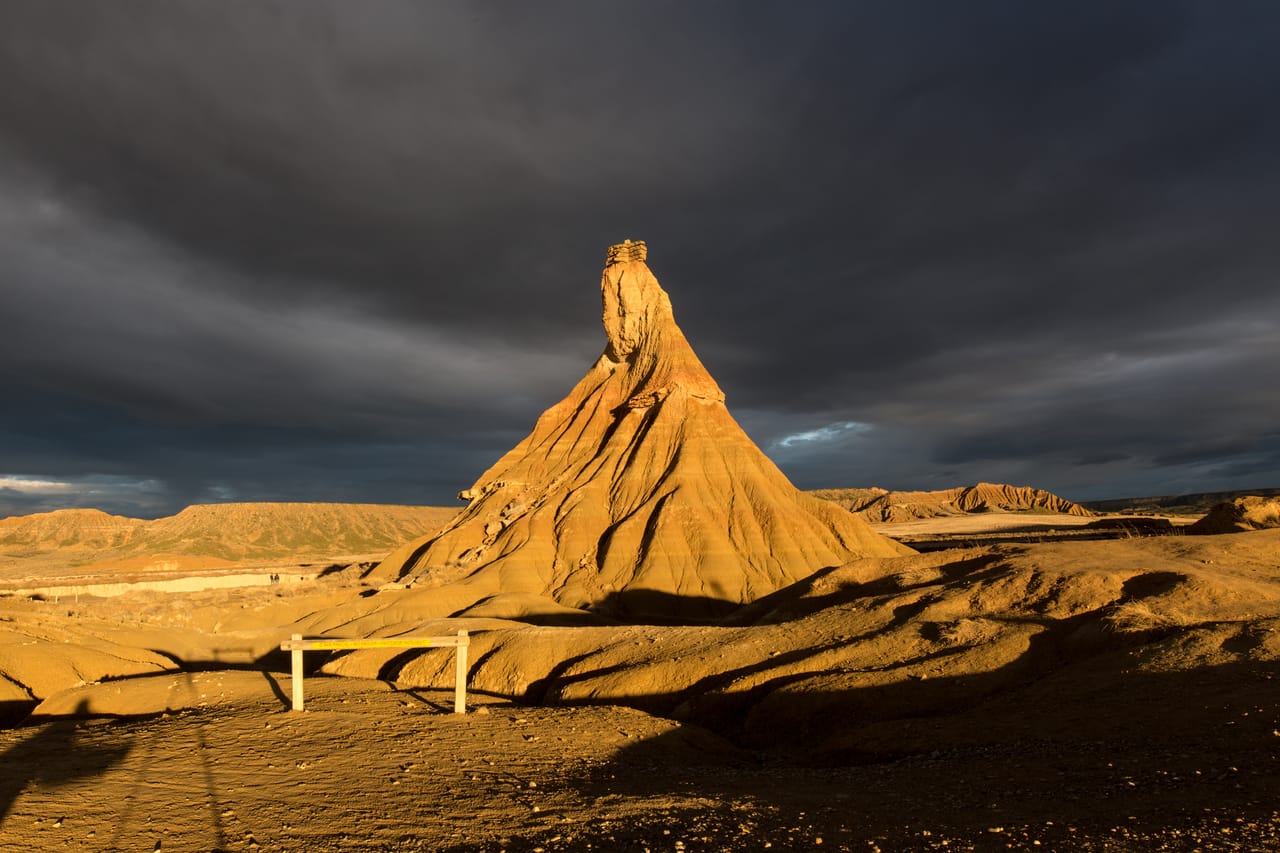
From Tudela to the Bardena Blanca
You leave Tudela heading north and cross the Ebro. For twenty minutes, nothing hints at what is coming: orchards, vegetable fields, greenhouses. At Arguedas, the hill above the village is riddled with cuevas, cave houses lived in until the 1960s. Then the tarmac stops, the earth turns white, and the horizon opens up all at once.
You explore the desert by car, on wide, flat dirt tracks. You drive at 40 km/h at most and stop at the foot of the buttes. Near the main track stands Castildetierra, a column of clay capped with sandstone. The park opens at 8 am, and photographers often arrive right at that hour.
The loop then leaves the desert. To the north, Olite keeps the palace of the kings of Navarre. To the east, the road enters Aragon through the Cinco Villas, as far as Sádaba castle. On the way back, you stop at Tudela, the second city of Navarre, for its cathedral.
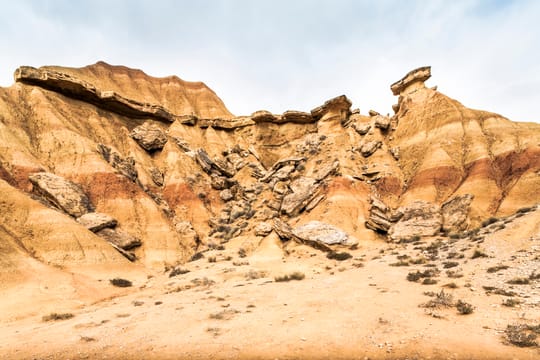
A desert of clay and gypsum
The Bardenas are not a desert of sand. The ground is made of clay, gypsum and sandstone, a soft earth that nothing holds back. It is mostly water that has shaped it: a few violent storms each year wash the earth away and open up ravines. Where a harder layer of sandstone protects the clay, a butte remains, like Castildetierra or El Rallón. The area covers nearly 42,000 hectares, in three parts: El Plano to the north, the Bardena Blanca in the centre, the Bardena Negra to the south.
Only the Bardena Blanca looks like the picture people have of a desert: pale ravines, lone buttes, almost no trees. In its middle, the air force has used a 2,244-hectare firing range since 1951; it is closed to the public and marked. The open tracks all around are enough to see the desert. After a storm, you do not set off. Wet clay turns into mud that you sink into.
The landscape served as a set for the James Bond film The World Is Not Enough, then for the sixth season of Game of Thrones, filmed in 2015. A butte bears the name of Sanchicorrota, a bandit who hid out in the desert and attacked travellers; he died in 1452.
After a storm, you do not set off.
Royal land run by the villages
The name comes from the kings of Navarre, who owned these lands. They granted their use to the neighbouring communities. Even today, 22 congozantes share the Bardenas: 19 municipalities, the Pyrenean valleys of Roncal and Salazar, and the monastery of La Oliva. The community has its seat in Tudela; from 1820 to 1858, its assemblies met at the sanctuary of the Virgen del Yugo, above Arguedas.
Every year, on 18 September, the flocks from the Pyrenean valleys arrive along the cañada of the Roncaleses, an old drove road. They enter the Bardenas at El Paso, near Carcastillo, and spend the winter there. The nature park dates from 1999, and Unesco made the Bardenas a biosphere reserve in 2000.
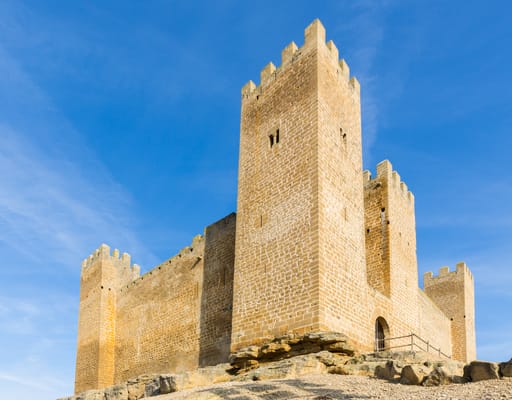
Castillo de Sádaba
A fortress standing alone above the village, with the Roman mausoleum of the Atilii close by, out in the fields. It is the easternmost stop on the loop, already in Aragon.
Practical notes
- When to go
- March to May, then October. In summer, it is often over 35 °C, with no shade at all.
- Getting there
- Pamplona and Zaragoza an hour away, Bilbao two. Last fuel at Tudela or Arguedas.
- Access
- Main entrance via Arguedas. Open from 8 am until an hour before dark. Dirt tracks, 40 km/h at most, passable in an ordinary car in dry weather.
- Sleeping in a van
- Free aire at Arguedas (Paseo del Bordón, 48 hours at most), campsite at Villafranca. Camping and bivouacking are forbidden across the whole of the Bardenas, vans included.
- Worth knowing
- The firing range is closed and marked. After heavy rain, some tracks close and entry is not advised; hunts, rallies and military exercises close others. Notices are on bardenasreales.es.
- Allow
- Two days for the Bardena Blanca, five to circle the desert by way of Olite and the Cinco Villas.
What not to miss
- 1CastildetierraThe lone butte everyone photographs, when the park opens or in the late afternoon.
- 2El RallónA butte in the Bardena Blanca that you climb on foot: a hike of about twelve kilometres.
- 3El Balcón de PilatosCliffs in the south of the Bardena Blanca, with a view over the whole desert.
- 4The cuevas of ArguedasCave houses cut into the hillside, lived in until the 1960s.
- 5The royal palace of OliteA Gothic palace-castle whose towers are all different, three quarters of an hour from Tudela.
- 6Tudela CathedralAt the start of the loop, a Last Judgement portal carved around 1200.
Bardenas Reales in pictures
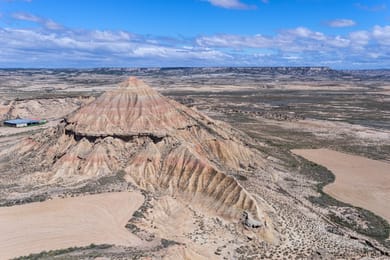
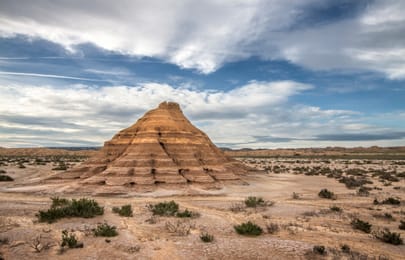
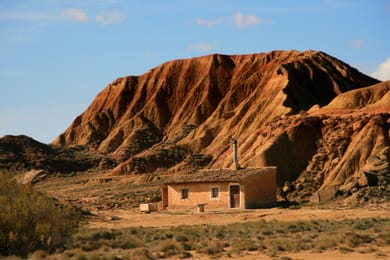
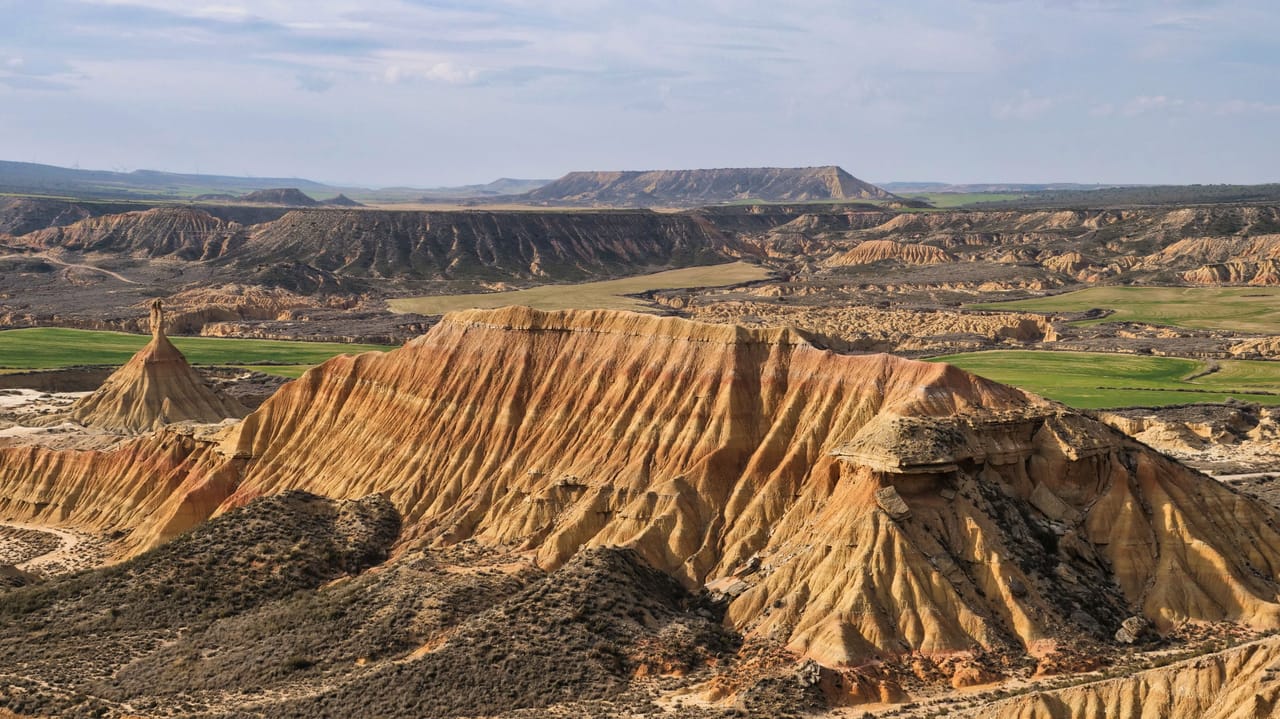
The Bardenas seen from the Cabezo de las Cortinillas.
The Ribera’s table
Around the Bardenas, the Ribera is Navarre’s kitchen garden. Tudela artichokes, Navarre asparagus and lettuce hearts, the cogollos, are eaten almost unadorned, or brought together in a menestra of vegetables.
The piquillos, small red peppers roasted over a wood fire, come from Lodosa, upstream on the Ebro. Spring, the ideal season for the desert, is also the season for vegetables: Tudela even holds a festival in their honour.
Bardenas Reales, le désert qui commence après le dernier verger


 +7stops
- 1Iglesia de la Magdalena · Iglesia de San Pedro (Tudela)
- 2Morera del Castillo de Olite · Castillo de Olite
- 3Mausoleo de los Atilios · Castillo de Sádaba
Free, no account needed — start from its places and make it yours.
Also worth reading
Wide open spaces
The Aragonese Pyrenees, from Ordesa to Loarre
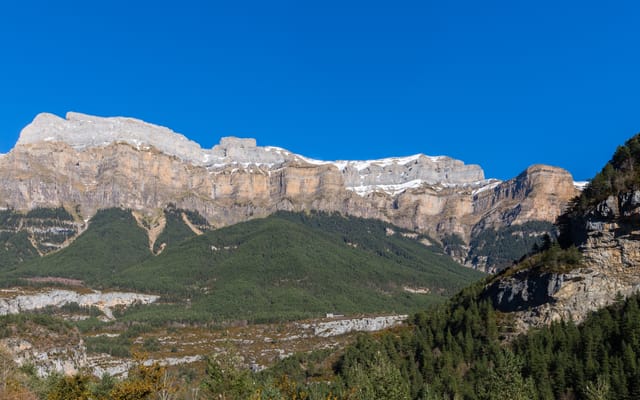
The Ordesa canyon beneath Monte Perdido, Romanesque monasteries tucked under cliffs, an outsized international railway station and stone villages with conical chimneys. Six days on a loop from Huesca, on the dry, sunny side of the Pyrenees.
Wide open spaces
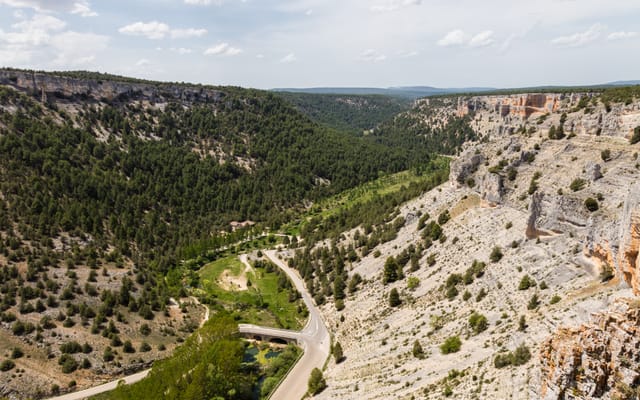
The Cañón del Río Lobos, a fault line in Castile
Between Soria and Burgos, the Castilian plateau opens without warning onto a limestone canyon where griffon vultures nest. You drive little, you walk a lot, and on weekdays you meet few people.
Wide open spaces
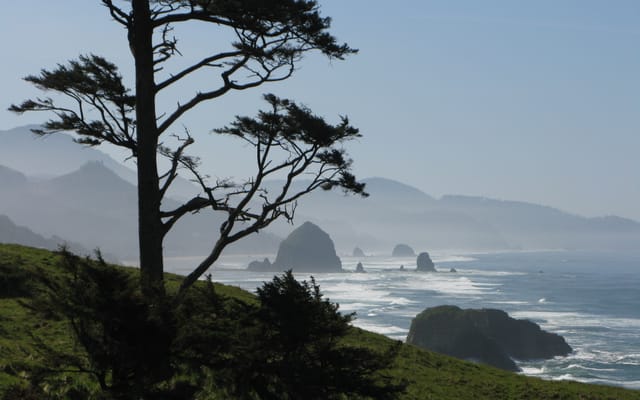
The Pacific Northwest, from the Olympic Peninsula to the Cascade volcanoes
Rainforests, a coast of headlands and lighthouses, redwoods and two active volcanoes. A two-week loop from Seattle, by way of the Olympic Peninsula, the Oregon coast and Mount Rainier.
A starting point, a few wishes — ViaLooma builds the trip day by day, map, stops and roadbook included.