Umbria, from Assisi to the Piano Grande
Umbria has no sea and no border. It is a region of hilltop towns, saints and mountains in the middle of Italy. This trip covers it in a week from Perugia, from Assisi to the Piano Grande and on to Orvieto.
Umbria by car
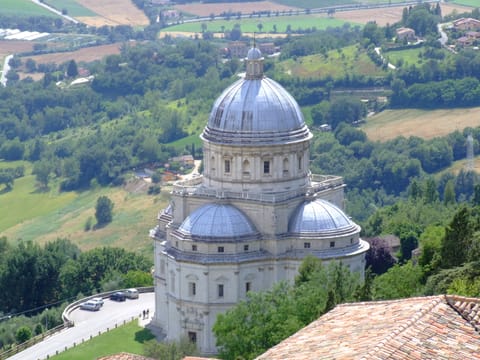
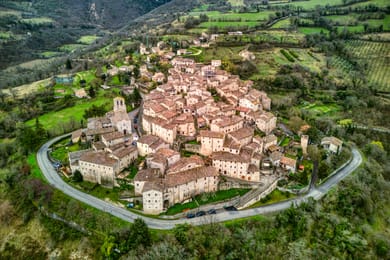
Umbria is seen from hill to hill. The towns are built on high ground, often less than an hour’s drive apart. You park below, walk up or take an escalator or a funicular, and spend a few hours in sloping streets, between a church and a square. Then you drive on through the olive trees. South of Perugia, Todi has kept its walls and, below them, a large Renaissance church, Santa Maria della Consolazione.
In the middle, the Valle Umbra is a plain of olive trees lined with small hilltop towns. In Spello, the streets are covered with carpets of flowers for Corpus Christi. In Montefalco, frescoes by Benozzo Gozzoli tell the life of St Francis. From Trevi, you see the olive groves stretch from Assisi to Spoleto.
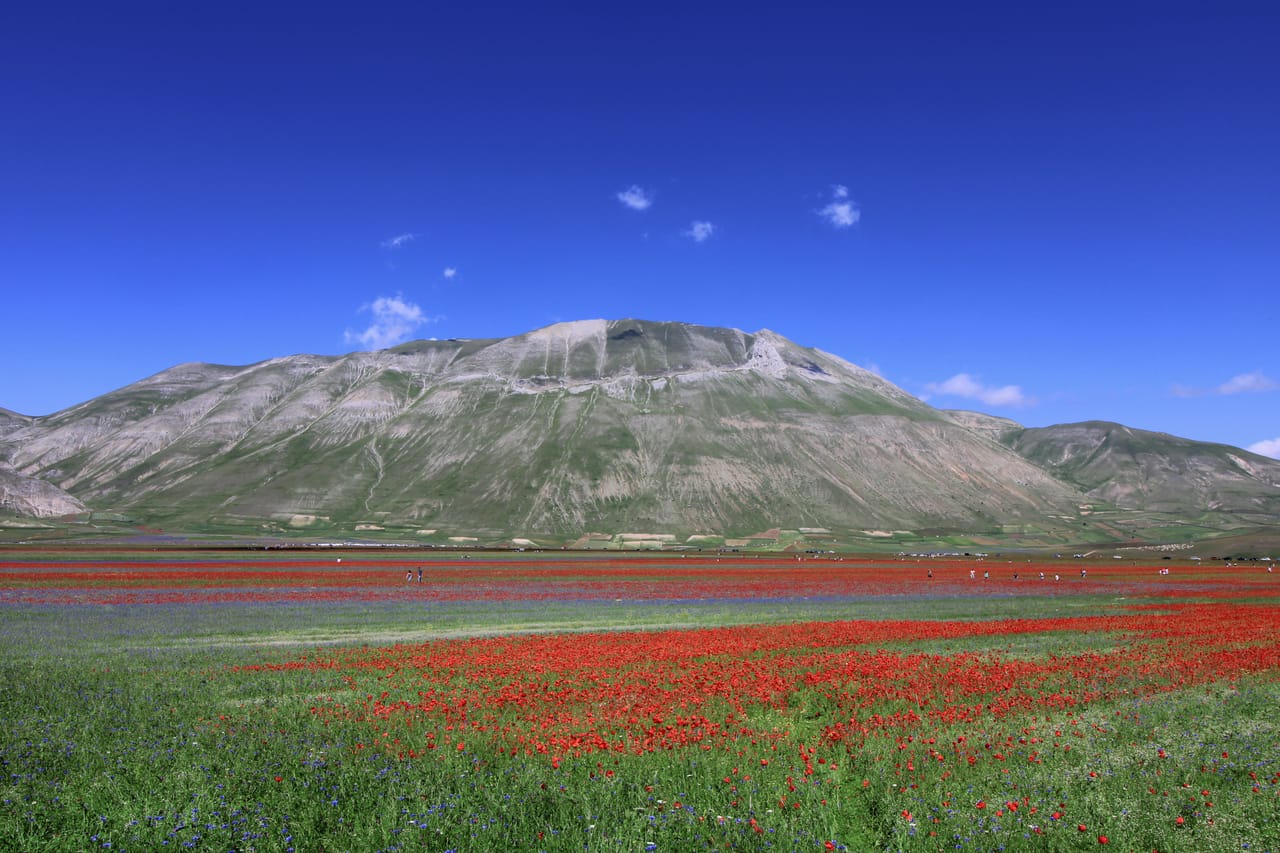
To the east, the road goes through Spoleto, follows the Valnerina up to Norcia, then climbs to the Piano Grande, a large plain surrounded by mountains, with the village of Castelluccio at 1,452 metres. From late May to early July, the lentil fields flower there, along with poppies and cornflowers. These are crops: you look at them from the road.
Perugia and the Salt War
Before the Romans, the region belonged to the Umbrians, who gave it their name. Their language is known from seven bronze tablets kept in Gubbio, the Iguvine Tablets. Perugia was an Etruscan town, then a Roman one, then an independent city until 1540.
That year it rebelled against a papal tax on salt: the Salt War. Pope Paul III put it down and had a fortress, the Rocca Paolina, built on top of the Baglioni family’s houses. Since 1983, escalators have run through the fortress and the medieval streets it covers. People say Umbrian bread has been made without salt since that revolt; historians doubt it.
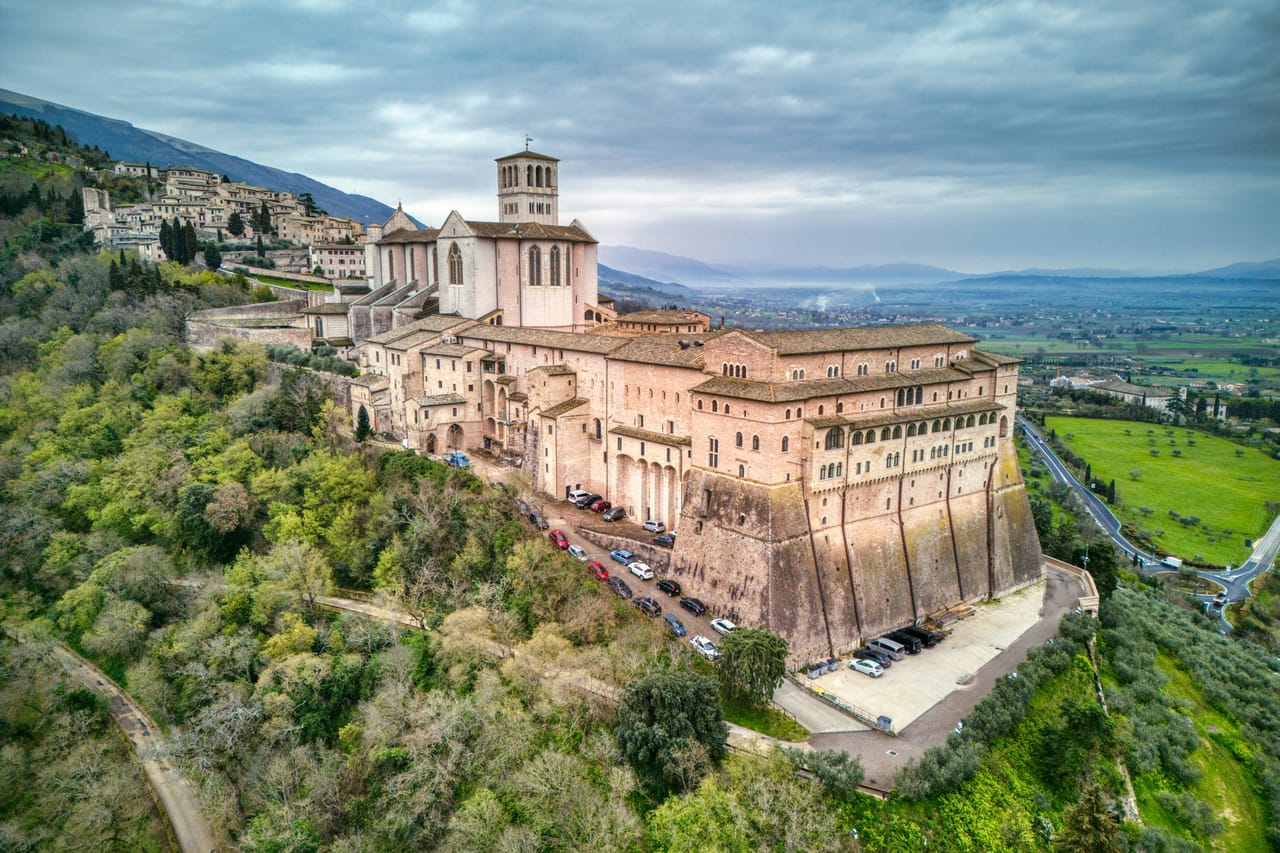
Assisi remains, above all, the town of St Francis.
Saints and legends
St Francis died on 3 October 1226, near the Porziuncola, a small chapel that now stands inside the Basilica of Santa Maria degli Angeli. Shortly before, he had written the Canticle of the Creatures, one of the oldest poems in Italian. Assisi remains, above all, the town of St Francis. Since 2026, 4 October has been a public holiday in Italy.
St Benedict was born in Norcia around 480. The earthquake of 30 October 2016 destroyed his basilica; restored, it reopened in autumn 2025. Higher up, the Sibillini mountains have their legends: a sibyl is said to live in a cave, and the body of Pontius Pilate to have been thrown into a lake below Monte Vettore.
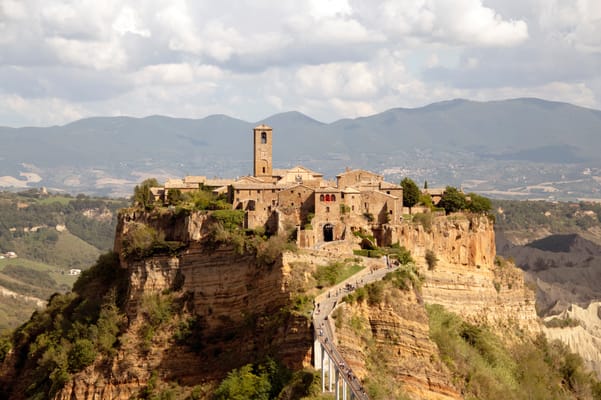
Civita di Bagnoregio
Nicknamed “the dying town”, it was founded by the Etruscans on a hill of tuff that is slowly crumbling away. You enter on foot, over a footbridge, with a ticket. About ten people still live there.
Practical notes
- When to go
- Late May to early July for the flowering at Castelluccio, September–October for the grape harvest. In winter, snow can close the road to the Piano Grande.
- Getting there
- Perugia is about two hours from Rome and from Florence. Umbria’s airport is twelve kilometres from the centre.
- Access
- All tarmac. The mountain roads between Spoleto and Castelluccio are slow. In Gubbio, the road up to Sant’Ubaldo is narrow.
- Sleeping in a van
- Campsites near Assisi, the Marmore Falls and Lake Trasimeno. Motorhome aires in Gubbio, Spello, Spoleto and Orvieto. No overnight stays on the Piano Grande meadows.
- Worth knowing
- Town centres are limited-traffic zones with cameras. Park below, then go up by the minimetrò in Perugia, the escalators in Spoleto or the funicular in Orvieto.
- Allow
- A week for the loop, half a day more for Civita di Bagnoregio.
What not to miss
- 1The Basilica of Saint FrancisUpstairs, frescoes of the saint’s life attributed to Giotto; downstairs, his tomb.
- 2GubbioIn the Bottaccione gorge, a layer of clay rich in iridium helped prove the theory of the asteroid that wiped out the dinosaurs.
- 3The springs of the ClitunnoSprings with clear water, already mentioned by Virgil, and a small ancient temple listed by UNESCO.
- 4The Marmore FallsThree drops, 165 metres in all, created by a Roman canal. The flow depends on the timetable of a power station.
- 5Orvieto’s DuomoA façade covered in gold mosaics and, inside, the Last Judgement painted by Signorelli.
- 6St Patrick’s WellA well dug for Pope Clement VII after the Sack of Rome: 54 metres deep, with two spiral ramps that never meet.
Umbria in pictures
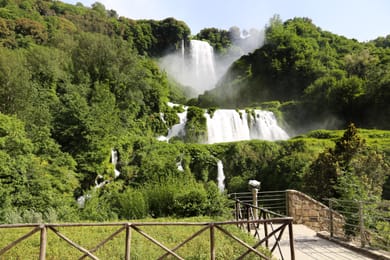
The Marmore Falls and their three drops.
The Umbrian table
Umbrian cooking is mountain cooking: strangozzi, long handmade pasta, served with black truffle from Norcia, and Castelluccio lentils in soup. Norcia has been known for its cured meats for so long that in Italian a norcino is the butcher who prepares pork.
Montefalco makes a strong red wine, Sagrantino, also as a passito. Orvieto makes a white wine, in cellars dug into the tuff since Etruscan times. In Perugia, people buy Baci, chocolates sold with a short love note since the 1930s.
Loop from Perugia


 +23stops
- 1Rocca Paolina · Fontana Maggiore · Palazzo dei Consoli · Basilica di Sant'Ubaldo
- 2Basilica di San Francesco · Assisi · Basilica di Santa Maria degli Angeli · Spello
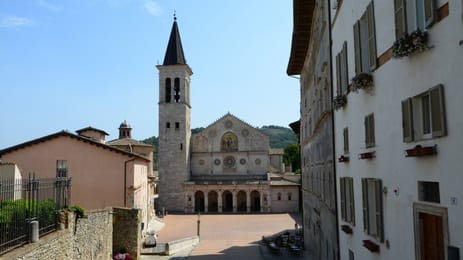
- 3Bevagna · Montefalco · Trevi · Duomo di Spoleto
Free, no account needed — start from its places and make it yours.
Also worth reading
Wide open spaces
Calabria, from the Costa degli Dei to the forests of the Sila
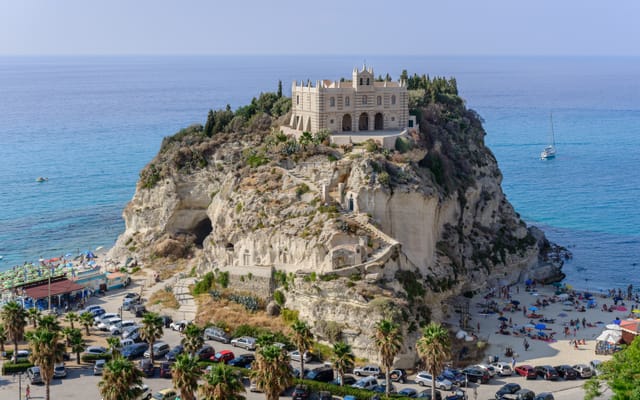
The toe of the boot, caught between two seas with barely a plain to its name: from the cliffs of Tropea to Scilla’s rock, from the temples of Magna Graecia to the pines of the Sila. A week-long loop from Lamezia Terme, first along the coast, then up into the mountains.
Wide open spaces
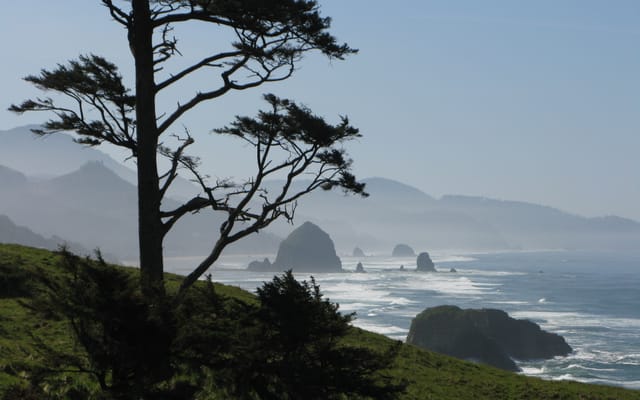
The Pacific Northwest, from the Olympic Peninsula to the Cascade volcanoes
Rainforests, a coast of headlands and lighthouses, redwoods and two active volcanoes. A two-week loop from Seattle, by way of the Olympic Peninsula, the Oregon coast and Mount Rainier.
Wide open spaces
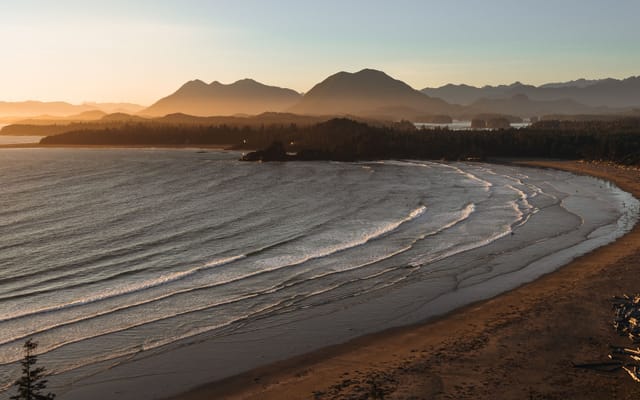
Vancouver Island, from Victoria to the beaches of Tofino
An island of giant forests, beaches pounded by the Pacific and small harbours where boats leave to see orcas. Nine days on a loop from Victoria, from Port Renfrew to Tofino and up to Telegraph Cove.
A starting point, a few wishes — ViaLooma builds the trip day by day, map, stops and roadbook included.