Puglia and Matera, from the Sassi to the tip of Italy’s heel
Puglia, in the south-east of Italy, stretches between the Adriatic and the Ionian Sea; Matera is just next door, in Basilicata. Eight days on a loop from Bari, from the Sassi of Matera to the trulli of Alberobello, then from the Baroque of Lecce to Capo di Leuca.
From Bari to Capo di Leuca
The loop sets out from Bari, follows the Adriatic, then runs down to Capo di Leuca. The landscape comes down to three words: stone, olive trees and the sea. The road runs between olive groves and dry-stone walls, from one white village to the next. In Bari Vecchia, the Basilica of St Nicholas holds the saint’s relics, carried off from Myra by sailors in 1087; Orthodox pilgrims still come here. North of Bari, the cathedral of Trani stands right at the water’s edge. Inland, Castel del Monte, built around 1240 for Frederick II, sets a perfect octagon on a hilltop, flanked by eight octagonal towers. What it was for is still debated.
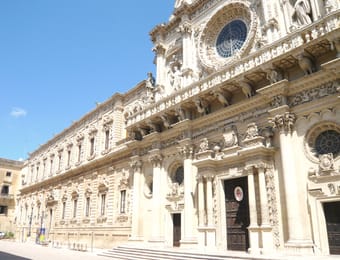
The route also slips out of Puglia for a detour to Matera, in Basilicata. South-east of Bari, Lecce owes its Baroque to its stone, a soft limestone that carves easily, then hardens in the air and turns the colour of honey. The façade of Santa Croce is its showcase.
On the coast, Otranto remembers 1480: 813 townspeople who refused to convert were beheaded there by the Ottomans. Their bones line a chapel in the cathedral. On the floor, a 12th-century mosaic brings together the Tree of Life, Alexander the Great and a ‘Rex Arturus’. Then come Punta Palascia, the easternmost point of Italy, and Leuca. The loop leaves aside the Gargano, to the north, which deserves a trip of its own.
The trulli of Alberobello
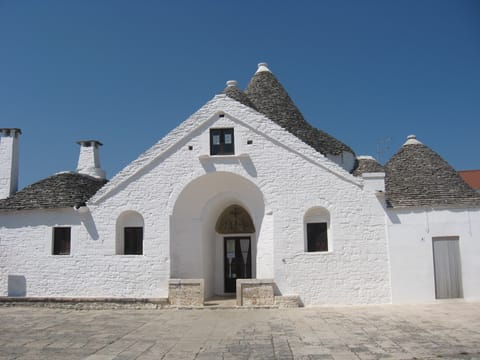
In Alberobello, more than a thousand trulli cover the hill of the Rione Monti. They are white houses capped with cones of stones laid without mortar. A stubborn tradition has it that the counts of Conversano imposed the technique: the houses could be pulled down before the king’s officials came through, and the tax escaped. The Trullo Sovrano, from the 18th century, is the only one in town with an upper floor. It is open to visitors.
The neighbouring district of Aia Piccola, which is quieter, has a few hundred trulli that are still lived in. The trulli of Alberobello have been on Unesco’s World Heritage List since 1996.
Outside the town, you come across them all over the Valle d’Itria, among vineyards and olive groves.
Families and animals shared the same cave.
Matera, the Sassi and the Murgia
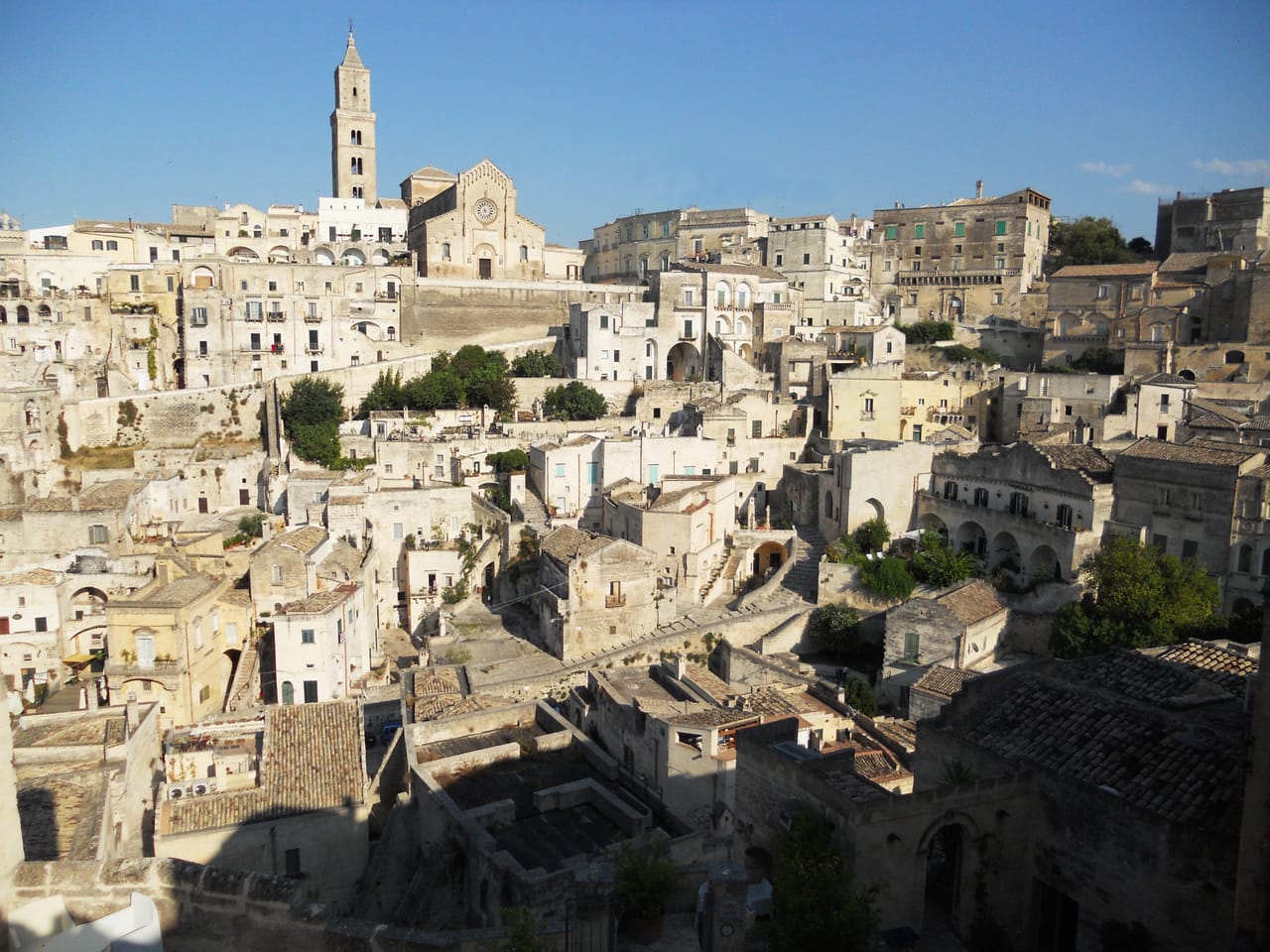
In 1945, in Christ Stopped at Eboli, Carlo Levi recounted what his sister had seen of the Sassi: caves tiered down a funnel, like Dante’s Inferno. Families and animals shared the same cave. Talk soon turned to a ‘national disgrace’. A special law in 1952 gradually emptied the Sassi of the 15,000 or so people who lived there. The Sassi were listed by Unesco in 1993, and in 2019 Matera became European Capital of Culture.
Below the town, the Gravina has cut a canyon. On the far bank, the Murgia plateau has some 150 rock-hewn churches. You reach the Murgia Timone viewpoint on foot, by a steep path and a suspension bridge, or by car as far as the Jazzo Gattini visitor centre, close by. Since 2026, there has been a charge for access to the viewpoint. Some fifteen kilometres from Matera by road, the Cripta del Peccato Originale, rediscovered in 1963, holds frescoes from the early Middle Ages. It is nicknamed the ‘Sistine Chapel’ of rupestrian art.
Craco
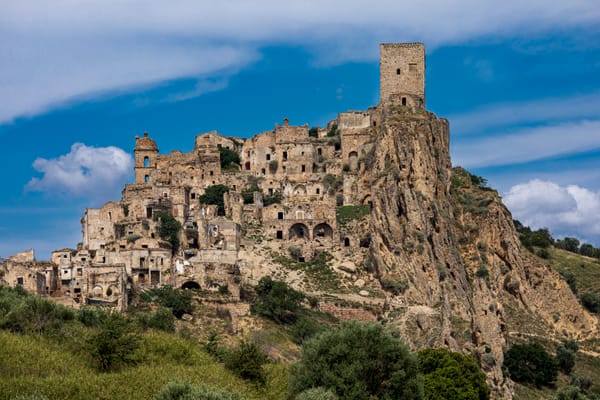
A village perched on clay, emptied by landslides from 1963 onwards, then abandoned after the 1980 earthquake. You walk round it with a guide, a hard hat on your head. Film-makers love it: Francesco Rosi shot Christ Stopped at Eboli here, and Mel Gibson came for The Passion of the Christ.
Practical notes
- When to go
- May and June, then September. In August, the Salento coast is overrun.
- Getting there
- Airport and ferry port at Bari. Naples is three hours away by road, Rome four and a half.
- Access
- Almost all the historic centres are ZTLs, limited-traffic zones watched by cameras: park at the edge.
- Sleeping in a van
- Campsites and motorhome aires near Matera, Alberobello and Lecce, and along the Salento coast.
- Worth knowing
- The Cripta, the Grotte di Castellana and Craco can only be visited with a guide, at set times: it is best to book.
- Allow
- Eight days for the loop, ten or twelve with the Gargano.
What not to miss
- 1OstuniThe White City, whitewashed on its hill above the olive groves.
- 2The Valle d’ItriaLocorotondo, Cisternino and Martina Franca, among trulli and dry-stone walls.
- 3GalatinaThe town where the ‘tarantate’, women said to have been bitten by the tarantula, came every 29 June to implore St Paul.
- 4GallipoliAn old town on its own island, tied to the mainland by a bridge.
- 5The Grotte di CastellanaThe way down is through the Grave, a chasm open to the sky.
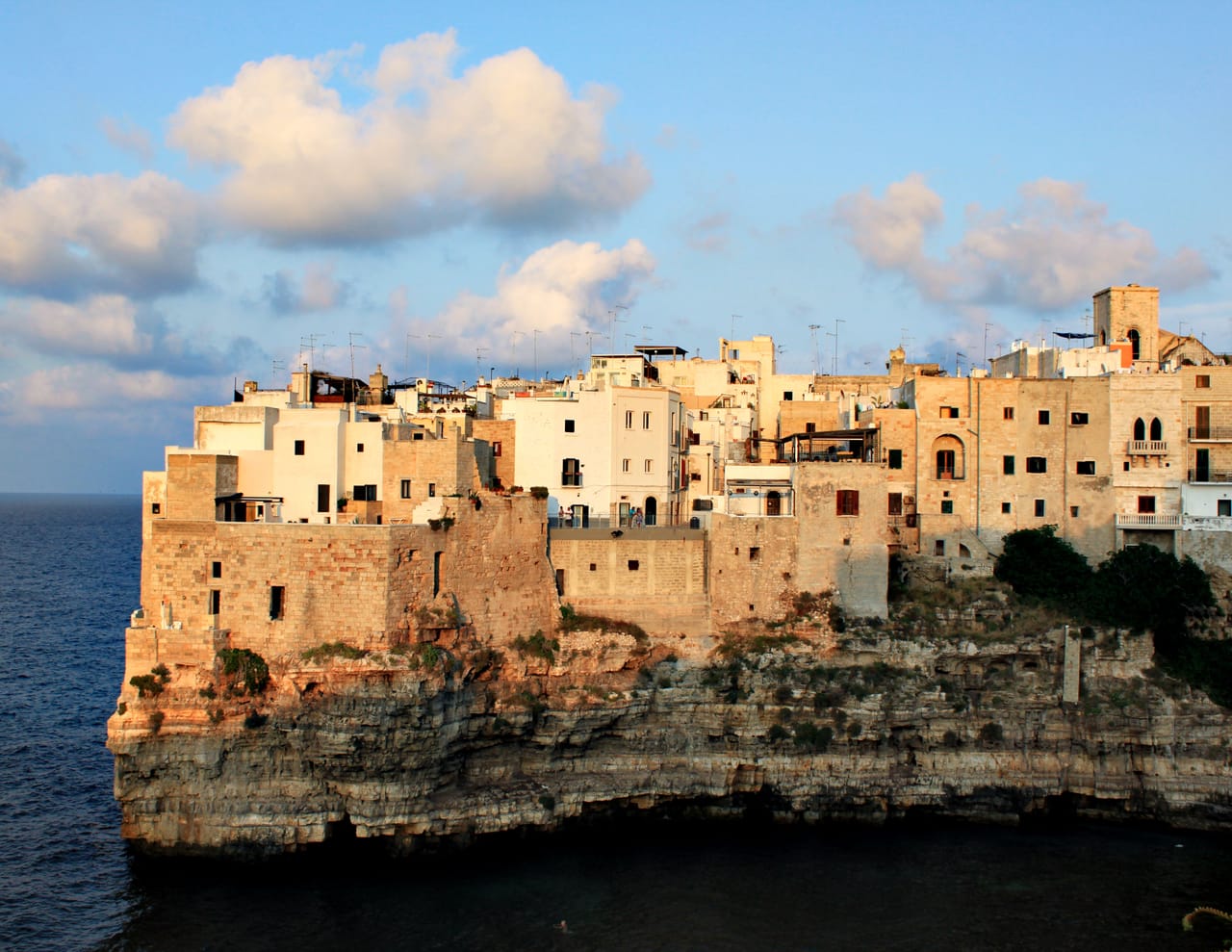
- 6Polignano a MareThe old town on the edge of the cliff, above the Adriatic.
Puglia and Matera in pictures
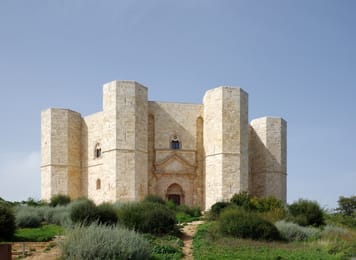
Castel del Monte, Frederick II’s octagon, on a hilltop in the Murge.
Puglia’s table
Here, everything starts with durum wheat. In 2003, the bread of Altamura became the first bread in Europe to be awarded a protected designation of origin. In Bari Vecchia, women shape orecchiette on their doorsteps; they are eaten with cime di rapa, bitter turnip tops.
Burrata was born in Andria. In the Valle d’Itria, some butcher’s shops cook bombette on the premises, little rolls of stuffed pork. To drink: a white from Locorotondo, a primitivo or negroamaro red and, in Lecce, espresso over ice with almond milk.
Loop from Bari


 +23stops
- 1Cattedrale di Trani · Castel del Monte · Cattedrale di Santa Maria Assunta · Sassi di Matera
- 2Cattedrale di Matera · Chiesa dei Santi Pietro e Paolo · Cripta del Peccato Originale
- 3Alberobello · Locorotondo · Basilica di San Martino
Free, no account needed — start from its places and make it yours.
Also worth reading
Wide open spaces
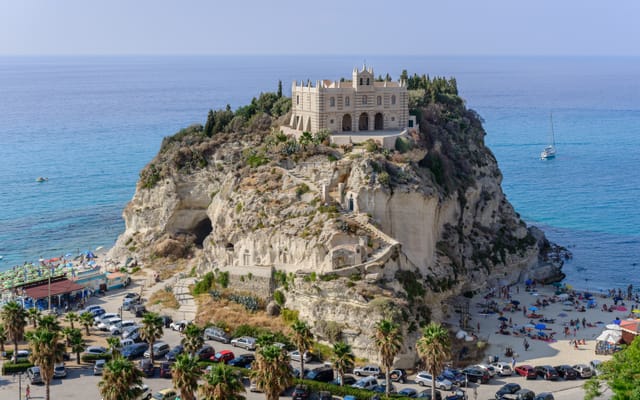
Calabria, from the Costa degli Dei to the forests of the Sila
The toe of the boot, caught between two seas with barely a plain to its name: from the cliffs of Tropea to Scilla’s rock, from the temples of Magna Graecia to the pines of the Sila. A week-long loop from Lamezia Terme, first along the coast, then up into the mountains.
Coast and islands
The Amalfi Coast, from Vesuvius to Ravello
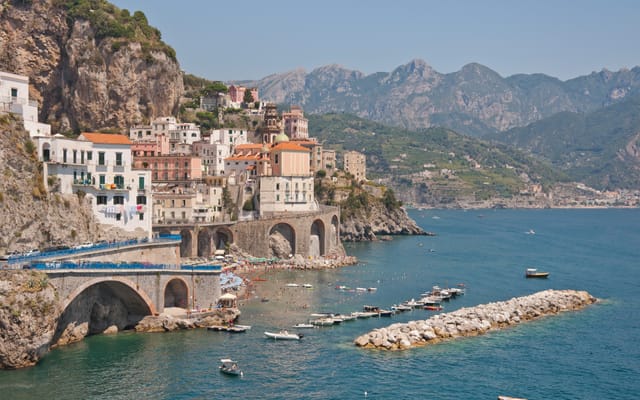
Vesuvius and the towns it buried in AD 79, then the Amalfi Coast, its terraced villages and its lemon trees above the sea. Five days on a loop from Naples, from Pompeii to Ravello.
Coast and islands
Sicily, from golden mosaics to Greek temples
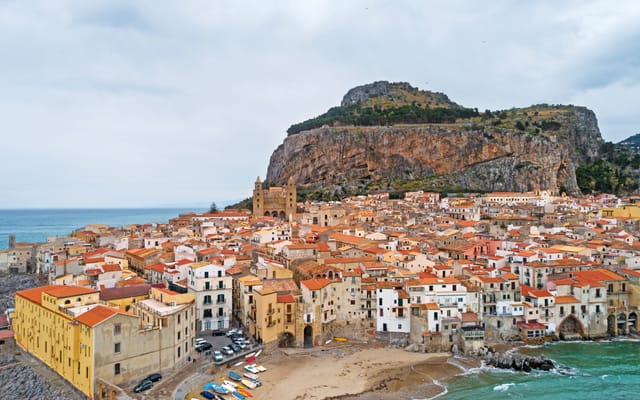
Greeks, Carthaginians, Arabs and Normans all coveted this island, and each left their mark: Doric temples, golden mosaics, Baroque towns rebuilt after an earthquake. Eleven days on a loop from Palermo, by way of Etna, Syracuse and the salt pans of the west.
A starting point, a few wishes — ViaLooma builds the trip day by day, map, stops and roadbook included.