The Amalfi Coast, from Vesuvius to Ravello
Vesuvius and the towns it buried in AD 79, then the Amalfi Coast, its terraced villages and its lemon trees above the sea. Five days on a loop from Naples, from Pompeii to Ravello.
A road above the sea
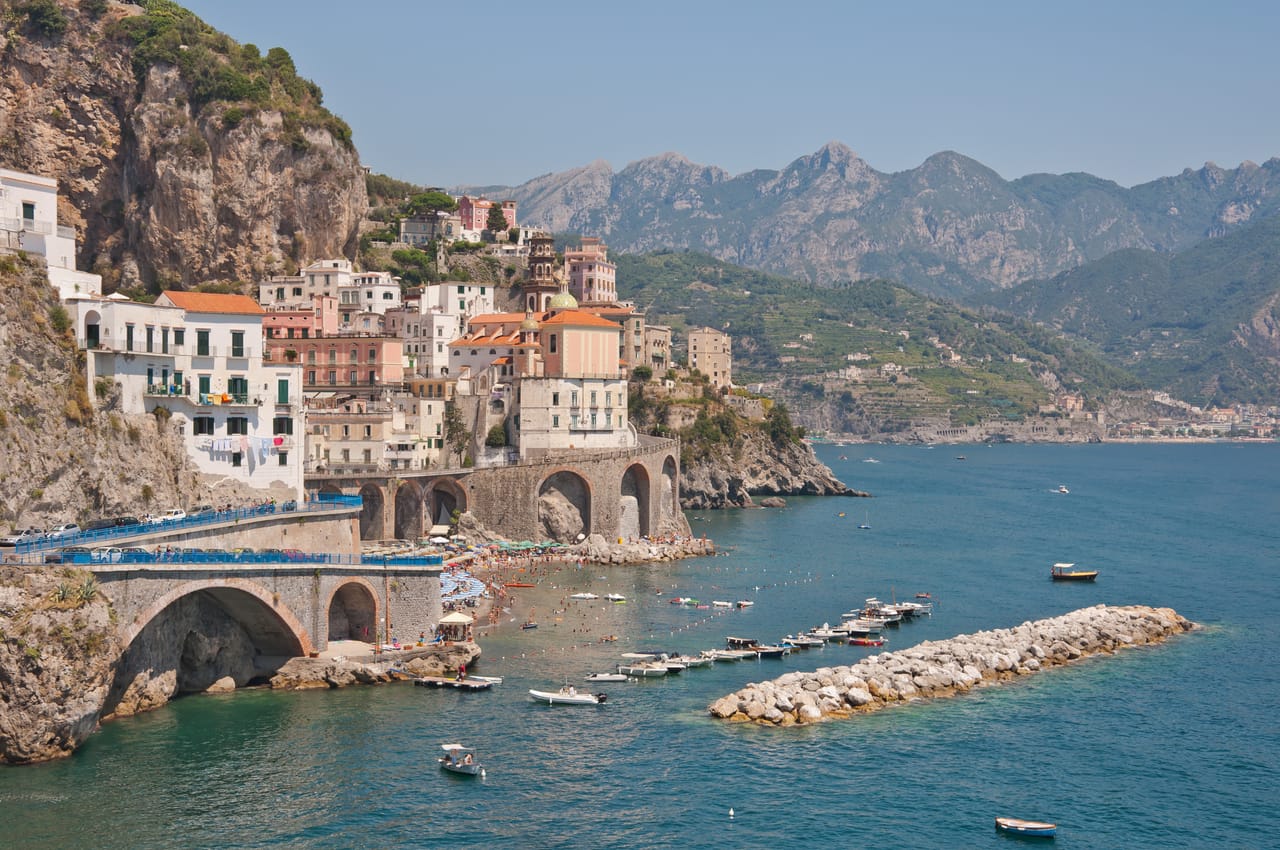
The Amalfi Coast is not first and foremost a coast of beaches. It is the southern flank of the Lattari Mountains, which drops almost sheer into the sea. The Amalfitana, cut into the cliffs between 1832 and 1850, winds for some fifty kilometres above the water. Thirteen towns cling to the mountainside, with their terraced lemon groves. Unesco added the coast to the World Heritage list in 1997.
Here, you park the car more often than you drive it. At Atrani, the road runs on arches above the white houses. Higher up, the Path of the Gods links Bomerano, a hamlet of Agerola, with Nocelle, above Positano: about 8 kilometres and three to four hours on foot, with the sea below.
On the Naples side, the loop takes in Herculaneum, Pompeii and the crater of Vesuvius.
Pompeii and Herculaneum
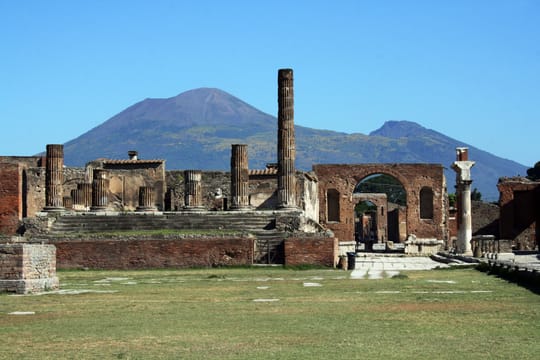
In AD 79, Vesuvius buried Pompeii and Herculaneum. The only eyewitness account amounts to two letters from Pliny the Younger to Tacitus. Most manuscripts date the eruption to 24 August. But a charcoal inscription found at Pompeii in 2018, dated 17 October, argues for the autumn. At Pompeii, the forum faces the volcano, which you can see beyond the Temple of Jupiter. Paved streets, shops, baths, houses built round an atrium: the city can still be read.
In 1863, Giuseppe Fiorelli had the idea of pouring plaster into the hollows left by the victims’ bodies. Many of the frescoes and mosaics, the Alexander Mosaic among them, are in the National Archaeological Museum in Naples.
Herculaneum, closer to the crater, was buried by searing pyroclastic flows under some twenty metres of material. The wood there turned to charcoal without vanishing: beams, doors, entire upper storeys. In the boat sheds, excavators found more than three hundred skeletons, people who had no doubt hoped to escape by sea.
The wood there turned to charcoal without vanishing: beams, doors, entire upper storeys.
Amalfi and Ravello
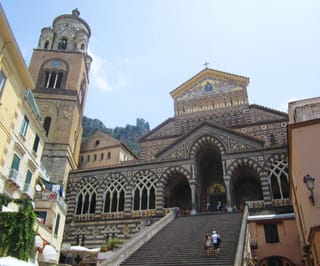
Almost always independent from 839 until the Norman conquest of 1073, Amalfi traded with Byzantium and Egypt. In 1208, Cardinal Pietro Capuano brought the relics of St Andrew back from Constantinople; they are kept in the crypt of the Duomo. Next door, the Cloister of Paradise, built from 1266 onwards, interlaces its arches in the Arab manner. Higher up, in the Valley of the Mills, they made a rag paper, bambagina.
Some 350 metres above the sea, Ravello welcomed Richard Wagner in 1880. In the gardens of the Villa Rufolo, he believed he had found Klingsor’s magic garden in Parsifal. Since 1953, concerts have been held there every summer. The gardens of the Villa Cimbrone, bought in 1904 by an Englishman, Ernest Beckett, end on the Terrace of Infinity, lined with marble busts above the void.
Paestum
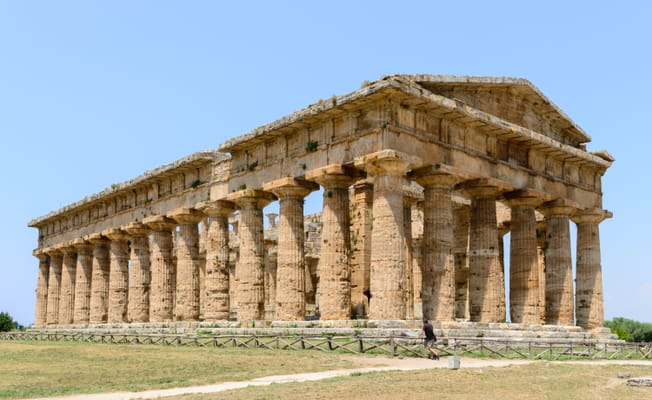
Greeks from Sybaris founded the city around 600 BC, under the name of Poseidonia. Paestum still has three Doric temples standing on an open plain. In the museum, the Tomb of the Diver, painted around 470 BC, is a unique example of Greek figurative painting from its time. Allow an extra half-day.
Practical notes
- When to go
- April to June, then September and October. In July and August, the coast reaches saturation point.
- Getting there
- Naples has an airport and a high-speed rail station. From 1 to 30 November 2026 the airport closes for works, and some flights move to Salerno.
- Access
- On certain days set each year, from 10 am to 6 pm, the Amalfitana is closed to cars whose number plates end in a digit of the same parity as the date, hire cars included. Check that year’s calendar and exemptions before you set off.
- Sleeping in a van
- Campsites at Pompeii and around Sorrento. Motorhomes and caravans are banned from the Amalfitana from 6.30 am to midnight: carry on by bus or by boat.
- Worth knowing
- The path to the crater of Vesuvius must be booked online. So must the car parks on the access road; from there, a shuttle runs up to the start of the path. At Pompeii, tickets carry your name and entries are capped at 20,000 a day.
- Allow
- Five days from Naples, a week with Paestum and Capri.
What not to miss
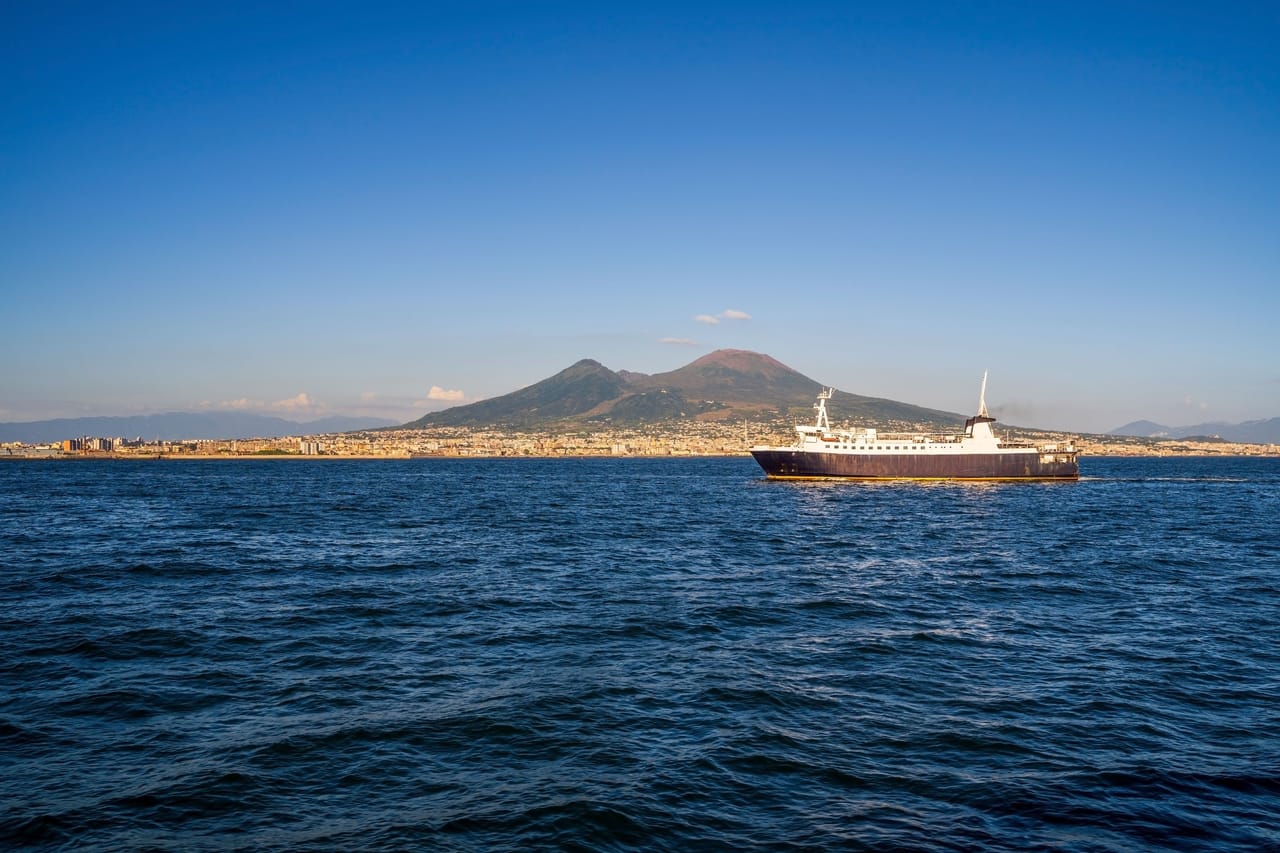
- 1The crater of VesuviusAbout two hours there and back, and a 170-metre climb to the rim of the crater.
- 2The villa at OplontisA Roman villa with remarkably well-preserved frescoes, attributed, though not with certainty, to Poppaea, Nero’s wife.
- 3SorrentoTorquato Tasso’s birthplace, set on its cliff of tuff facing Vesuvius.
- 4The Bay of IerantoA bay that once housed a quarry, given back to nature, 45 minutes on foot from Nerano, near the headland where the ancients placed the Sirens.
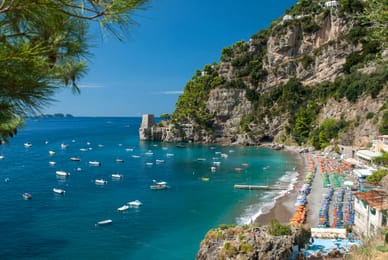
- 5PositanoA village of houses tumbling down to the beach, made famous by John Steinbeck in 1953.
- 6The Fiordo di FuroreA narrow gorge spanned by the Amalfitana, where Rossellini filmed with Anna Magnani.
The Amalfi Coast in pictures
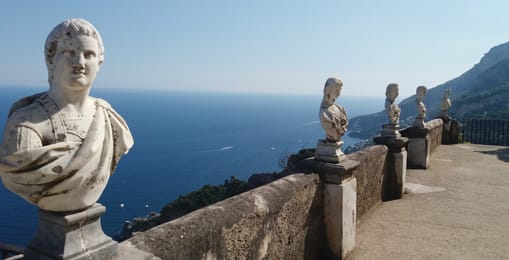
The Terrace of Infinity at the Villa Cimbrone, in Ravello: marble busts above the void.
The coast’s table
On the coast, everything starts with the lemon. The sfusato amalfitano, long and pointed, grows on terraces, under pergolas roofed with straw mats; Sorrento has its own lemon, the Sorrento oval. Between them they make limoncello and scent the sfogliatella Santa Rosa, born, so tradition has it, in a convent at Conca dei Marini.
At Cetara, colatura di alici is drawn off: the juice of salted anchovies, an heir to Roman garum, now protected by a designation of origin. Amalfi’s scialatielli are served with seafood. Towards Naples, you find Gragnano pasta, the Lacryma Christi of Vesuvius and pizza.
Loop from Naples


 +12stops
- 1Scavi archeologici di Ercolano · Vesuvio · Villa di Poppea
- 2Pompei · Sorrento
- 3Area naturale Baia di Ieranto · Positano · Fiordo di Furore · Grotta dello Smeraldo
Free, no account needed — start from its places and make it yours.
Also worth reading
Wide open spaces
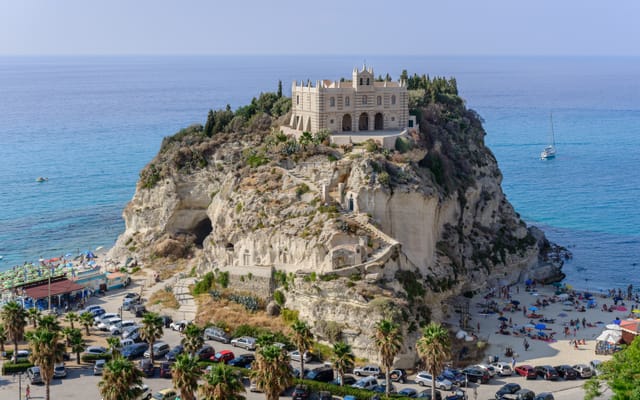
Calabria, from the Costa degli Dei to the forests of the Sila
The toe of the boot, caught between two seas with barely a plain to its name: from the cliffs of Tropea to Scilla’s rock, from the temples of Magna Graecia to the pines of the Sila. A week-long loop from Lamezia Terme, first along the coast, then up into the mountains.
Coast and islands
Sicily, from golden mosaics to Greek temples
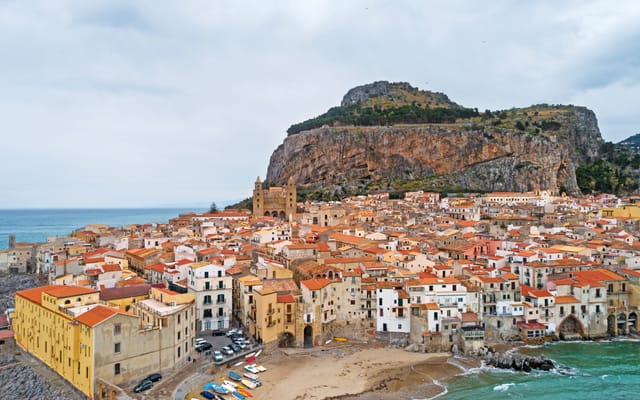
Greeks, Carthaginians, Arabs and Normans all coveted this island, and each left their mark: Doric temples, golden mosaics, Baroque towns rebuilt after an earthquake. Eleven days on a loop from Palermo, by way of Etna, Syracuse and the salt pans of the west.
Coast and islands
The Cinque Terre and the Riviera di Levante, from Genoa to the Gulf of Poets
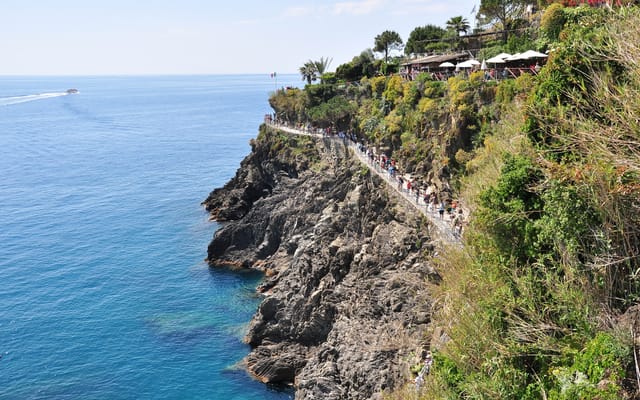
East of Genoa, the mountains fall into the sea and the coast becomes a string of headlands, tiny harbours and terraced vineyards. Five days from Genoa to Lerici, by way of Portofino, the five villages of the Cinque Terre and the Gulf of Poets.
A starting point, a few wishes — ViaLooma builds the trip day by day, map, stops and roadbook included.