Thessaloniki, Mount Olympus and Halkidiki
A great Byzantine city, the tombs of the kings of Macedon, the highest mountain in Greece and three peninsulas on the Aegean Sea. A six-day loop from Thessaloniki, from Pella to Mount Athos.
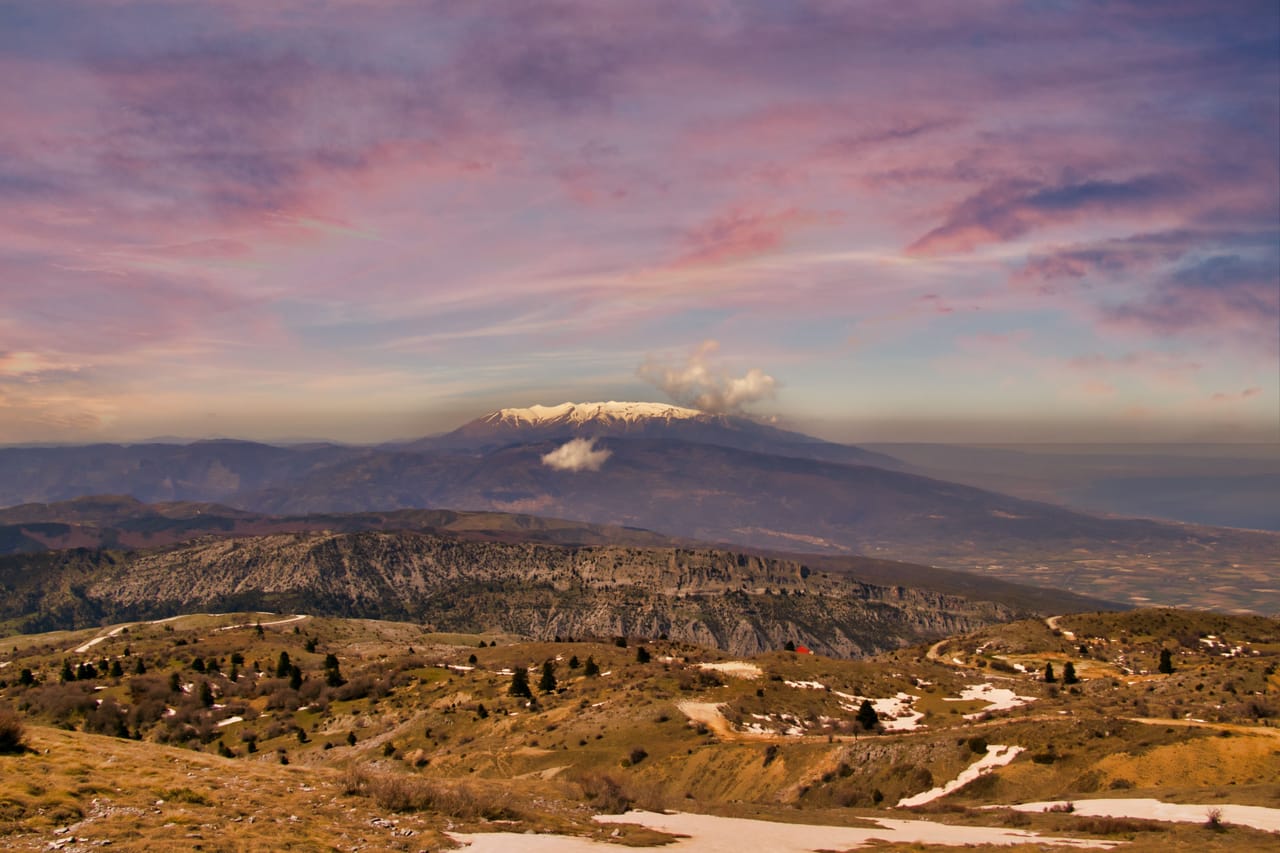
From Mount Olympus to the beaches of Halkidiki
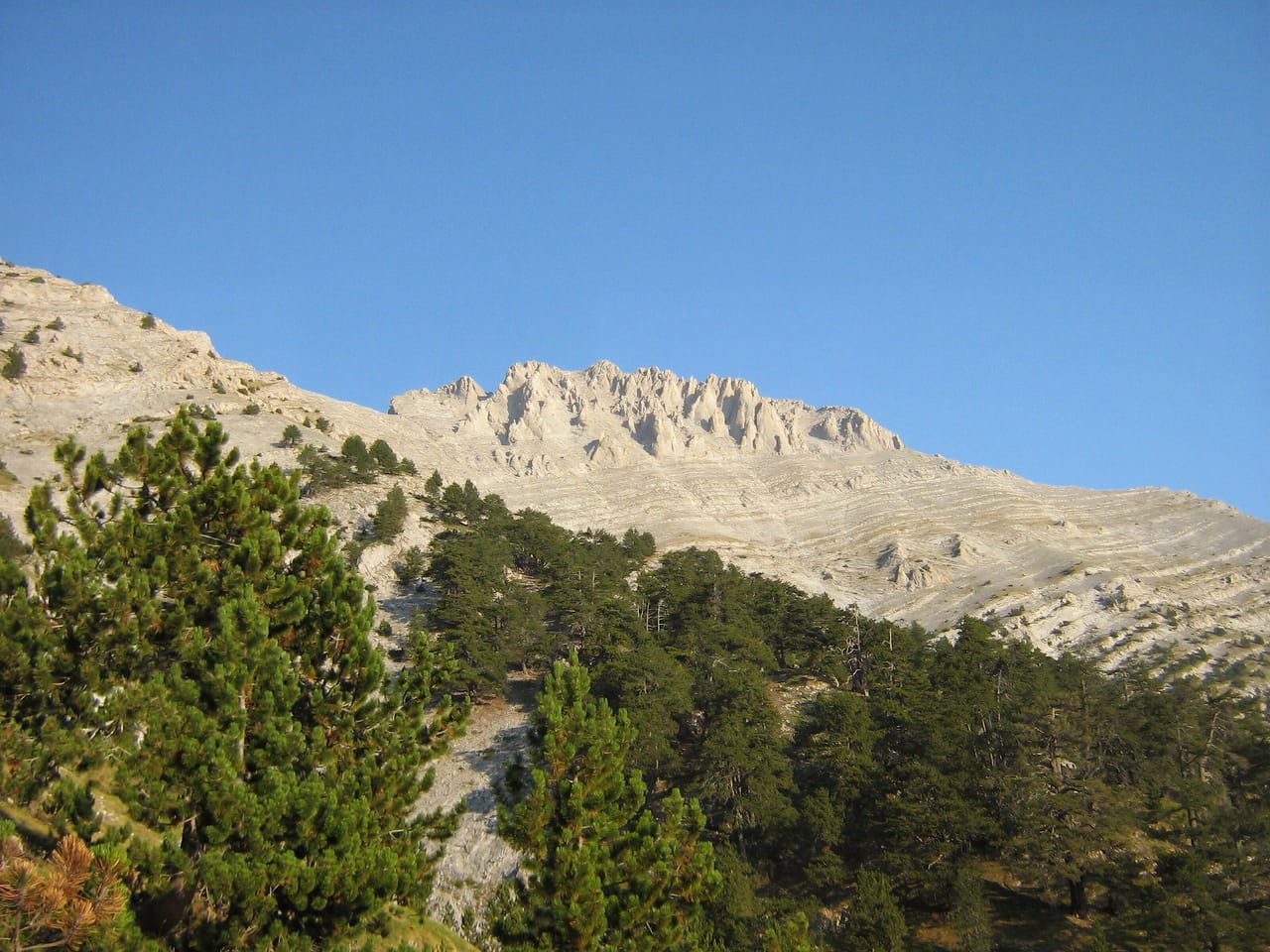
Northern Greece is best explored as a loop from Thessaloniki. South of Katerini, the motorway runs along the sea, and Mount Olympus rises about twenty kilometres from the shore, up to 2,918 metres. From Litochoro, an 18-kilometre road climbs in hairpins above the Enipeas gorge to Prionia, where the path to the mountain refuges begins.
To the east, Halkidiki reaches out into the sea in three peninsulas. Kassandra, the nearest, is the liveliest. Sithonia is wilder: its coast road runs all the way round, between pine trees and granite coves, by way of Porto Koufo, an almost closed natural harbour already mentioned by Thucydides.
The third peninsula belongs to Mount Athos, a republic of monasteries closed to women. From Ouranoupoli, boats sail along its coast and its monasteries, more than 500 metres offshore. The summit reaches 2,033 metres.
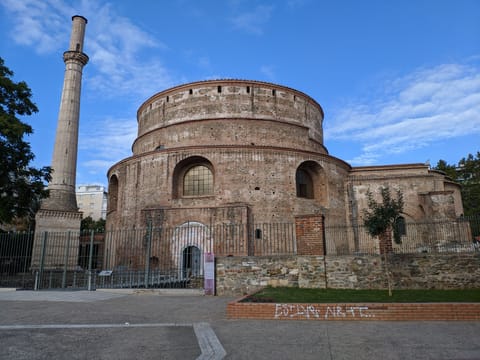
Thessaloniki, Roman and Byzantine
Thessaloniki was founded around 315 BC by Cassander, who named it after his wife, a half-sister of Alexander the Great. Around AD 300, the emperor Galerius built a palace here, a triumphal arch and the Rotunda, a large round building in brick. The Rotunda later became a church, then a mosque, and its minaret still stands. It is one of the city’s fifteen Early Christian and Byzantine monuments listed as a World Heritage Site since 1988.
The basilica of Saint Demetrius, dedicated to the city’s patron saint, was rebuilt after the great fire of 1917. The church of Hagia Sophia dates from the 7th century. On the seafront, the White Tower, an Ottoman tower, is now the symbol of the city. Above the centre, the upper town, Ano Poli, has kept its steep lanes and its houses with overhanging upper floors. It is crowned by the Heptapyrgion, a fortress that served as a prison until 1989.
After the Jews were expelled from Spain in 1492, the Sephardim were for a long time the majority in Thessaloniki. Most of the city’s Jews were deported in 1943.
The Rotunda later became a church, then a mosque, and its minaret still stands.
Aigai, Pella and Dion, the cities of the Macedonian kings
The first capital of Macedon, Aigai, is today’s Vergina. In 1977, the archaeologist Manolis Andronikos found royal tombs there under a burial mound, one of them intact and attributed to Philip II, Alexander’s father. The museum was built inside the mound, around the tombs. The site has been a World Heritage Site since 1996, and the restored palace reopened in 2024.
Around 400 BC, King Archelaus made Pella his capital. Alexander the Great was born here in 356 BC. The city’s houses have yielded pebble mosaics, including a stag hunt signed “Gnosis made it”. At the foot of Mount Olympus, Dion was the sacred city of the Macedonians; Alexander made sacrifices there before setting off for Asia. In Thessaloniki, the Archaeological Museum displays the gold from the tombs of Sindos and the Derveni krater.
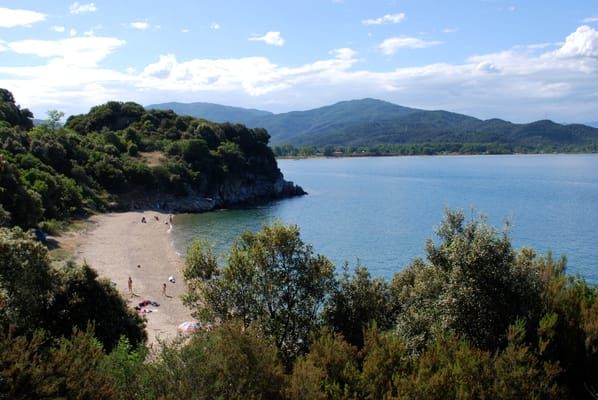
Ancient Stagira
Aristotle’s birthplace sits on a scrub-covered headland above Olympiada. Philip II destroyed it in 348 BC. It was later rebuilt, it is said to thank Aristotle for teaching Alexander. You often have the place almost to yourself.
Practical notes
- When to go
- May–June and September. July and August fill the beaches of Halkidiki. The refuges on Mount Olympus are open roughly from mid-May to the end of October.
- Getting there
- Thessaloniki has an international airport. The loop is about 850 kilometres; the A1 motorway, towards Mount Olympus, is a toll road.
- Access
- Everything is tarmac, except the track to the Zygou monastery. The road to Prionia is narrow, and its car park fills up in the morning in summer.
- Sleeping in a van
- Plenty of campsites. In towns, a van of 7.50 metres or less can park like a car, unless a sign says otherwise. Wild camping is still banned: no awning, table or chairs outside.
- Worth knowing
- Men who want to enter Mount Athos must get a permit. The ruins of Zygou, just before the boundary of the monastic state, can be visited without one.
- Allow
- Six days. An extra night in Sarti or Ouranoupoli makes the trip more relaxed.
What not to miss
- 1The Enipeas gorgeThe E4 path follows the river from Litochoro to Prionia, over wooden bridges.
- 2The old Monastery of Saint DionysiosFounded in the 16th century and destroyed by the German army in 1943, it has been partly restored since.
- 3Platamon CastleA Crusader fortress above the sea, at the end of the Vale of Tempe.
- 4Petralona CaveAn archaic human skull was found here in 1960, dated to at least 277,000 years ago.
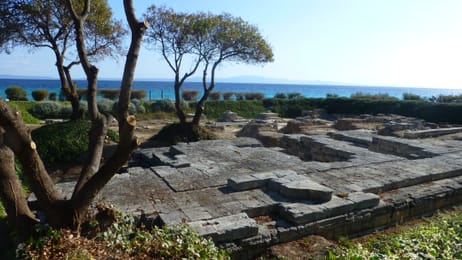
- 5Afytos and KallitheaA hilltop village, and the ruins of the sanctuary of Zeus Ammon by the water.
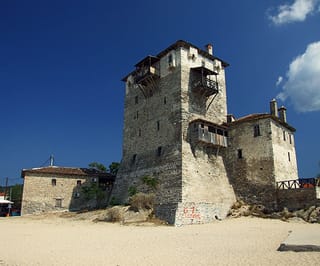
- 6The tower of OuranoupoliA Byzantine tower on the beach, where the Australian Joice NanKivell Loch lived.
Thessaloniki, Mount Olympus and Halkidiki in pictures
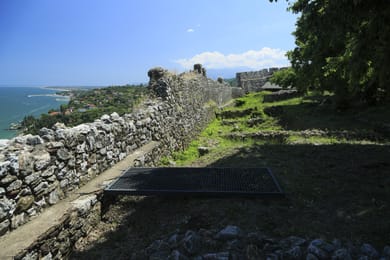
The walls of Platamonas castle above the sea, under a blue sky.
The Macedonian table
In Thessaloniki, the day starts with a bougatsa, a filo pastry filled with custard or cheese. In the evening, people share meze in the tavernas of the Ladadika, near the port. The mussels from the Thermaic Gulf come from Chalastra.
In Halkidiki, the large green olives have a protected designation of origin. On the slopes of Mount Itamos, in Sithonia, the Porto Carras estate makes wine. In Arnaia, you can buy honey. The red wine to take home is the xinomavro from Naoussa.
Loop from Thessaloniki


 +21stops
- 1Λευκός Πύργος · Ροτόντα · Ιερός Ναός Αγίου Δημητρίου Θεσσαλονίκης · Επταπύργιο · Αρχαιολογικό Μουσείο Θεσσαλονίκης
- 2Πέλλα · Μουσείο Βασιλικών Τάφων Αιγών · Αρχαίο Δίον · Λιτόχωρο
- 3Φαράγγι Ενιπέα · Μονή Αγίου Διονυσίου εν Ολύμπω · Καταρράκτες Ενιπέα · Κάστρο του Πλαταμώνα
Free, no account needed — start from its places and make it yours.
Also worth reading
Wide open spaces
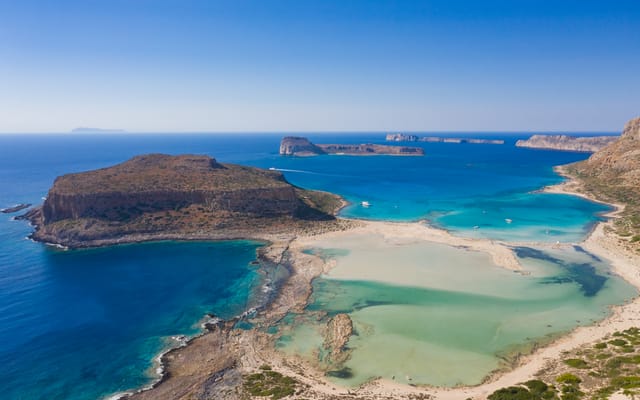
Crete, from Knossos to Balos
Greece’s largest island mixes Minoan palaces, Venetian harbours, gorges and pink-sand beaches. This nine-day trip starts in Heraklion and ends in Chania, by way of Lasithi, the south coast and the far west.
Coast and islands
The Peloponnese, from Mycenae to Cape Tainaron
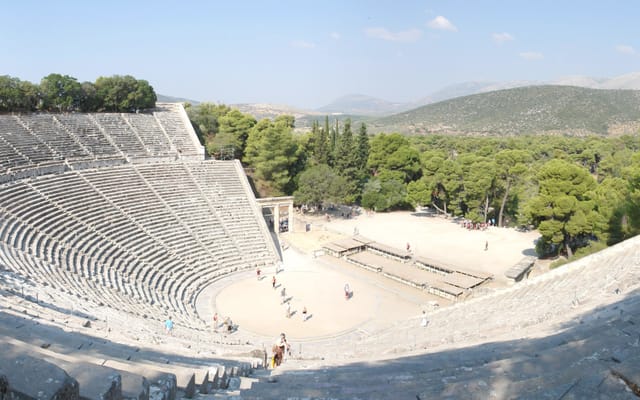
Bronze Age cities, the sanctuaries of Olympia and Epidaurus, Byzantine towns and villages of tower houses. A nine-day loop from Athens, through Arcadia, the Mani and Monemvasia.
Coast and islands
Pelion, between the Gulf of Volos and the Aegean
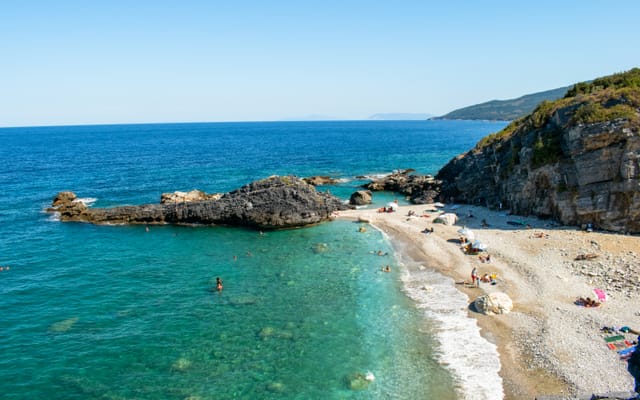
Pelion is a forested mountain that sits between a calm gulf and the Aegean Sea. This trip takes five days to loop around it from Volos, through its stone villages, its pebble coves and its winding roads.
A starting point, a few wishes — ViaLooma builds the trip day by day, map, stops and roadbook included.