The Peloponnese, from Mycenae to Cape Tainaron
Bronze Age cities, the sanctuaries of Olympia and Epidaurus, Byzantine towns and villages of tower houses. A nine-day loop from Athens, through Arcadia, the Mani and Monemvasia.
Around the Peloponnese
You enter the Peloponnese by crossing the Corinth Canal, an hour from Athens. From the bridge, you see a dead-straight cut 6.3 kilometres long, with sheer rock walls, finished in 1893. After that, the road goes all the way round the peninsula: ancient sites, Venetian fortresses, beaches and mountain villages.
Inland, Arcadia is a land of fir forests and gorges. Dimitsana is built in terraces above the Lousios Gorge, where monasteries cling to the cliff. Here you cannot see the sea, and the roads are full of bends.
To the south, the Mani road runs along the coast between the Taygetus and the sea, from one village of grey stone tower houses to the next. It leads to Cape Tainaron, the southern tip of mainland Greece. Further east, Monemvasia is a town on a rock, joined to the coast by a causeway. You enter it on foot, through the great west gate.
Mycenae and the Mycenaean world
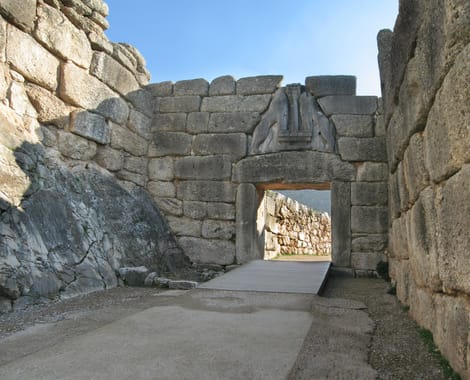
Mycenae was the great city of Bronze Age Greece, between the 16th and the 12th century BC. The citadel opens through the Lion Gate, built around 1250 BC. Its walls are made of huge blocks, laid without mortar. Later, the Greeks believed they were the work of the Cyclopes, one-eyed giants: ever since, they have been called Cyclopean walls. Mycenae and its neighbour Tiryns have been on the UNESCO World Heritage List together since 1999.
In 1876, Heinrich Schliemann excavated the royal graves and found a gold mask, which he attributed to King Agamemnon. The mask is in fact several centuries older; it is on display at the National Archaeological Museum in Athens. The Treasury of Atreus was never a treasury: it is a great domed tomb.
Near Pylos, the Palace of Nestor was discovered in 1939. Around 1180 BC, a fire baked the clay tablets of its archives. These texts in Linear B showed that the Mycenaeans already spoke a form of Greek.
The Treasury of Atreus was never a treasury: it is a great domed tomb.
Olympia and Epidaurus, two great sanctuaries
Olympia was a sanctuary of Zeus. According to tradition, the first games were held there in 776 BC, then every four years for more than a thousand years. The athletes’ vaulted passage still leads to the stadium. The Temple of Zeus housed Phidias’s statue of the god, one of the Seven Wonders of the World. Before each edition of the Games, the Olympic flame is still lit in front of the Temple of Hera.
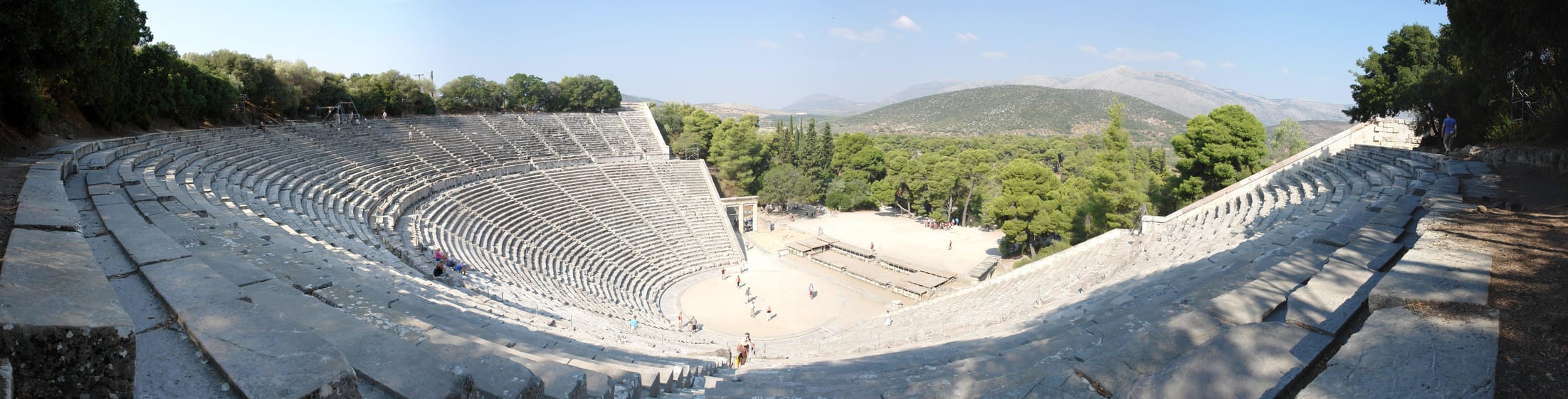
Epidaurus was the sanctuary of Asclepius, the god of medicine. Its theatre, from the late 4th century BC, seats about 14,000. Its acoustics are famous: a coin dropped in the centre can be heard, they say, right up in the top row. Since 1955, the Epidaurus Festival has staged ancient plays there on summer evenings.
Vytina
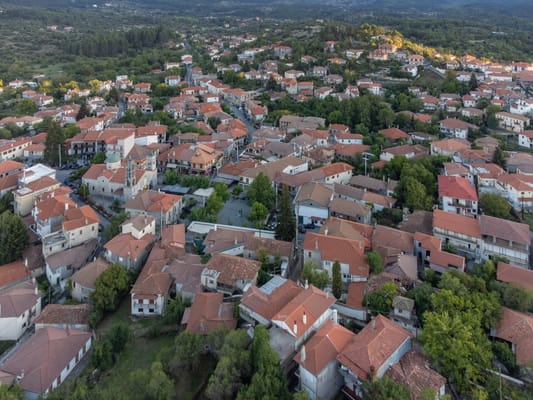
A mountain village at over 1,000 metres, at the foot of Mount Mainalo, surrounded by fir forests. This is the place to buy fir honey and the local cheeses.
Practical notes
- When to go
- April–June and September–October. Summer is very hot at the sites, which have little shade; in winter, they close earlier.
- Getting there
- The loop starts from Athens and its airport; the Corinth Canal is an hour’s drive away.
- Access
- Everything is tarmac. Toll motorways: Attiki Odos, Olympia Odos and Moreas. Narrow, winding roads in the Mani and Arcadia.
- Sleeping in a van
- Wild camping is forbidden; a van parked where it is allowed is often tolerated, without a table, chairs or awning. Plenty of campsites on the coast, at Gialova, near Gythio and around Nafplio.
- Worth knowing
- Site tickets on hhticket.gr. Cover up in monasteries. In the north, the Kalavryta rack railway has been suspended since March 2026.
- Allow
- Nine days for the loop, one or two more for Vytina or the temple at Bassae.
What not to miss
- 1MystrasA Frankish castle from 1249 and, below it, a Byzantine town, on a slope of the Taygetus, with its frescoed churches.
- 2MonemvasiaA car-free lower town and, at the top of the rock, the ruins of the upper town.
- 3The Diros CavesAbout 1.2 kilometres by boat through a flooded cave, among the stalactites.
- 4Cape TainaronIn legend, an entrance to the Underworld; a path of about 2 kilometres leads to the lighthouse.
- 5PalamidiThe Venetian fortress above Nafplio: 999 steps according to legend, more like 857 in reality.
- 6MesseneA city founded in 369 BC by Epaminondas, with its stadium and its walls.
The Peloponnese in pictures
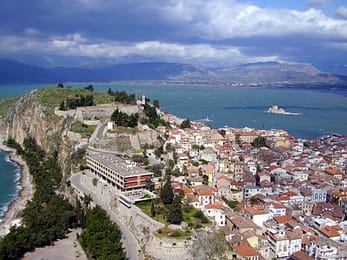
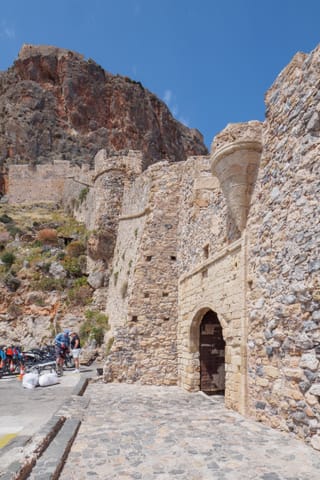
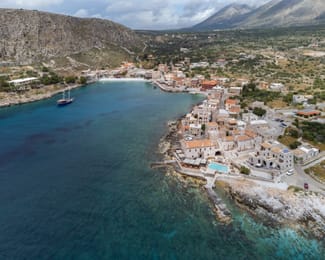
Nafplio seen from Akronafplia, with the Argolic Gulf and the islet of Bourtzi.
The Peloponnese table
The Peloponnese is a land of olives: the Kalamata variety, purple and almond-shaped, has its own designation of origin. In the Mani, people eat siglino, salted and smoked pork, and sausages flavoured with orange peel. For dessert, diples are strips of fried dough drizzled with honey.
Near Mycenae, Nemea makes red wines from the agiorgitiko grape. Monemvasia gave its name to malmsey, a sweet wine sold all over Europe in the Middle Ages and revived with a designation of origin in 2010. In the harbours of the Mani and in Gythio, you eat grilled fish.
Loop from Athens


 +27stops
- 1Διώρυγα της Κορίνθου · Αρχαία Κόρινθος · Μονή Μεγάλου Σπηλαίου · Καλάβρυτα
- 2Αγία Λαύρα Καλαβρύτων · Δημητσάνα Αρκαδίας · Ολυμπία
- 3Αρχαιολογικό Μουσείο Ολυμπίας · Ανάκτορο του Νέστορα · Βοϊδοκοιλιά · Νιόκαστρο Ναυαρίνου
Free, no account needed — start from its places and make it yours.
Also worth reading
Wide open spaces
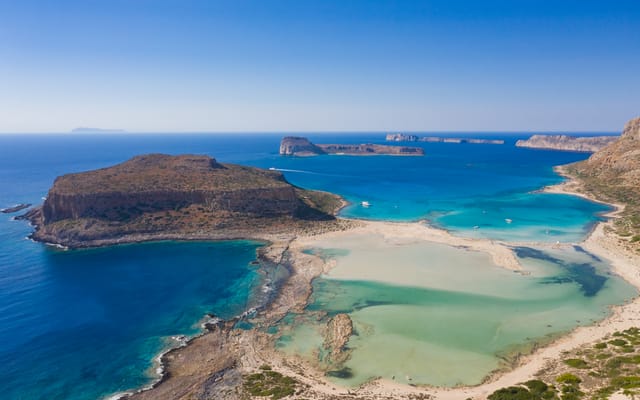
Crete, from Knossos to Balos
Greece’s largest island mixes Minoan palaces, Venetian harbours, gorges and pink-sand beaches. This nine-day trip starts in Heraklion and ends in Chania, by way of Lasithi, the south coast and the far west.
Coast and islands
Thessaloniki, Mount Olympus and Halkidiki
A great Byzantine city, the tombs of the kings of Macedon, the highest mountain in Greece and three peninsulas on the Aegean Sea. A six-day loop from Thessaloniki, from Pella to Mount Athos.
Coast and islands
Pelion, between the Gulf of Volos and the Aegean
Pelion is a forested mountain that sits between a calm gulf and the Aegean Sea. This trip takes five days to loop around it from Volos, through its stone villages, its pebble coves and its winding roads.
A starting point, a few wishes — ViaLooma builds the trip day by day, map, stops and roadbook included.