The Alsace Wine Route, from Strasbourg to Thann
Vines halfway up the slopes at the foot of the Vosges, a half-timbered village every two or three kilometres and a castle on every ridge. Five unhurried days, from Strasbourg Cathedral to the collegiate church of Thann.
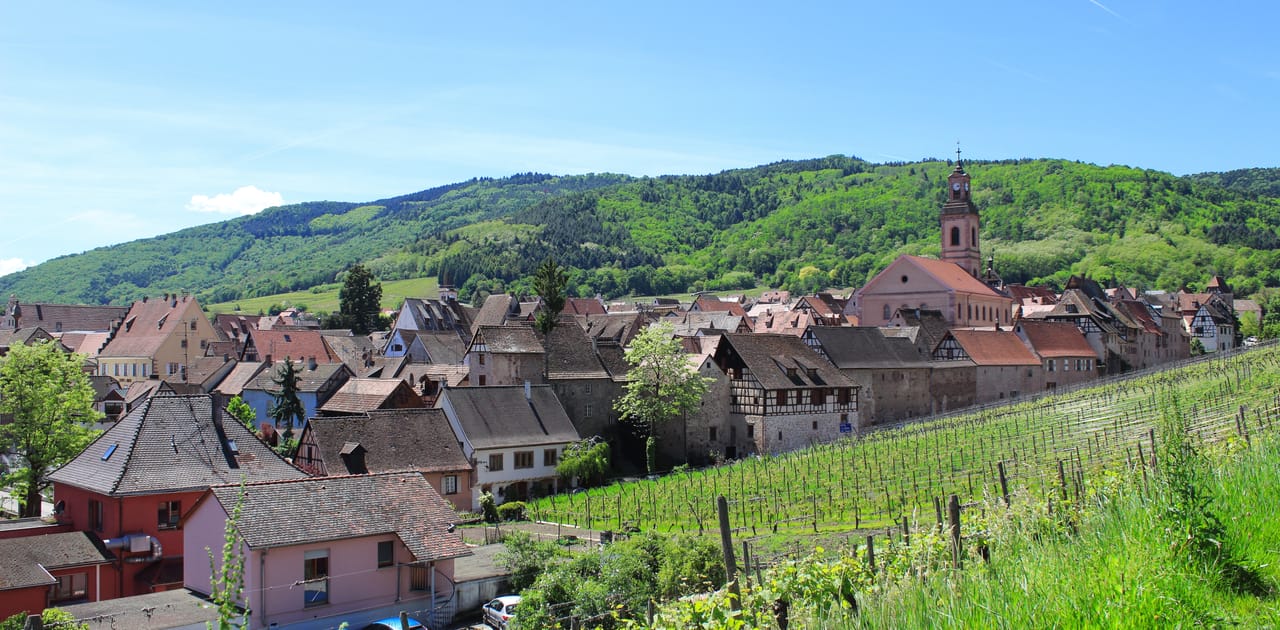
Vines and villages at the foot of the Vosges
The Alsace Wine Route follows the foot of the Vosges for some 170 kilometres, from Marlenheim to Thann. It runs through the vines halfway up the slopes, above the Rhine plain. There is a village every two or three kilometres, a church tower in every fold of the hills. You park outside the ramparts, walk round the village, taste a wine at a winegrower’s, then drive on. Opened in 1953, it is one of the oldest wine routes in France.
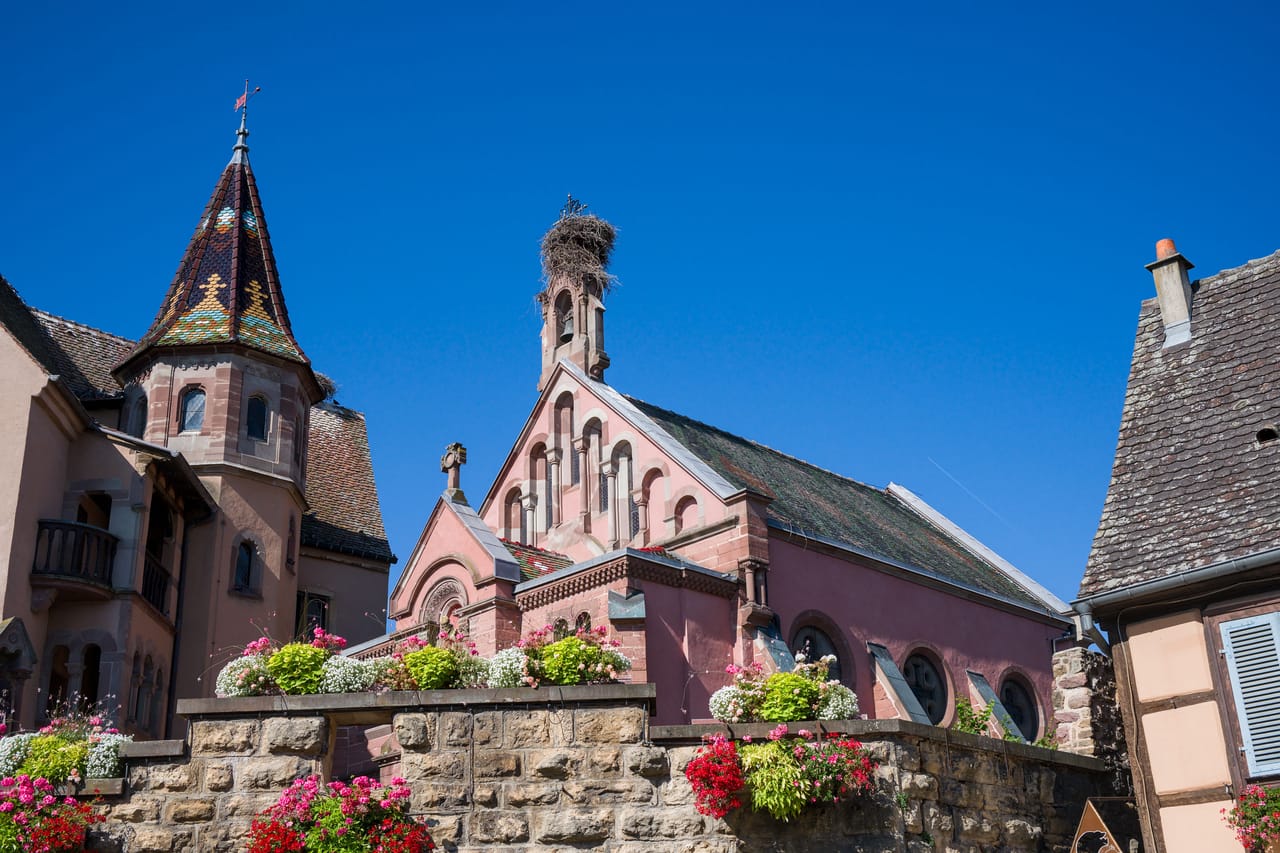
The villages have kept their walls and their half-timbered houses. Riquewihr still has its ramparts, its Dolder tower and its 16th- and 17th-century houses. Kaysersberg, where Albert Schweitzer was born in 1875, stretches out below its castle. Eguisheim is built in concentric rings around its old castle. In spring and summer, storks nest on the roofs. They had almost vanished from Alsace by the 1970s. They were reintroduced, thanks in part to the centre at Hunawihr, and are plentiful again.
The Vosges stop the clouds coming in from the west. Colmar is one of the driest towns in France. The vineyards enjoy hot summers and long autumns, just right for late harvests.
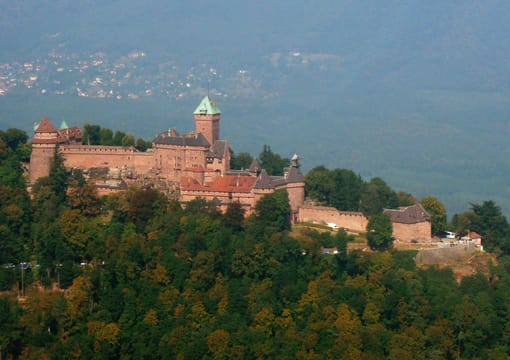
Haut-Kœnigsbourg, an emperor’s castle
Haut-Kœnigsbourg stands at more than seven hundred metres, above the Alsace plain. Ruined in the Thirty Years’ War, it was given in 1899 to Kaiser Wilhelm II. Alsace was German at the time. The Kaiser had it rebuilt from top to bottom by the architect Bodo Ebhardt. This rebuilding was criticised at the time. Today the castle is one of the most visited monuments in the region.
The castle is a reminder of the German era. Alsace changed nationality four times between 1871 and 1945. It was annexed to the German Empire after the war of 1870 and became French again in 1918. The Reich annexed it de facto in 1940. It was liberated in 1944 and 1945.
From this history, it has kept a local law, with a system for religion inherited from the Concordat. Alsatian, a Germanic dialect much older than these annexations, can still be heard, mostly in the countryside and among older people. The village names are Germanic in origin: Riquewihr, Kaysersberg, Eguisheim.
Alsace changed nationality four times between 1871 and 1945.
Colmar and the Isenheim Altarpiece
In Colmar, Little Venice follows the Lauch, between timber-framed houses and the old tanners’ and market gardeners’ quarters. The sculptor Bartholdi, who made the Statue of Liberty, was born here. A replica of his statue greets travellers at the northern entrance to the town.
The Unterlinden Museum holds the Isenheim Altarpiece. Matthias Grünewald painted it around 1512–1516 for the Antonites, a religious order that cared for victims of St Anthony’s fire, a disease that made the limbs burn. Its great Crucifixion shows Christ with his body covered in sores.
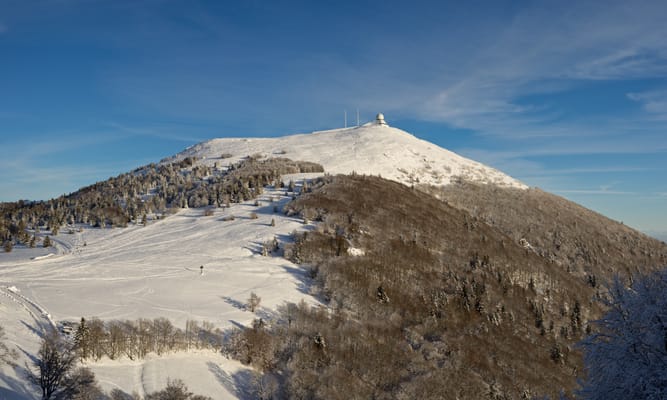
Grand Ballon
It is the highest point in the Vosges, at 1,424 metres. The Route des Crêtes passes just below the summit. On a clear day you can see the Alsace plain, the Black Forest and, to the south, the Alps. Built during the First World War to supply the front, the road is partly closed in winter.
Practical notes
- When to go
- September–October for the harvest and the colours, December for the Christmas markets. Spring is quiet and in flower.
- Getting there
- Strasbourg is two hours from Paris by TGV, and less than two hours’ drive from Basel and Stuttgart.
- Access
- Everything is tarmac and well signposted. The villages are explored on foot from car parks outside the ramparts.
- Sleeping in a van
- Motorhome aires in many wine villages, sometimes at the winegrowers’ own estates, and campsites in the main towns.
- Worth knowing
- During the Christmas markets, Strasbourg and Colmar restrict car access to the centre: park on the outskirts.
- Allow
- Five days without hurrying, a week if you add the Route des Crêtes.
What not to miss
- 1Strasbourg CathedralThanks to its 142-metre spire, the cathedral was the tallest building in the world for more than two centuries. Its astronomical clock comes to life every day at 12.30 pm.
- 2Mont Sainte-OdileThe convent of the patron saint of Alsace, ringed by a “pagan wall” more than ten kilometres long.
- 3Haut-KœnigsbourgThe castle rebuilt for Wilhelm II, with the plain and the Black Forest on the horizon.
- 4RiquewihrIts ramparts, its Dolder tower and its winegrowers’ houses, surrounded by grand cru vineyards.
- 5The Isenheim AltarpieceGrünewald’s masterpiece, in Colmar’s Unterlinden Museum.
- 6EguisheimA village built in rings, with the three keeps of Haut-Eguisheim above it.
The Alsace Wine Route in pictures
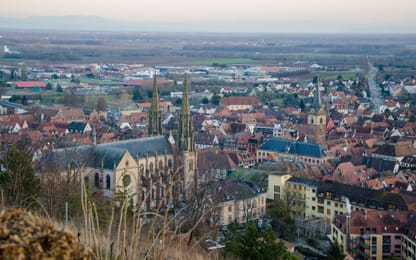
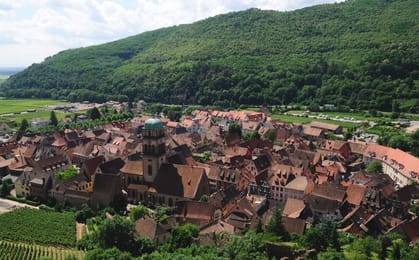
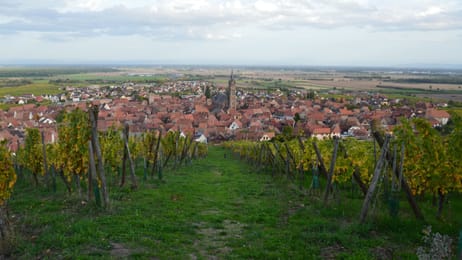
The rooftops of Obernai, seen from the vines.
The Alsace table
Alsace makes mostly whites: riesling, gewurztraminer, pinot gris, muscat, sylvaner, pinot blanc. The only red is pinot noir. The wines carry the name of their grape rather than their village, and fifty-one named sites are classified grand cru. Crémant d’Alsace is the region’s sparkling wine.
At the table, you eat choucroute garnie, sauerkraut piled with sausages and pork; baeckeoffe, slow-cooked in an earthenware dish; and tarte flambée. For an afternoon snack, you eat kougelhopf, baked in its fluted ring mould. In autumn, the new wine is drunk with walnuts and onion tart in a winstub, the Alsatian wine tavern with wood-panelled walls.
Strasbourg → Thann


 +13stops
- 1Cathédrale Notre-Dame de Strasbourg · Petite France · Obernai
- 2Mont Sainte-Odile · Mittelbergheim · Château du Haut-Koenigsbourg
- 3Bergheim · Ribeauvillé · Hunawihr · Riquewihr
Free, no account needed — start from its places and make it yours.
Also worth reading
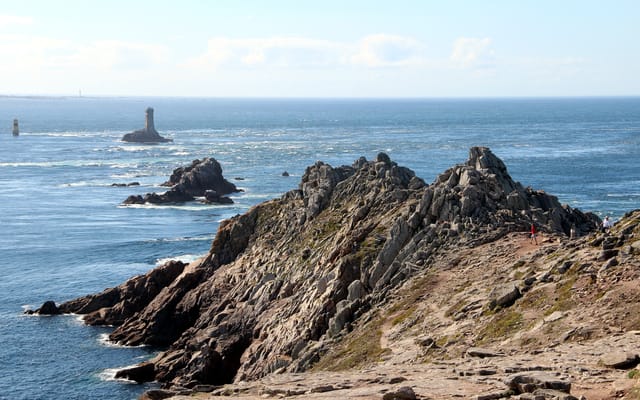
Coast and islands
The coast of Brittany, from Saint-Malo to Vannes
The corsair city, the pink granite, the headlands of Finistère and the standing stones of Morbihan: nearly eight hundred kilometres along the coast, from the Channel to the Atlantic, in eight days.
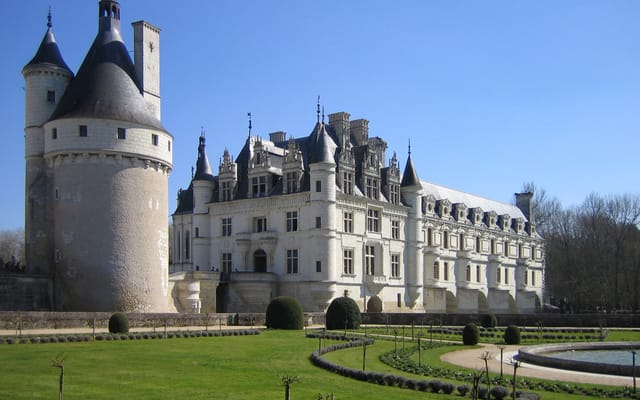
Heritage and culture
The châteaux of the Loire, from Blois to Saumur
Chambord, Chenonceau, Villandry, Chinon: the valley where the French court lived for more than a century, and where every château tells of a reign. Six days along the Loire and its tributaries, rarely driving more than an hour at a stretch.
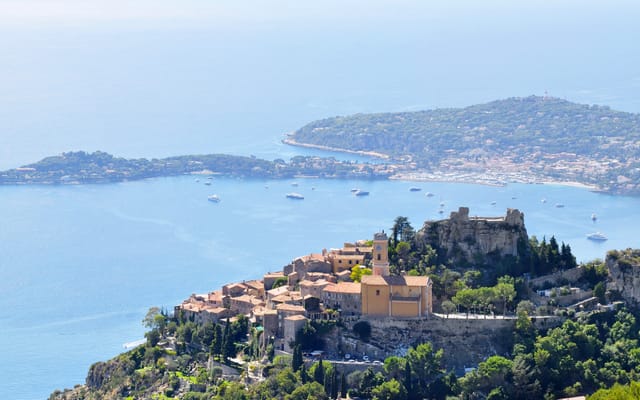
Coast and islands
The French Riviera and the hills behind Nice
Corniche roads hanging above the Mediterranean, hilltop villages twenty minutes from the beaches, alpine valleys an hour from Nice. A six-day loop to see both faces of the Riviera.
A starting point, a few wishes — ViaLooma builds the trip day by day, map, stops and roadbook included.