The Grossglockner Road, from Salzburg to the Krimml Falls
The Grossglockner Road crosses the Hohe Tauern at the foot of Austria’s highest mountain. Five days on a loop from Salzburg, with gorges, an ice cave and the Krimml Falls.
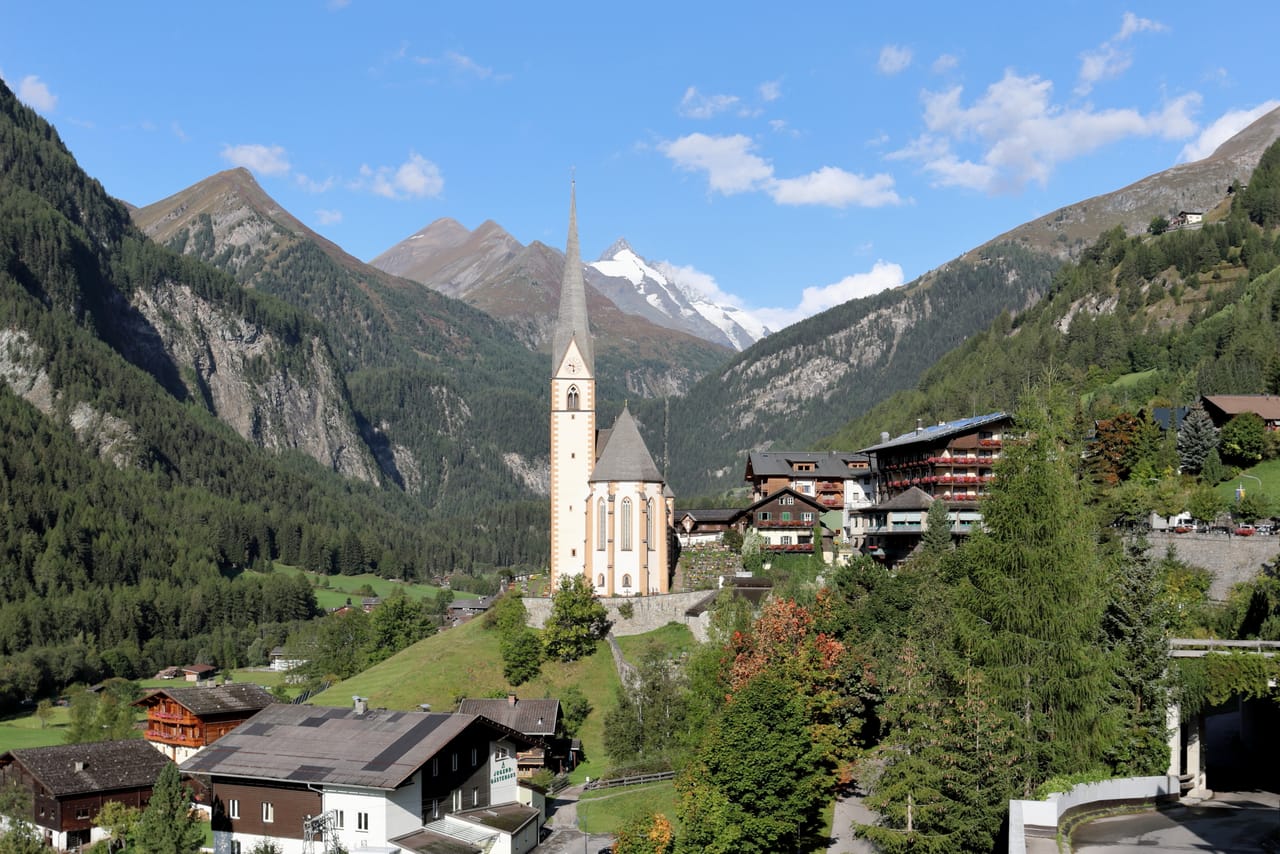
The road over the Hohe Tauern
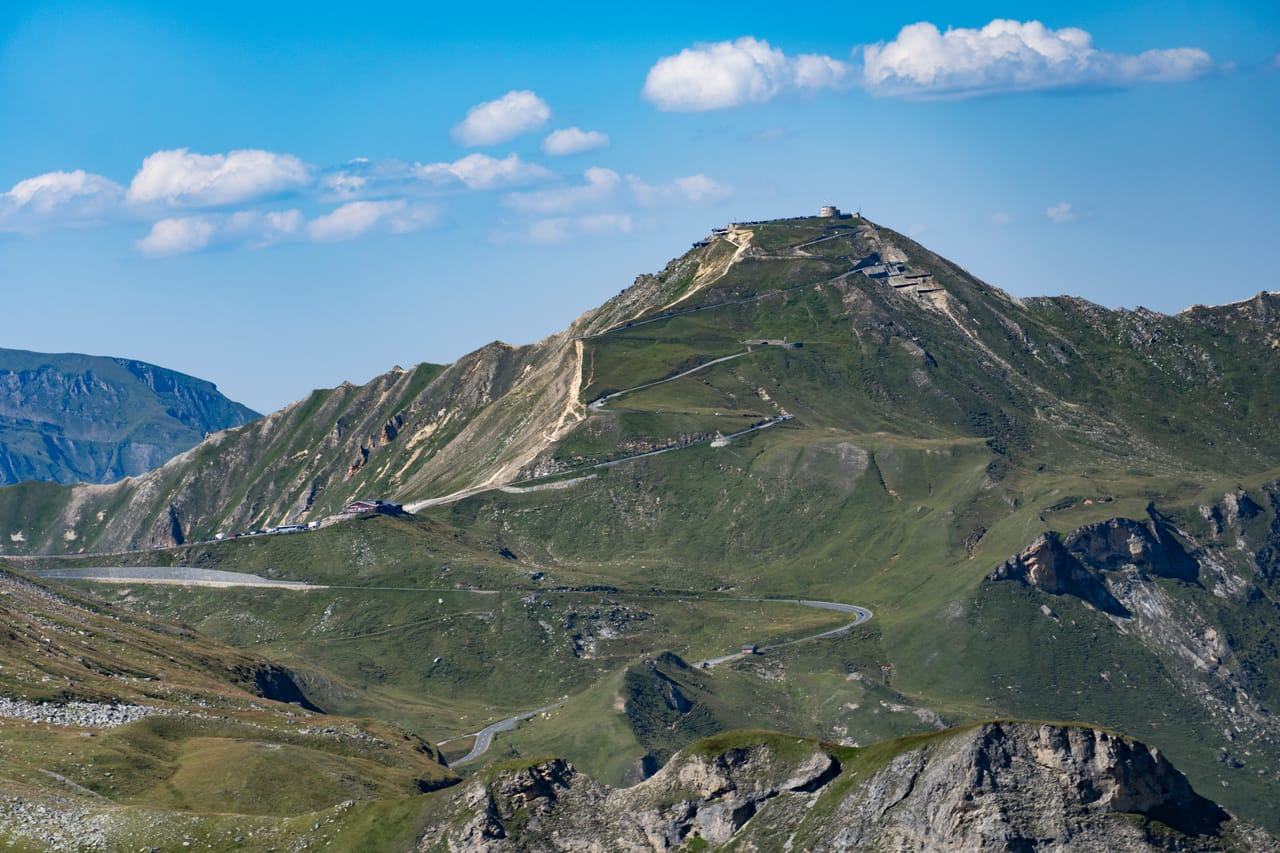
The Grossglockner Road starts at Fusch, in the state of Salzburg, goes through the Hochtor tunnel at 2,504 metres, then drops down to Heiligenblut, in Carinthia. It is 48 kilometres long and has 36 hairpin bends. In an hour of climbing, you go from spruce forest to alpine pastures, then to scree and snowfields. At Fuscher Törl, a short spur road, partly cobbled, climbs to the Edelweißspitze, at 2,571 metres, the highest point of the road.
On the other side, a second spur road leads to the Kaiser-Franz-Josefs-Höhe, facing the Grossglockner, Austria’s highest mountain at 3,798 metres. Marmots live around the viewpoint. Further down, the pointed spire of Heiligenblut stands out against the mountain: this is the postcard view.
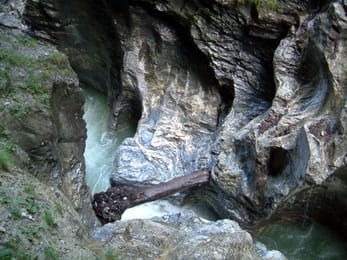
As well as the pass, the loop from Salzburg takes in gorges that you walk through on footbridges, above the torrent. At Werfen, the Eisriesenwelt is the largest ice cave in the world. To the west, the Krimml Falls drop 380 metres in three tiers: they are the highest in Austria.
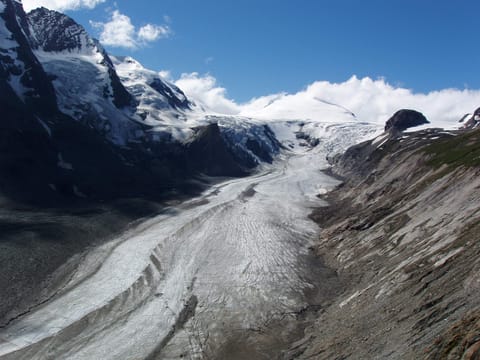
The Pasterze, a shrinking glacier
From the Kaiser-Franz-Josefs-Höhe, you look down on the Pasterze, still Austria’s largest glacier. The viewpoint is named after Emperor Franz Joseph, who walked up from Heiligenblut in 1856 to see the glacier. Empress Elisabeth, on horseback, had stopped further down. Since that visit, the glacier’s area has shrunk by almost half. In recent years, its snout has retreated by tens of metres a year, and the ice has thinned by up to around ten metres every year. Its tongue is about to break away: the title would then pass to the Gepatschferner, in Tyrol.
The Pasterze lies at the heart of Hohe Tauern National Park, created in stages from 1981. At 1,856 km², it is the largest national park in the Alps. It spreads across three Austrian states, Salzburg, Carinthia and Tyrol, and has more than 300 peaks over 3,000 metres.
People were crossing the pass long before the road was built.
A 1930s road over a very old pass
The road was built from 1930 to 1935, during the Depression, to create jobs. It was designed by Franz Wallack, an engineer with the state of Carinthia. In August 1931, 2,357 workers were on the site at the same time. The road opened on 3 August 1935.
People were crossing the pass long before the road was built. Excavations carried out since 1994 near the Hochtor have uncovered a sanctuary, with Celtic and Roman coins. Heiligenblut, “Holy Blood”, owes its name to a legend. According to tradition, a Danish prince, Briccius, was returning from Constantinople with a phial of Christ’s blood when he died in an avalanche, around 914. Three ears of wheat are said to have grown in the snow above his body. The relic is still kept in the church.
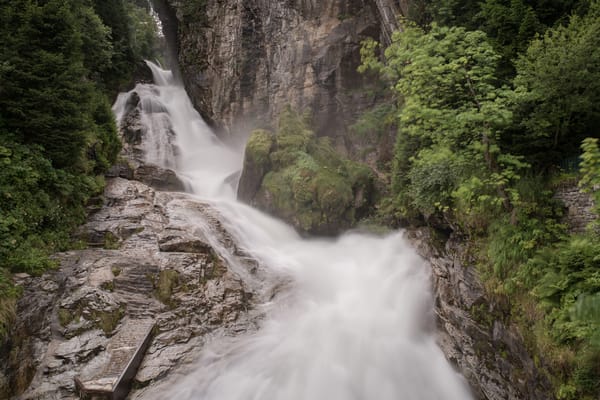
The Bad Gastein Waterfall
Here the Gasteiner Ache drops about 340 metres in three tiers, right in the centre of the spa town. A stone bridge from 1840 crosses just above the water, between the grand hotels.
Practical notes
- When to go
- June to September. The Grossglockner Road usually opens in early May and closes in late October or early November, depending on the snow.
- Getting there
- Salzburg is an hour and a half from Munich. A vignette is compulsory on the motorway up to 3.5 tonnes; above that, a per-kilometre toll paid with the GO-Box.
- Access
- Everything is tarmac. The Grossglockner Road and the Felbertauern tunnel are toll roads. The Edelweißspitze spur, steep and partly cobbled, is not recommended for large motorhomes.
- Sleeping in a van
- Campsites near Salzburg, at Zell am See, at Heiligenblut and at Krimml. Wild camping is forbidden.
- Worth knowing
- The Grossglockner Road is closed at night, at times that vary with the season. The gorges and the Eisriesenwelt close in winter.
- Allow
- Five days for the loop, including a full day for the Grossglockner Road.
What not to miss
- 1The Krimml FallsA zigzag path runs alongside the three tiers, about an hour to the top.
- 2The EisriesenweltOf its 42 kilometres of passages, only the first kilometre, covered in ice, is open to visitors, always with a guide.
- 3The LiechtensteinklammA narrow gorge with walls up to 300 metres high in places, opened to visitors in 1876.
- 4The Hallein salt mineWorked from 600 BC to 1989, with miners’ slides and an underground lake.
- 5Hellbrunn PalaceBuilt from 1613 for a prince-archbishop, with trick fountains that soak visitors.
- 6Hohensalzburg FortressBegun in 1077, it towers over Salzburg’s old town.
The Grossglockner Road in pictures
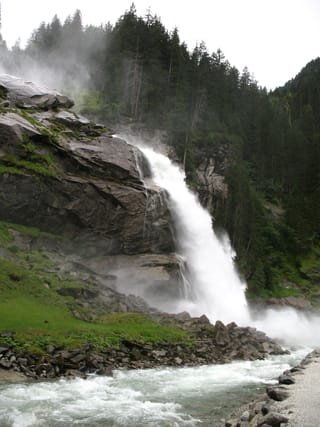
One of the tiers of the Krimml Falls, amid the spray and the forest.
The food of the Hohe Tauern
In the Pinzgau, people eat Kasnocken, small dumplings with strong cheese and fried onions. In mountain huts, you order a Kaiserschmarrn, a thick pancake cut into pieces. In Carinthia, Kärntner Kasnudeln are large ravioli filled with curd cheese, potato and mint, sealed by hand.
In Salzburg, the Salzburger Nockerl is a sweet soufflé in three peaks, said to stand for the city’s hills. Mozartkugeln, balls of marzipan coated in chocolate, were invented in 1890 by the confectioner Paul Fürst.
Loop from Salzburg


 +14stops
- 1Schloss Mirabell · Mozarts Geburtshaus · Salzburger Dom · Festung Hohensalzburg
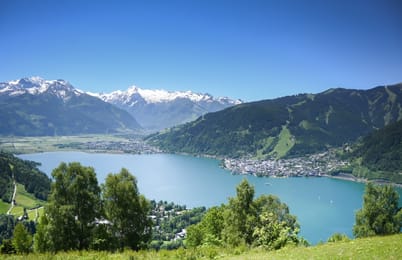
- 2Festung Hohenwerfen · Liechtensteinklamm · Zell am See · Eisriesenwelt
- 3Edelweißspitze · Fuscher Törl · Kaiser-Franz-Josefs-Höhe · Heiligenblut am Großglockner
Free, no account needed — start from its places and make it yours.
Also worth reading
Wide open spaces
The Salzkammergut, from Salzburg to Hallstatt
Green and turquoise lakes at the foot of the mountains, villages on the water’s edge and salt mines worked since prehistory. A five-day loop from Salzburg, through Bad Ischl, Hallstatt, the Dachstein and the Traunsee.
Wide open spaces
The Pacific Northwest, from the Olympic Peninsula to the Cascade volcanoes
Rainforests, a coast of headlands and lighthouses, redwoods and two active volcanoes. A two-week loop from Seattle, by way of the Olympic Peninsula, the Oregon coast and Mount Rainier.
Wide open spaces
Vancouver Island, from Victoria to the beaches of Tofino
An island of giant forests, beaches pounded by the Pacific and small harbours where boats leave to see orcas. Nine days on a loop from Victoria, from Port Renfrew to Tofino and up to Telegraph Cove.
A starting point, a few wishes — ViaLooma builds the trip day by day, map, stops and roadbook included.