The Bernese Oberland, from Lake Thun and Lake Brienz to the Jungfrau
Two lakes, dozens of waterfalls and, to the south, the Eiger, the Mönch and the Jungfrau. A five-day loop from Bern, through castles, gorges and glacial valleys.
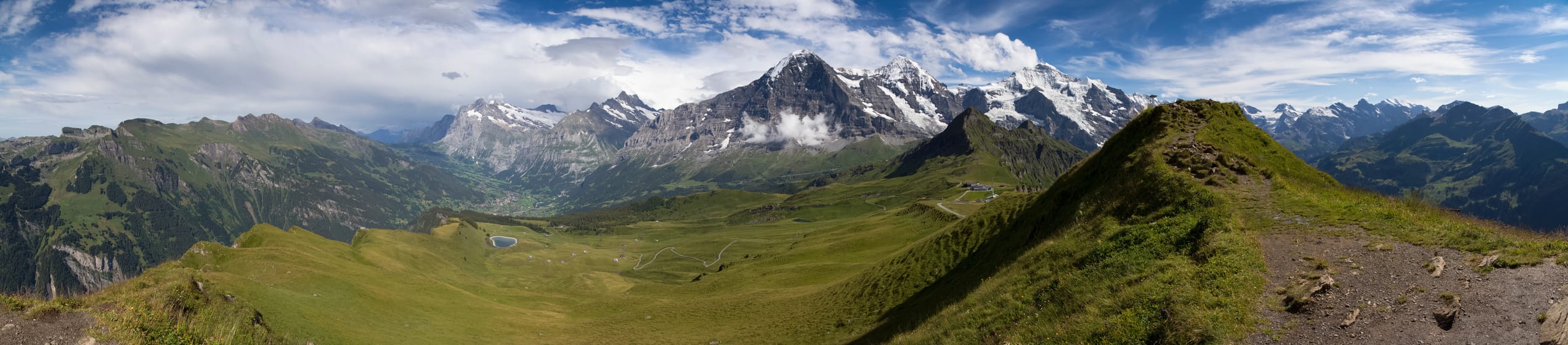
Two lakes and three great peaks
The Bernese Oberland is a short loop from Bern, rarely more than an hour and a half’s driving a day. The road follows Lake Thun, then Lake Brienz, on either side of Interlaken. To the south, the Eiger, the Mönch and the Jungfrau rise above or close to 4,000 metres.
Above Kandersteg, a gondola climbs towards the Oeschinensee, a turquoise lake at the foot of the Blüemlisalp. In the Lauterbrunnen valley, the road ends at Stechelberg, among the waterfalls. Grindelwald sits at the foot of the Eiger’s north face. From there, a gondola climbs to First, an hour’s walk from the Bachalpsee.
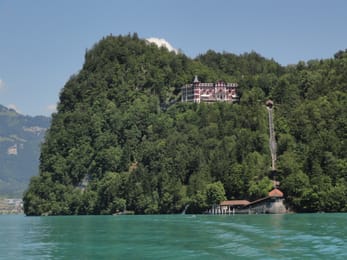
On the shores of Lake Brienz, the Giessbach Falls come down in fourteen cascades. In the evening, the Harder funicular climbs above Interlaken, facing the two lakes and the three peaks.
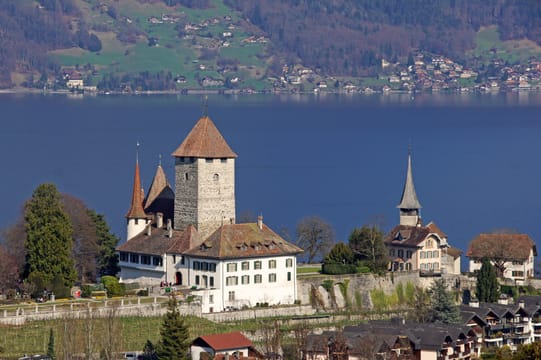
The castles of Lake Thun
Around Lake Thun, three medieval castles stand a few kilometres apart. In Spiez, the castle looks down on a small bay, with its residential tower built after 1200. Right next to it, the castle church is Romanesque; tradition has it that it was founded by Rudolph II, King of Burgundy. Two Bernese families, the Bubenbergs and then the von Erlachs, lived there from the 14th to the 19th century. The castle is now a museum, surrounded by vineyards that run down to the water.
Thun castle is the oldest of the three: its keep dates from 1180–1190, in the time of Duke Berthold V of Zähringen. On the north shore, Oberhofen castle became the summer residence of Count de Pourtalès in 1844.
Further along the north shore, you can visit the St Beatus Caves for one kilometre. Legend says the hermit Beatus drove a dragon out of them.
Its name means ‘dust stream’: the water breaks up into droplets before it reaches the bottom.
The Lauterbrunnen valley and the Jungfrau Railway
The Lauterbrunnen valley was carved out by a glacier: a flat floor, and almost vertical limestone walls with dozens of waterfalls pouring down them. The Staubbach drops 297 metres, just behind the village. Its name means ‘dust stream’: the water breaks up into droplets before it reaches the bottom. The Trümmelbach Falls, for their part, flow inside the mountain: ten waterfalls fed by the glaciers of the Eiger, the Mönch and the Jungfrau. You go up by a lift cut into the rock.
Wengen and Mürren have no road. From Stechelberg, a cable car climbs to Mürren, then to the Schilthorn, at 2,970 metres: its revolving restaurant appears in a 1969 James Bond film. From the Kleine Scheidegg, the Jungfrau Railway, completed in 1912, runs under the Eiger and the Mönch to the Jungfraujoch, at 3,454 metres. It is the highest railway station in Europe, at the heart of the Jungfrau-Aletsch site, on the UNESCO World Heritage List since 2001.
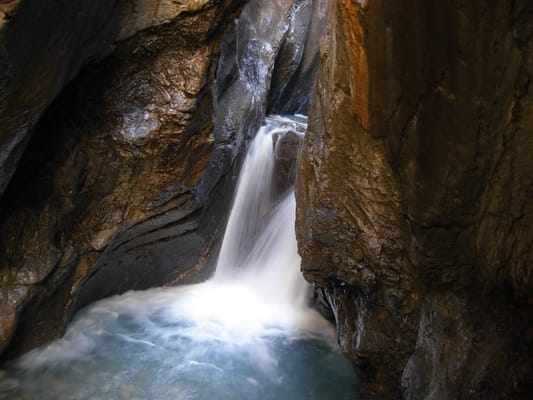
The Rosenlaui Glacier Gorge
Below the Rosenlaui glacier, the Weissenbach has carved a narrow gorge with polished walls, which you follow along walkways and through tunnels. Open from May to October; the road, narrow and winding, is not suitable for large motorhomes.
Practical notes
- When to go
- June to September. Gorges, funiculars and waterfall sites with walkways usually open from April or May to October.
- Getting there
- Bern is an hour from Basel and an hour and a quarter from Zurich by motorway. The vignette is compulsory; above 3.5 tonnes, a heavy vehicle charge replaces it.
- Access
- Everything is tarmac. The Grosse Scheidegg road is closed to private cars between Schwarzwaldalp and Grindelwald. In summer, the village car parks fill up early.
- Sleeping in a van
- Campsites in Interlaken, Lauterbrunnen, Grindelwald, Kandersteg and along the lakes. Overnight stays outside campsites are banned or tightly restricted in most municipalities.
- Worth knowing
- Booking is compulsory for the Jungfraujoch from May to October, and for the Oeschinensee gondola from May to early November. There is no parking for vans at the gondola’s lower station. Around the Oeschinensee, some paths are closed because of rockfall. In Iseltwald, on Lake Brienz, there is a charge for the jetty made famous by a Korean series.
- Allow
- Five days for the loop, one or two more for the Jungfraujoch or Mürren.
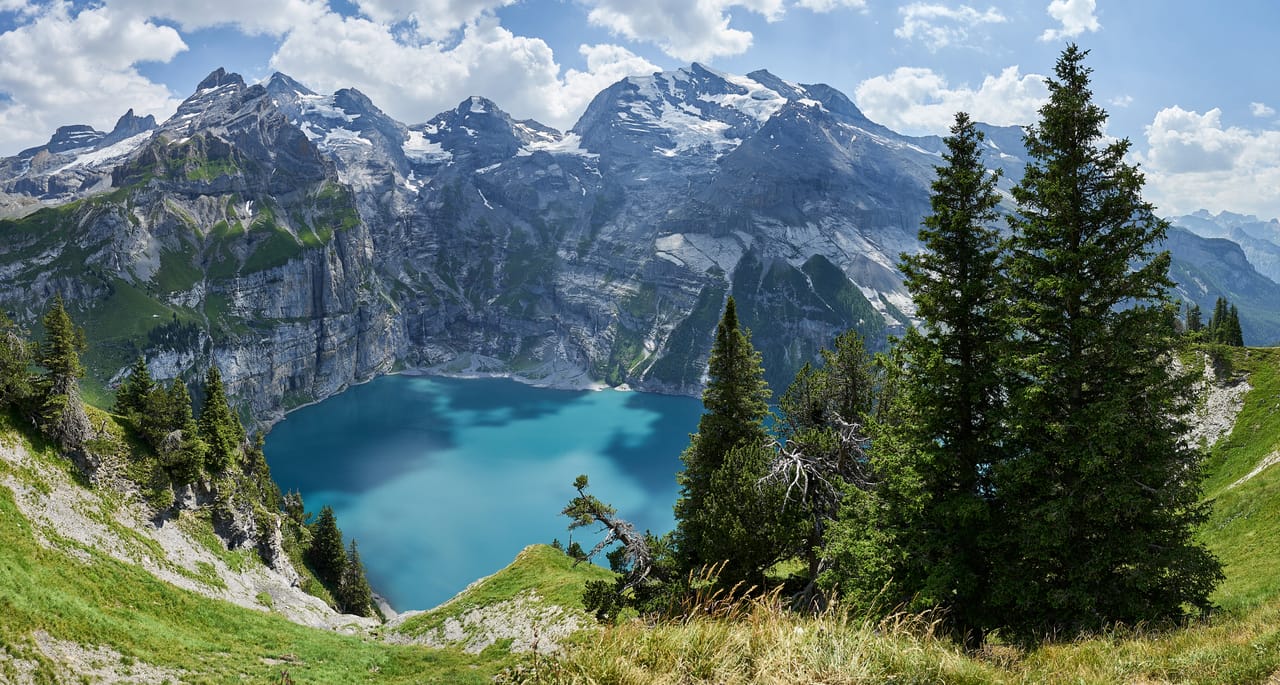
What not to miss
- 1Harder KulmThe viewpoint above Interlaken, facing the two lakes and the Jungfrau.
- 2The OeschinenseeA turquoise lake at 1,578 metres, a gondola ride and a twenty-minute walk from Kandersteg.
- 3The Grindelwald Glacier GorgeA path cut into the rock and a large net stretched above the torrent.
- 4The Reichenbach FallsThe funicular climbs to the spot where Conan Doyle makes Sherlock Holmes disappear.
- 5The Aare GorgeA 1.4-kilometre walkway along the bottom of a gorge, in places only a metre wide.
- 6BallenbergMore than a hundred rural houses from all over Switzerland, rebuilt in the open air.
The Bernese Oberland in pictures
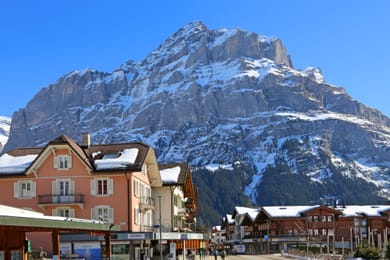
Grindelwald below the snow-covered Wetterhorn.
The Bernese Oberland table
Oberland cooking is mountain cooking. Rösti, a cake of grated potatoes, comes with almost everything. The Bernese platter brings together bacon, sausages and ham on sauerkraut or green beans. Hobelkäse, a hard alpine cheese, is served in thin rolled shavings.
The lakes provide whitefish and trout. Around Spiez and Oberhofen, a few vineyards produce a local wine. Meiringen claims to have invented the meringue; nothing proves it.
Loop from Berne


 +16stops
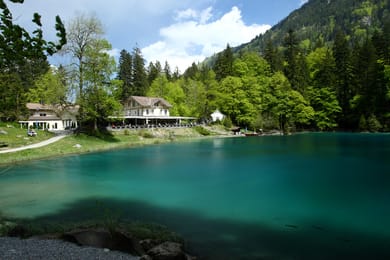
- 1Schloss Thun · Schloss Spiez · Blausee (Berner Oberland) · Kandersteg
- 2Schloss Oberhofen · St. Beatus-Höhlen · Interlaken · Harderbahn
- 3Lauterbrunnen · Staubbachfall · Trümmelbachfälle
Free, no account needed — start from its places and make it yours.
Also worth reading
Wide open spaces
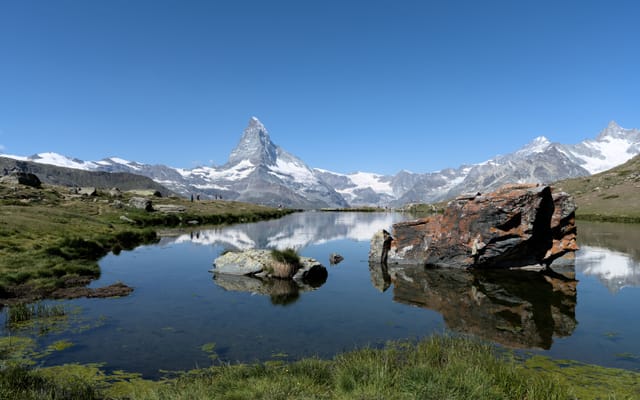
Valais, from the passes to the Matterhorn
Six days on the road across Valais, from the Grimsel and Furka passes to the abbey of Saint-Maurice. On the way, the Aletsch Glacier, Zermatt and the Matterhorn, and valleys where the road zigzags up to the dams.
Wide open spaces
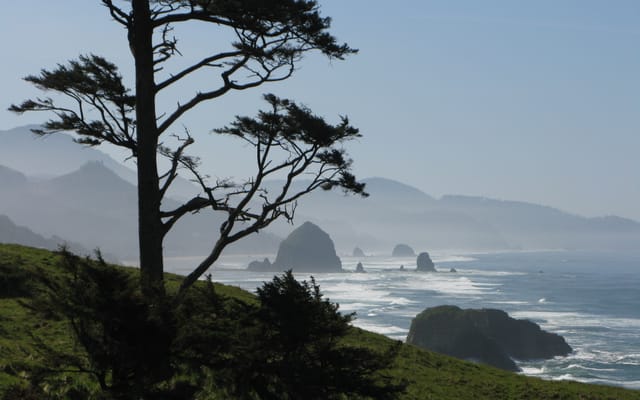
The Pacific Northwest, from the Olympic Peninsula to the Cascade volcanoes
Rainforests, a coast of headlands and lighthouses, redwoods and two active volcanoes. A two-week loop from Seattle, by way of the Olympic Peninsula, the Oregon coast and Mount Rainier.
Wide open spaces
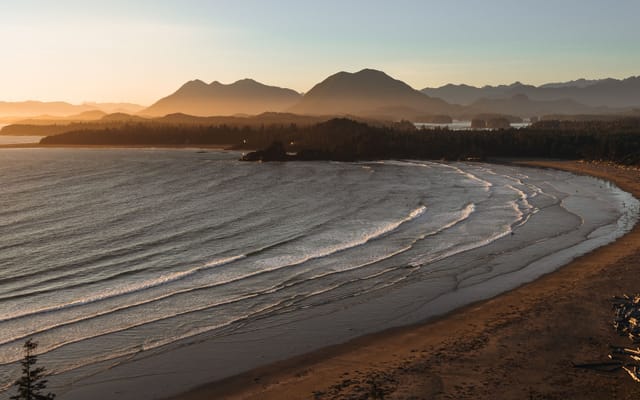
Vancouver Island, from Victoria to the beaches of Tofino
An island of giant forests, beaches pounded by the Pacific and small harbours where boats leave to see orcas. Nine days on a loop from Victoria, from Port Renfrew to Tofino and up to Telegraph Cove.
A starting point, a few wishes — ViaLooma builds the trip day by day, map, stops and roadbook included.