Kraków and the Tatras
A former royal capital, a salt mine, then Poland’s highest mountains two hours’ drive away. A six-day loop from Kraków, from Wieliczka to Zakopane and on to the Dunajec gorge.
From the Vistula to the Tatras
The trip starts in Kraków, which you explore on foot, with the car left in a car park. Just to the south, in Wieliczka, you go down into a salt mine worked from the 13th century until 1996, with tunnels and chapels carved out of the salt.
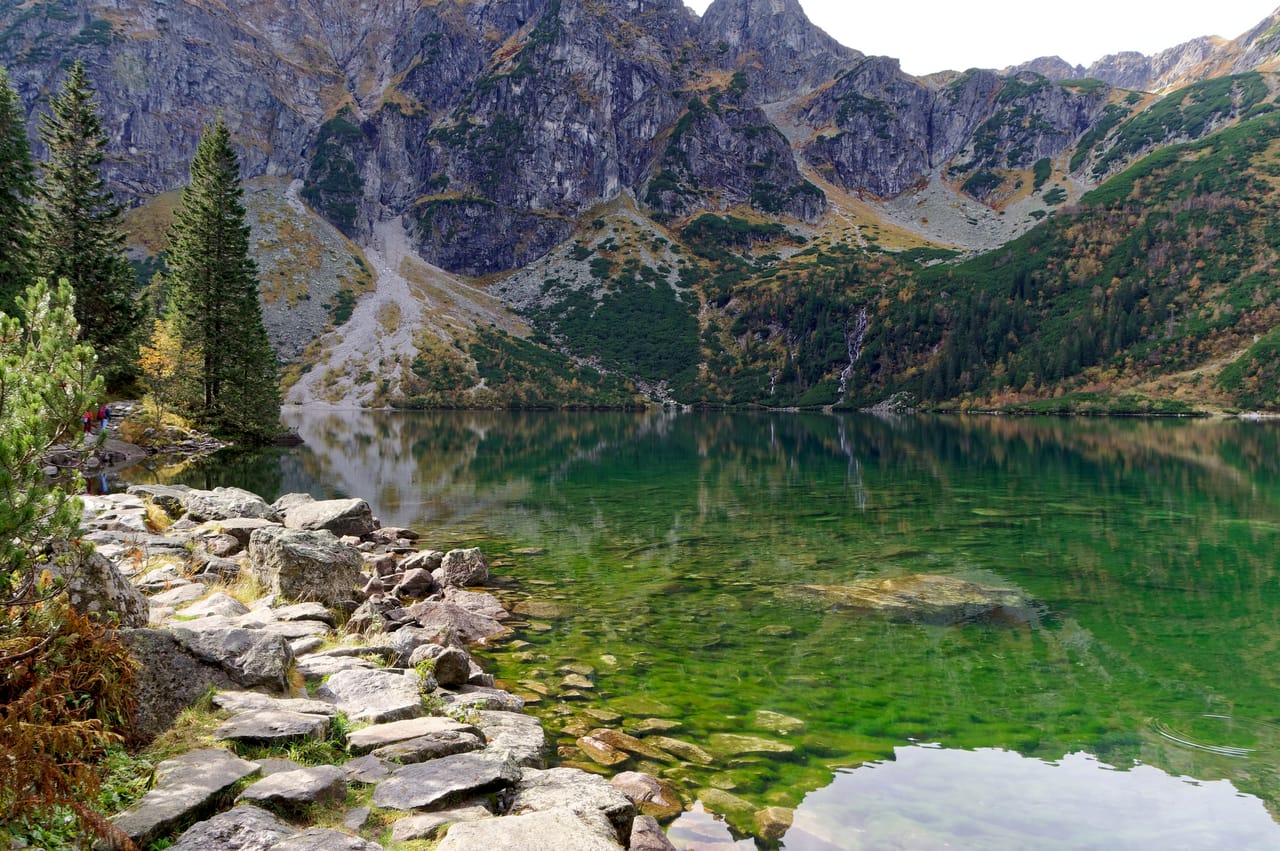
Then the road heads south. After the wooded Beskids, then Nowy Targ, the Tatras appear above the wooden villages. For Morskie Oko, the largest lake in the Tatras, you leave the car at Palenica Białczańska and walk about nine kilometres one way, along a road closed to cars.
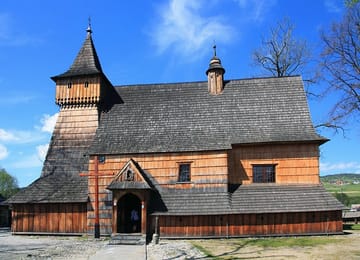
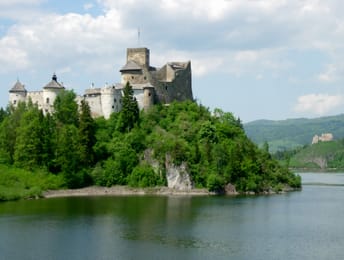
The way back runs through the Pieniny, further east: a wooden church, and two castles facing each other across a reservoir. There, you float down the Dunajec gorge on a wooden raft steered by boatmen in highland costume: 18 kilometres of meanders between cliffs, along the Slovak border.
Kraków, the old capital
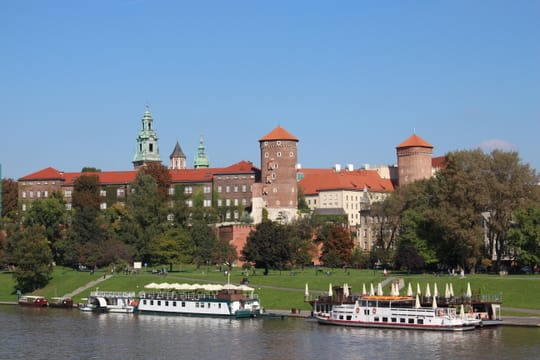
Kraków was the capital of Poland until the end of the 16th century. Sigismund III then moved his court to Warsaw, but kings were crowned and buried at Wawel until the 18th century. The castle and the cathedral stand on a hill above the Vistula. At the foot of the walls, a dragon statue breathes fire, a nod to one of the city’s legends. The historic centre has been on the Unesco World Heritage List since 1978.
The Rynek Główny is one of the largest medieval squares in Europe. Every hour, a trumpeter plays the hejnał from the top of St Mary’s Church. The tune stops in the middle of a note: according to tradition, a watchman was killed by a Tatar arrow while sounding the alarm.
To the south, Kazimierz, founded in 1335 by Casimir the Great, became Kraków’s Jewish quarter. Its Old Synagogue is the oldest surviving one in Poland. In Podgórze, Oskar Schindler’s former factory tells the story of the city under German occupation. An hour’s drive away, Auschwitz-Birkenau is the memorial site of the Holocaust. At least 1.1 million people were killed there, the vast majority of them Jews.
Kraków was the capital of Poland until the end of the 16th century.
Zakopane and the Tatras
Zakopane was a village of górale, the highlanders of Podhale, before it became a resort in the late 19th century. In the centre, Krupówki, a pedestrian street, is lined with shops and inns. Stanisław Witkiewicz created the Zakopane style there, inspired by the wooden houses of the nearby villages. The Villa Koliba, which he designed, is now a museum. He is buried in the old cemetery of Pęksowy Brzyzek, among artists and mountain guides.
The Kasprowy Wierch cable car dates from 1936. It climbs to just below the summit, at 1,987 metres, on the Slovak border. Morskie Oko lies at 1,395 metres, beneath Rysy, Poland’s highest peak at 2,499 metres. Its name means ‘eye of the sea’: according to legend, the lake is linked to the sea by an underground passage.
Pieskowa Skała Castle
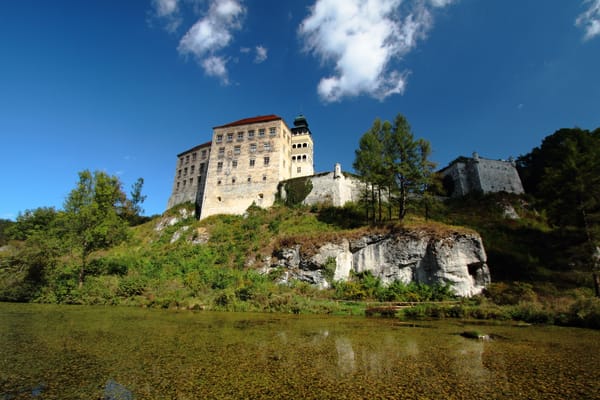
A Renaissance castle on a limestone cliff, in Ojców National Park. Next to it stands Hercules’ Club, a tall limestone pinnacle. A landscape of rocks, caves and forests, very different from the Tatras.
Practical notes
- When to go
- June to early October; September is quieter than summer. The Dunajec rafts run from April to the end of October. The Kasprowy Wierch cable car closes for several weeks in autumn for maintenance: check the dates on pkl.pl.
- Getting there
- Kraków airport is half an hour from the centre. Zakopane is about two hours’ drive away.
- Access
- No vignette; toll on the A4 between Kraków and Katowice. The roads to Kuźnice and Morskie Oko are closed to cars; the Palenica Białczańska car park is booked online through Tatra National Park.
- Sleeping in a van
- Campsites in Kraków, in Zakopane and on the shore of Lake Czorsztyn. Wild camping is banned in the national parks.
- Worth knowing
- Since 1 March 2026, entry to Auschwitz can only be booked on visit.auschwitz.org. Kraków has had a low-emission zone since January 2026: check your vehicle’s Euro standard. Since September 2026, the horse-drawn carts to Morskie Oko stop at the Wodogrzmoty Mickiewicza waterfalls.
- Allow
- Six days for the loop, one more for a hike or Pieskowa Skała.
What not to miss
- 1The Wieliczka salt mineSt Kinga’s Chapel, carved out of the salt some hundred metres underground.
- 2Kalwaria ZebrzydowskaA sanctuary founded in 1600, on the Unesco list, its chapels scattered across the hills.
- 3WadowiceThe house where Pope John Paul II was born, now a museum.
- 4The Oswald Balzer RoadA mountain road facing the peaks of the High Tatras.
- 5The church at DębnoA painted wooden church from the late 15th century, on the Unesco list.
- 6Niedzica CastleA former Hungarian fortress above Lake Czorsztyn.
Kraków and the Tatras in pictures
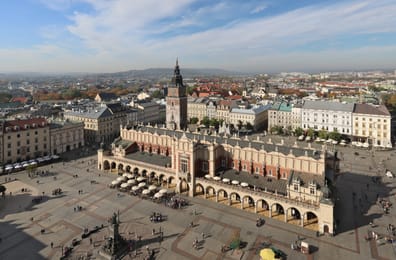
The Rynek Główny and the Cloth Hall, seen from the tower of St Mary’s.
Food in Lesser Poland
In Kraków, you eat pierogi, filled dumplings, and żurek, a sour rye soup. On the street, you buy an obwarzanek, a ring of bread close to a pretzel. In Wadowice, kremówka is a cream cake that John Paul II loved as a young man.
In the mountains, oscypek is a smoked sheep’s milk cheese. It is eaten grilled, with cranberry jam. The inns of Zakopane serve kwaśnica, a sauerkraut soup.
Loop from Krakow


 +17stops
- 1Rynek Główny w Krakowie · Zamek Królewski na Wawelu · Synagoga Stara w Krakowie · Fabryka Emalia Oskara Schindlera
- 2Kopalnia soli Wieliczka · Auschwitz-Birkenau · Auschwitz II – Birkenau
- 3Dom Rodzinny Ojca Świętego Jana Pawła II w Wadowicach · Sanktuarium pasyjno-maryjne w Kalwarii Zebrzydowskiej · Zakopane · Gubałówka
Free, no account needed — start from its places and make it yours.
Also worth reading
Wide open spaces
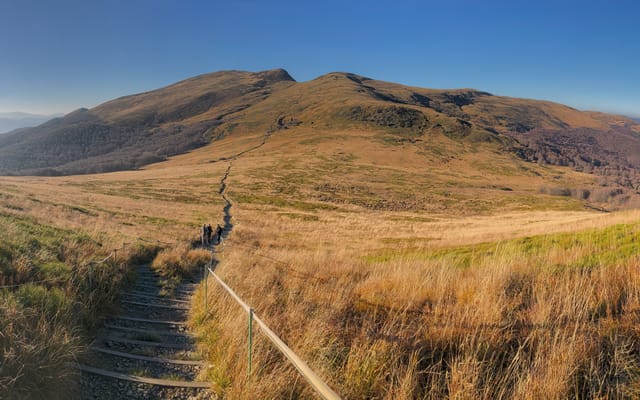
The Bieszczady, from wooden churches to the połoniny
In south-eastern Poland, on the borders with Slovakia and Ukraine, the Bieszczady are mountains of forest and high pasture, with few villages. A five-day circuit from Rzeszów, by way of Sanok, Lake Solina and the Great Bieszczady Loop.
Wide open spaces
Yellowstone, Grand Teton and Glacier: the great Rockies road trip
Three national parks on one road, from the Tetons to the glaciers of Montana, by way of the geysers of Yellowstone. Twelve days from Jackson to Kalispell, with bison by the roadside and two great mountain roads.
Wide open spaces
California’s national parks, from Joshua Tree to Yosemite
Five national parks, from the lowest point in North America to the giant sequoias. A two-week loop from Los Angeles, through the Mojave Desert, Death Valley, the Sierra Nevada and Yosemite.
A starting point, a few wishes — ViaLooma builds the trip day by day, map, stops and roadbook included.