Keukenhof and the tulip fields
In spring, the countryside between Haarlem and Leiden is covered in strips of flowers. This four-day trip starts from Haarlem and runs from Keukenhof to the windmills of Kinderdijk.
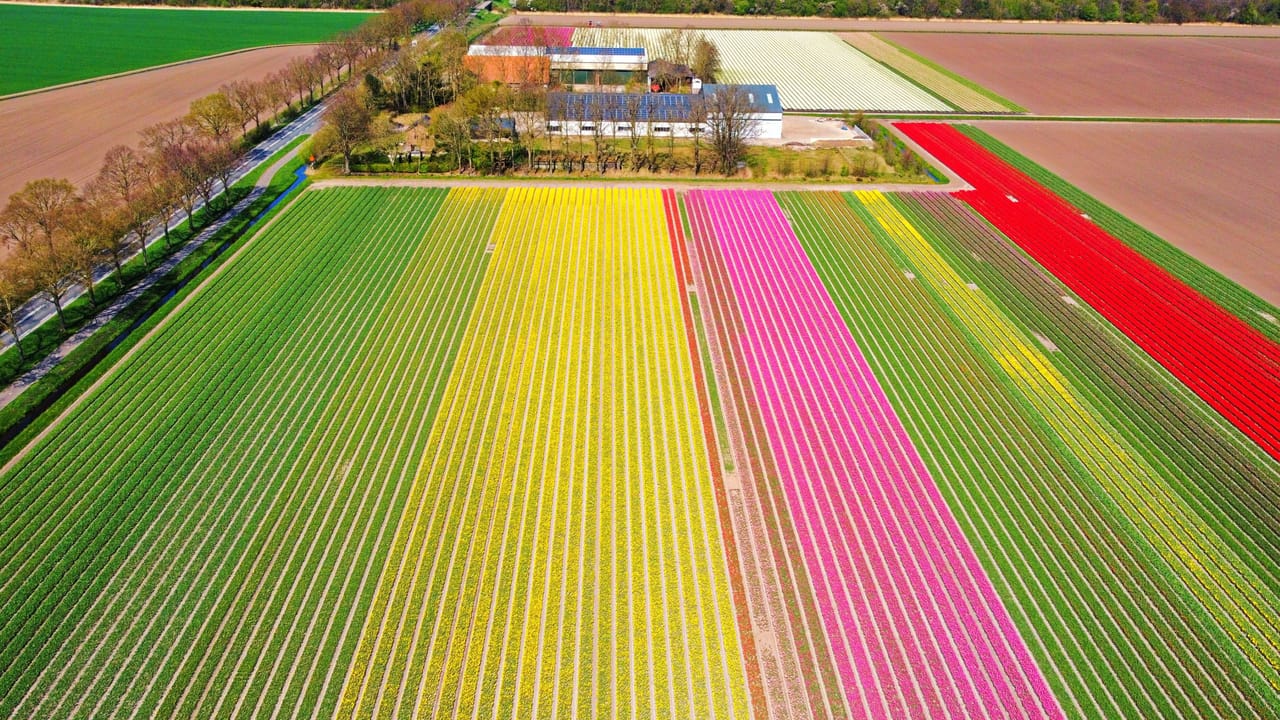
The flower fields of the Bollenstreek
Between Haarlem and Leiden lies the Bollenstreek, the ‘bulb region’. In spring, the plots form strips of solid colour, separated by ditches. Crocuses open the season in March. Then come hyacinths, daffodils and tulips, from late March to early May, with a peak that depends on the weather each year.
South of Haarlem, the N206 runs through Vogelenzang and De Zilk among the fields, as far as the Witte Kerkje, a small white church in Noordwijkerhout. Further east, the N208 crosses Hillegom and Lisse. In Lisse, Keukenhof shows its flowers in a large park. It is best to go in as soon as it opens, before the crowds.
The loop starts from Haarlem and goes beyond the flowers: the windmills of the Zaanse Schans, the canals of Leiden, Delft and Gouda, then the windmills of Kinderdijk, in a polder below sea level. You often drive along dykes, higher than the rooftops, and share the road with bikes.
The tulip, from Leiden to Haarlem
In the 1630s, Haarlem was one of the centres of the tulip trade. The most sought-after flowers had petals streaked with flames, like the famous Semper Augustus. In the winter of 1636–1637, prices rose very fast. People bought the bulbs by contract, often in taverns. The bulbs changed hands without leaving the ground. In February 1637, according to an account from the time, a sale in Haarlem found no more buyers. Prices collapsed: it was the end of tulip mania.
The tulip had arrived from the Ottoman Empire a few decades earlier. In 1593, the botanist Carolus Clusius became a professor in Leiden and ran the university’s botanical garden, founded in 1590. His tulips are seen as the starting point of bulb growing in the Netherlands. A reconstruction of his garden can be visited today in the Hortus botanicus.
The flames on the most expensive tulips actually came from a virus, unknown at the time. As for the crash, the historian Anne Goldgar showed in 2007 that it hit far fewer people than the usual story says: a small group of merchants and craftsmen.
The bulbs changed hands without leaving the ground.
Keukenhof and the bulb growers
In the 15th century, Keukenhof was the ‘kitchen garden’ of Teylingen Castle: its woods and vegetable gardens supplied game, fruit and vegetables. Countess Jacoba of Bavaria died at the castle in 1436. All that remains of the castle is a ruin, a few kilometres away. In 1857, the landscape architects Jan David and Louis Paul Zocher redesigned the estate as an English-style park.
In 1949, bulb growers and exporters made it their showcase, opened to the public in 1950. Every autumn, around seven million bulbs are planted over 32 hectares, for eight weeks of flowering. The fields around it are used for something else: the flowers are grown there for their bulbs. After flowering, the growers cut off the flower heads, and a colourful field turns green again in a few days.
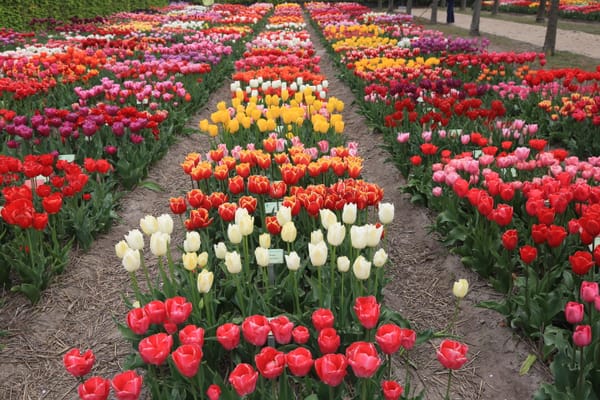
Hortus Bulborum
A conservation garden founded in 1928, growing more than 2,600 varieties of historic tulips. The oldest, the Duc van Tol, dates from 1595. It only opens in spring, while the flowers are out.
Practical notes
- When to go
- Late March to early May for the fields. Keukenhof is open from 18 March to 9 May 2027.
- Getting there
- Haarlem is about five hours from Paris and twenty minutes from Schiphol airport.
- Access
- No tolls, no vignette. Dyke roads are narrow and full of cyclists; in towns, park the van on the outskirts, as underground car parks have low ceilings.
- Sleeping in a van
- Wild camping is banned. Campsites and aires are in high demand in April around Lisse: book ahead.
- Worth knowing
- The fields are private: don’t walk between the rows. The flower parade from Noordwijk to Haarlem takes place in mid-April.
- Allow
- Four days for the loop, one more for Amsterdam, fifteen minutes from Haarlem by train.
What not to miss
- 1The Zaanse SchansGreen wooden houses, gathered on the banks of the Zaan between 1961 and 1974.
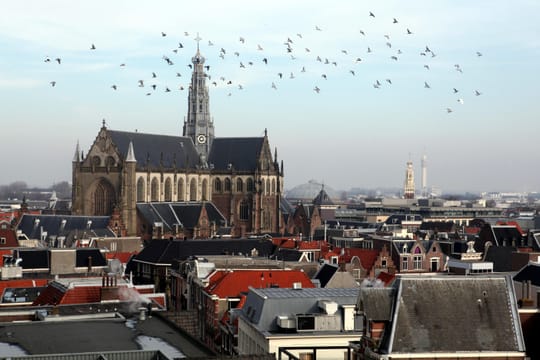
- 2The Grote Kerk in HaarlemIts Müller organ, completed in 1738, was played by Mozart at the age of ten, in 1766.
- 3The Hortus botanicus in LeidenThe oldest botanical garden in the Netherlands.
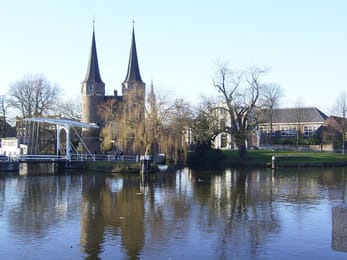
- 4The Nieuwe Kerk in DelftThe tomb of William of Orange and the crypt of the royal family.
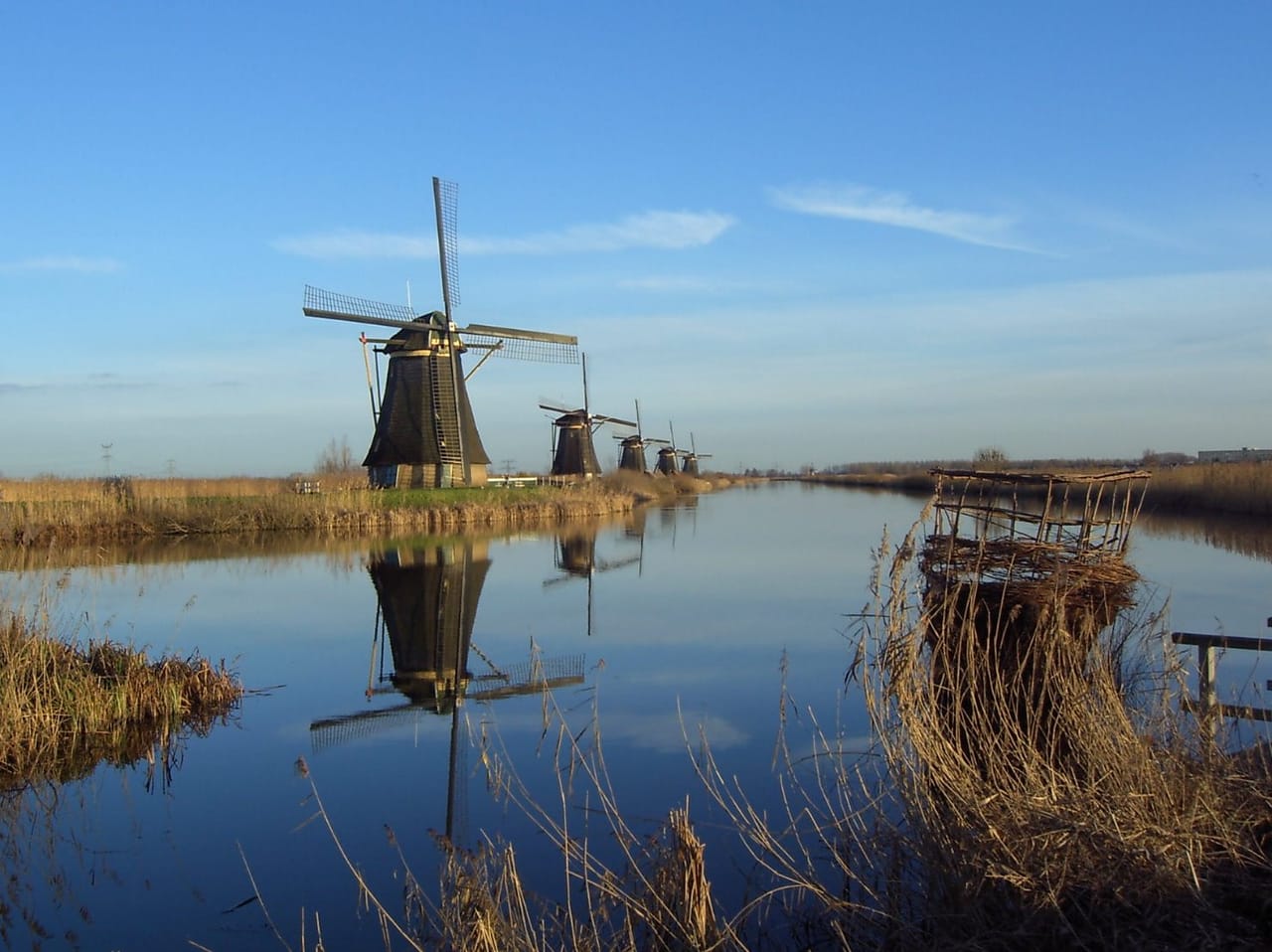
- 5KinderdijkNineteen windmills, most of them built around 1740 to drain the polder, on the Unesco list since 1997.
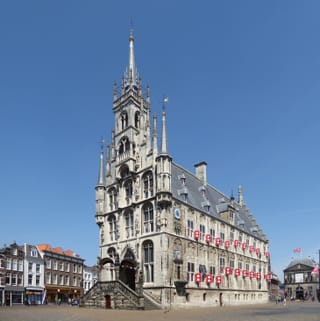
- 6Gouda town hallGothic, begun in 1448, standing alone in the middle of the market square.
Keukenhof and the tulip fields in pictures
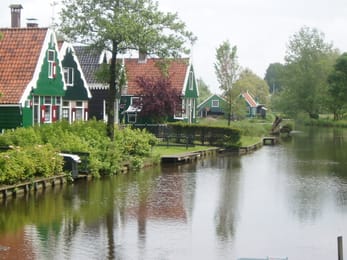
The green wooden houses of the Zaanse Schans, at the water’s edge.
The Dutch table
Cheese is everywhere: young or mature Gouda, and boerenkaas, farmhouse cheese. In Gouda, a cheese market is held in front of the Waag on Thursday mornings, from April to August. The town also claims the stroopwafel, two thin waffles stuck together with caramel syrup, best eaten warm.
At the markets you will find kibbeling (pieces of fried fish) and poffertjes, small pancakes with icing sugar. With drinks, bitterballen are served with a glass of jenever, the juniper spirit that gin descends from. The new herring only arrives in June, after the tulips.
Loop from Haarlem


 +10stops
- 1Zaanse Schans · Grote of Sint-Bavokerk · Teylers Museum
- 2Witte Kerkje · Keukenhof · Museum De Zwarte Tulp
- 3Slot Teylingen · Hortus botanicus Leiden · Burcht van Leiden · Nieuwe Kerk
Free, no account needed — start from its places and make it yours.
Also worth reading
Coast and islands
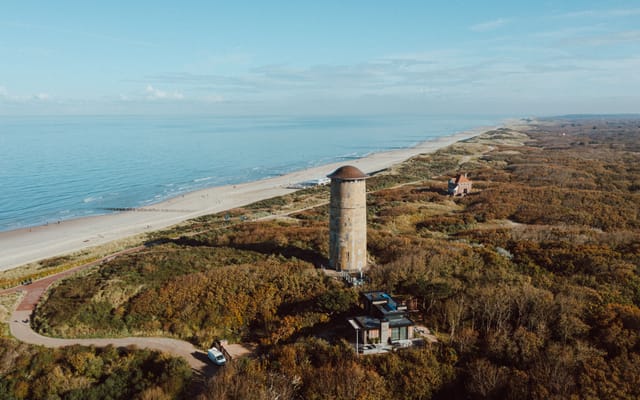
Zeeland, from Middelburg to the Delta dykes
Zeeland is the province of islands and dykes, in the south-west of the Netherlands. This five-day loop from Middelburg follows the coast, crosses the dams of the Delta Works and passes under the Scheldt to Sluis.

Wide open spaces
Eastern Canada, from Toronto to Quebec City
From Niagara Falls to the walls of Quebec City, the best way to see Eastern Canada is to follow the water. Eleven days on the road, through the Thousand Islands, the Rideau Canal, Ottawa, Montreal and the lakes of the Mauricie.
Wide open spaces
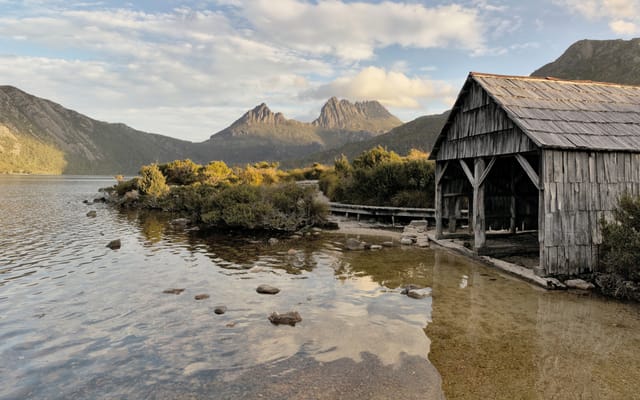
Tasmania on a loop, from Hobart to Cradle Mountain
Beaches lined with granite, rainforests and the ruins of a penal colony, on an island south of mainland Australia. This trip goes all the way round it in twelve days from Hobart, from Freycinet to Cradle Mountain.
A starting point, a few wishes — ViaLooma builds the trip day by day, map, stops and roadbook included.