Saxon Switzerland, from Dresden to the rocks of the Elbe
Half an hour from Dresden, the Elbe flows between sandstone towers, beech forests and fortresses on the heights. This trip takes four days to go round the region, from the Bastei to the Schrammsteine and on to Königstein.
A valley among the rocks
Upstream from Dresden, the road follows the Elbe. The banks soon close in and sandstone walls rise above the forests. Pedestrians cross the river by ferry at Rathen, Königstein or Bad Schandau, and old paddle steamers still run on the river.
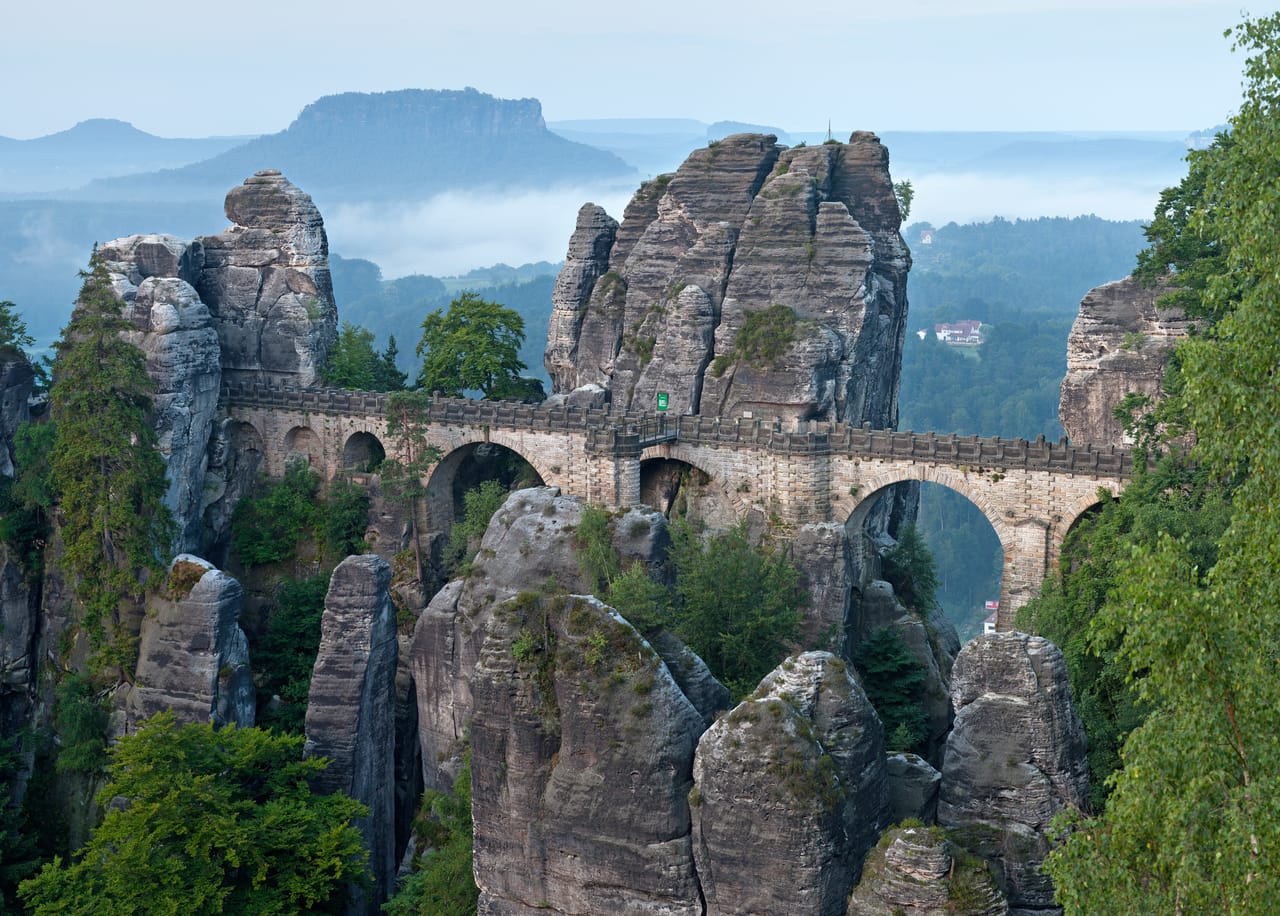
The highlight is the Bastei, a viewpoint almost 200 metres above the Elbe. A stone bridge from 1851 links its sandstone pinnacles. It is best to be there early, when the mist fills the valley. From there, steps lead down to the village of Rathen and, when the path is open, to the Amselsee, a small lake. In Rathen, an open-air theatre is set among the rocks.
Further east, the Kirnitzsch valley runs deep under the beeches. A small tram, in service since 1898, climbs it as far as the Lichtenhain waterfall. Since 1830, the water has been held back there, then released in front of visitors. Above Bad Schandau, you walk the Schrammsteine ridge by way of iron ladders.
Dresden and the Saxon court
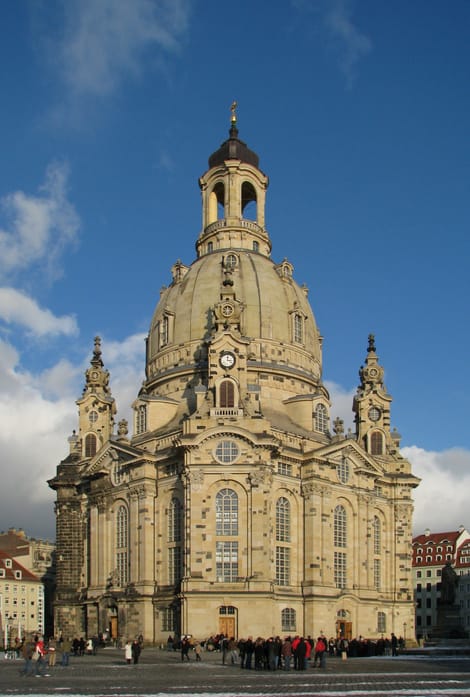
In the 18th century, Augustus the Strong, Elector of Saxony and King of Poland, made Dresden a baroque capital, nicknamed the Florence on the Elbe. The city’s great church, the Frauenkirche, collapsed on 15 February 1945, after the Allied bombing. Its ruins were left as they were for almost fifty years. Rebuilt with some of the original stones, darker than the new ones, it was consecrated again in 2005. The cross on the dome was made by a London goldsmith whose father had bombed Dresden.
Upstream, the palace of Pillnitz, the court’s summer residence, has curved Chinese-style roofs and a flight of steps going down to the Elbe. From 1747, the Venetian painter Bernardo Bellotto, Canaletto’s nephew, painted Dresden, Königstein and Pirna for the court.
The court also had its prisons. Countess Cosel, a favourite of Augustus the Strong who fell from grace, lived locked up in Stolpen castle from 1716 until her death in 1765.
These rocks reminded the two painters of Switzerland.
Sandstone and climbing
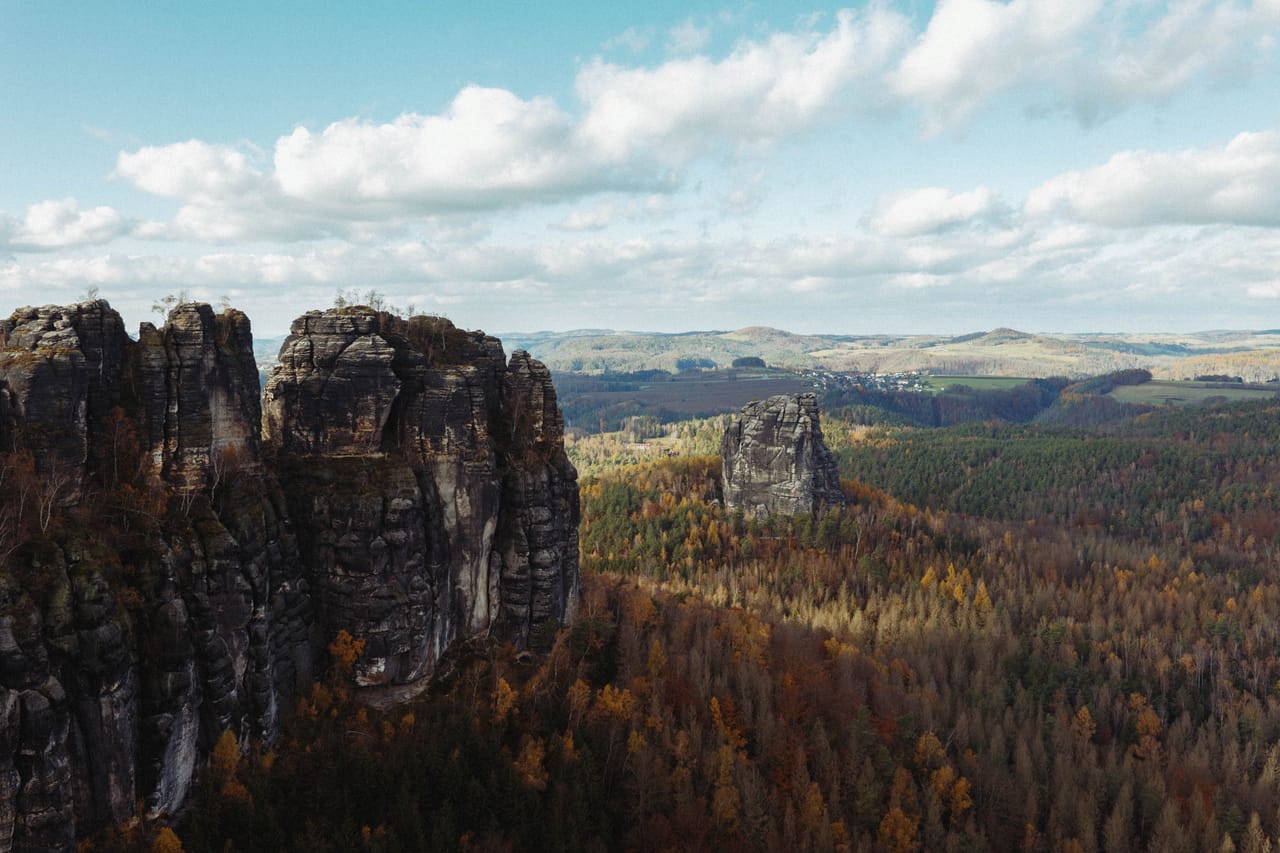
This sandstone formed at the bottom of a sea, in the Cretaceous. The Elbe and erosion cut it into plateaus, into buttes like the Lilienstein and into more than 1,100 pinnacles. The Saxon national park dates from 1990. The name Saxon Switzerland comes from two Swiss painters who came to the Dresden academy in 1766, Adrian Zingg and Anton Graff. These rocks reminded the two painters of Switzerland. The Malerweg, the Painters’ Way, now links the viewpoints the Romantics painted.
The region is also a cradle of climbing. In 1864, gymnasts from Bad Schandau reached the top of the Falkenstein, opposite the Schrammsteine. The Saxon rules, written down in 1913, still apply: no artificial aids, no chalk. From the paths, you see roped climbers almost everywhere.
Pravčická brána
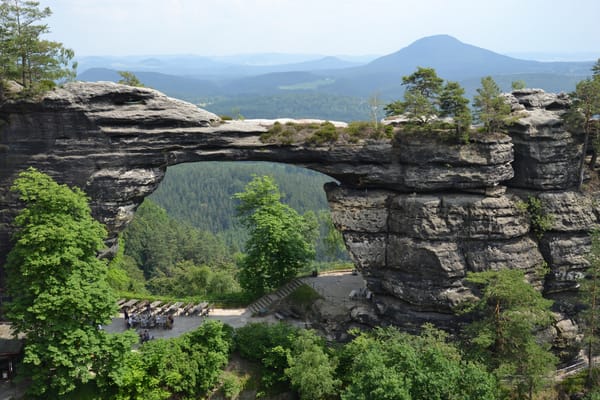
The largest natural sandstone arch in Europe, with a span of 26.5 metres. You leave the car in Hřensko, on the Czech side, then walk up; there is an entrance fee. Near the village, the boats through the Kamenice gorges are running again, after the 2022 fire.
Practical notes
- When to go
- May–June and September–October. In autumn, the beeches change colour. In summer, the Bastei is very busy.
- Getting there
- Dresden is about two hours’ drive from Berlin and from Prague.
- Access
- Everything is tarmac. The Kirnitzsch road is narrow. At the Bastei, the car park at the top fills up early.
- Sleeping in a van
- Overnight stays are banned in the national park outside authorised places. Campsites along the Elbe and the Kirnitzsch, motorhome aires around Sebnitz.
- Worth knowing
- No low-emission zone in Dresden. After the storm of 31 July 2026, paths between the Bastei, Rathen and Hohnstein are still closed: check before you set off.
- Allow
- Four days for the loop, one more to hike or cross into Bohemian Switzerland.
What not to miss
- 1Königstein FortressNever taken, 240 metres above the Elbe; General Giraud escaped from it down the cliff in 1942.
- 2The Pillnitz camelliaPlanted in 1801, it spends the winter under a glasshouse that moves on rails.
- 3The Stolpen wellDug by hand from 1608: it took 22 years to reach water.
- 4The KuhstallA large rock arch, half an hour’s walk from the Lichtenhain waterfall.
- 5Weesenstein CastlePartly built from the top down: the stables are on the fourth level, below the old cellars.
- 6PirnaA market square that still looks like Bellotto’s painting of it.
Saxon Switzerland in pictures
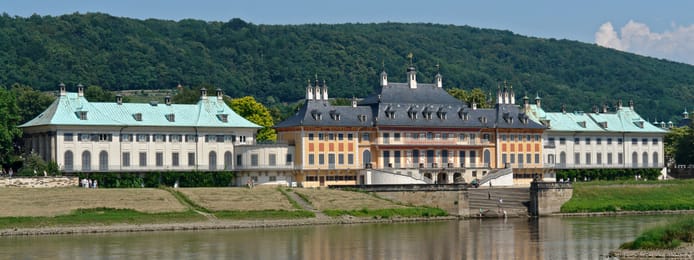
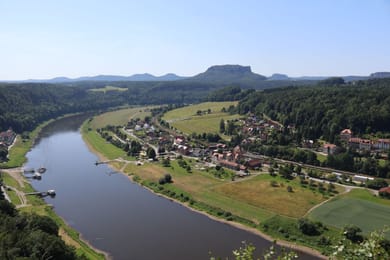
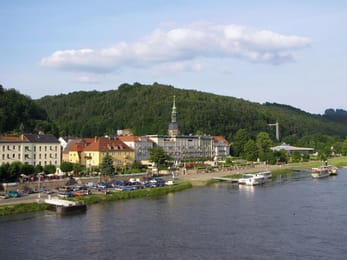
Pillnitz Palace and its steps leading down to the Elbe.
The Saxon table
Saxony loves its cakes. Dresden’s Eierschecke layers a pastry base, quark and an egg custard. Dresden Stollen, a Christmas bread with dried fruit, has protected geographical indication status. In restaurants, you will find Sauerbraten, a marinated beef roast.
Between Pirna and Diesbar-Seußlitz, the Saxon Wine Route follows the Elbe for about 60 kilometres. It is the most north-easterly wine region in Germany. The wine is mostly white. Goldriesling, a grape that originated in Alsace, is hardly grown anywhere except here.
Loop from Dresden


 +11stops
- 1Zwinger · Frauenkirche · Brühlsche Terrasse · Schloss Pillnitz
- 2Burg Stolpen · Bastei · Burg Hohnstein · Bad Schandau
- 3Schrammsteine · Lichtenhainer Wasserfall · Hinterhermsdorf
Free, no account needed — start from its places and make it yours.
Also worth reading
Wide open spaces
The Pacific Northwest, from the Olympic Peninsula to the Cascade volcanoes
Rainforests, a coast of headlands and lighthouses, redwoods and two active volcanoes. A two-week loop from Seattle, by way of the Olympic Peninsula, the Oregon coast and Mount Rainier.
Wide open spaces
Vancouver Island, from Victoria to the beaches of Tofino
An island of giant forests, beaches pounded by the Pacific and small harbours where boats leave to see orcas. Nine days on a loop from Victoria, from Port Renfrew to Tofino and up to Telegraph Cove.
Wide open spaces
Yellowstone, Grand Teton and Glacier: the great Rockies road trip
Three national parks on one road, from the Tetons to the glaciers of Montana, by way of the geysers of Yellowstone. Twelve days from Jackson to Kalispell, with bison by the roadside and two great mountain roads.
A starting point, a few wishes — ViaLooma builds the trip day by day, map, stops and roadbook included.