The Wachau, the Danube between Krems and Melk
Between Krems and Melk, the Danube runs through a valley of terraced vineyards, riverside villages and baroque abbeys. A three-day loop from Vienna, one bank on the way out, the other on the way back.
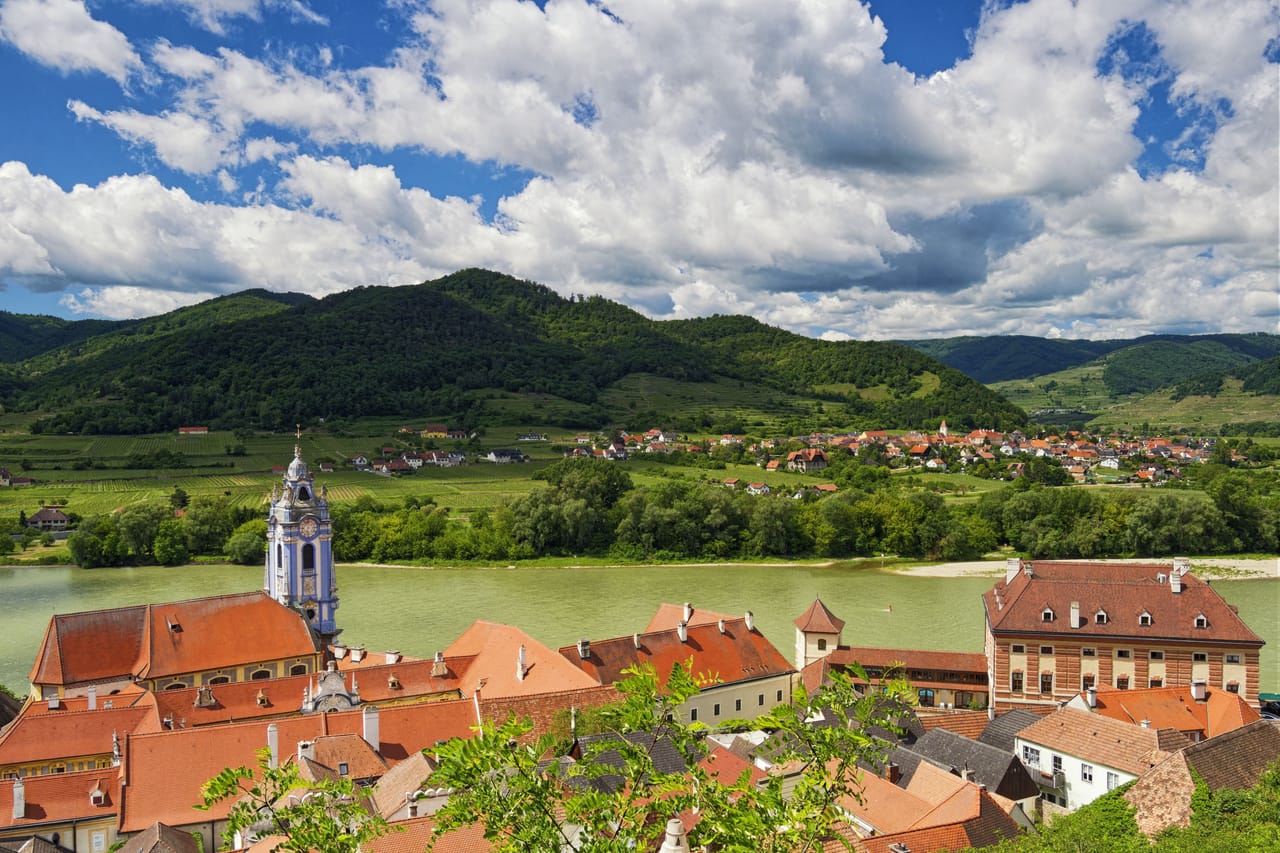
The Danube valley, from one bank to the other
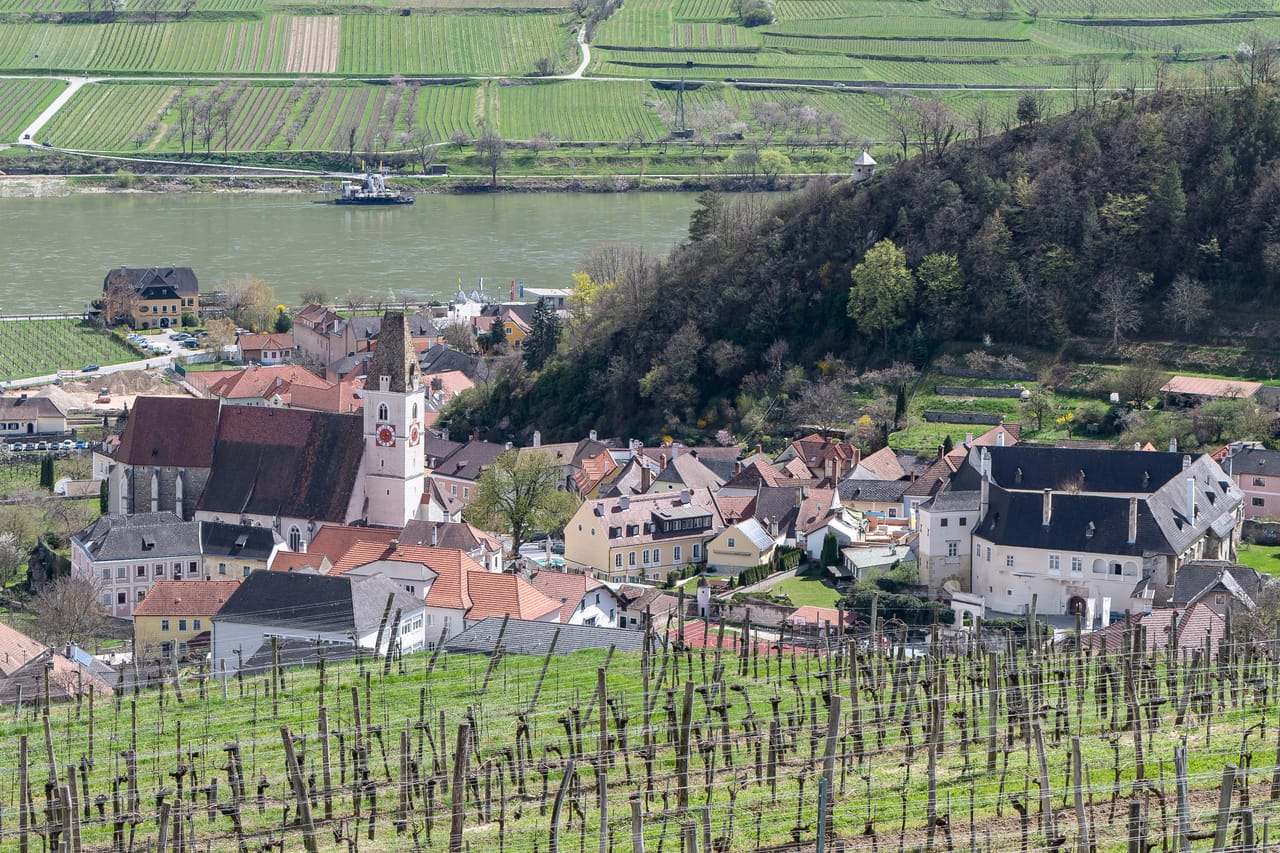
The Wachau is the stretch of the Danube valley between Melk and Krems, an hour from Vienna. For about 35 kilometres, the river flows between slopes of terraced vineyards, held up by dry-stone walls. On the north bank, the B3 runs right beside the water and through the wine villages: Dürnstein, Weißenkirchen, Spitz. On the south bank, the quieter B33 runs past apricot orchards.
Between Melk and Mautern, there is no bridge. You cross on cable ferries, pushed along by the current; the one at Spitz takes cars all year round, the one at Weißenkirchen from April to October. From late March to early November, scheduled boats also link Melk and Krems. At each end of the valley, a baroque abbey looks down on the river: Melk, yellow on its rock, and Göttweig, on its hill facing Krems.
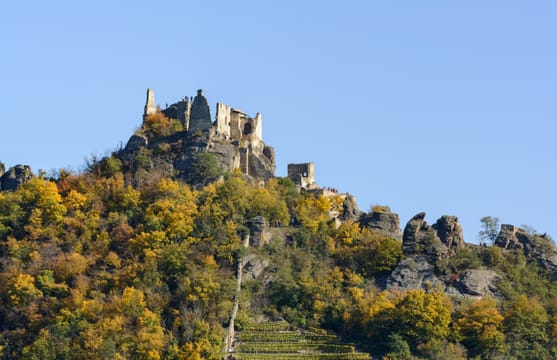
Dürnstein and Richard the Lionheart
In December 1192, on his way home from the Third Crusade, Richard the Lionheart crossed Austria in disguise. He was arrested near Vienna on the orders of Duke Leopold V. At Acre, Richard had had the duke’s banner thrown down from the walls. The King of England was locked up at Dürnstein, in the Kuenringer fortress above the Danube. At the end of March 1193, Leopold handed him over to the Emperor Henry VI. Richard was not freed until February 1194, for a ransom of 150,000 marks of silver.
According to tradition, Leopold’s share of the ransom paid for the walls of Vienna and the founding of Wiener Neustadt. A later legend tells how the minstrel Blondel found his king by going from castle to castle, singing.
In 1645, during the Thirty Years’ War, the Swedes took the fortress and blew up its entrance. After that it fell into ruin. A steep path climbs up from the village in about twenty minutes. From the top, you look down on the rooftops, the abbey’s blue-and-white tower and the river.
What is protected is not a monument, but a whole landscape.
A landscape on the UNESCO list
The Wachau has been a UNESCO World Heritage Site since 2000, as a cultural landscape. What is protected is not a monument, but a whole landscape. It takes in the terraces, the orchards, the villages, the abbeys and the old towns of Krems and Stein. In the 1970s, plans for a dam near Rossatz met with opposition from local people; they were dropped in 1983. Between Melk and Krems, there is still no dam on the Danube.
The valley is narrow because here the river cuts through the edge of the Bohemian Massif, an old bedrock of gneiss and granite. During the ice ages, the wind laid down loess on the slopes. It was in this loess, at Willendorf, that a workman found the Venus of Willendorf in 1908: an 11-centimetre figurine of a woman, around 29,500 years old. In the village, a monument marks the spot; the original is in Vienna’s Naturhistorisches Museum, where the trip ends.
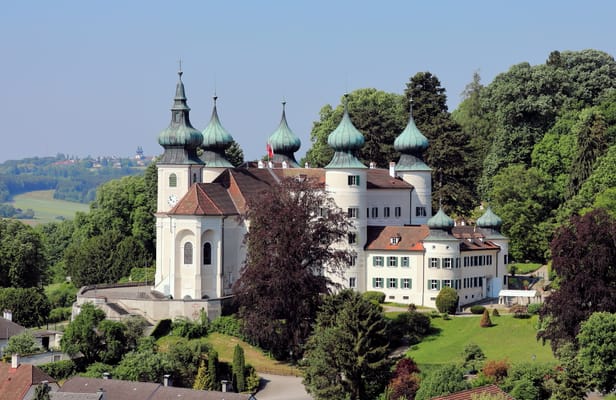
Artstetten Castle
Archduke Franz Ferdinand and his wife Sophie, assassinated in Sarajevo on 28 June 1914, are buried here. The court saw their marriage as unequal: Sophie could not be laid to rest in the Capuchin Crypt in Vienna, so the Archduke chose to be buried with her. The castle houses a museum, open from April to 1 November.
Practical notes
- When to go
- Late March–April for the apricot blossom, September–November for the grape harvest. In winter, several sites close.
- Getting there
- Krems and Melk are about an hour from Vienna by motorway.
- Access
- Everything is tarmac. The B3 is narrow through the villages and busy with cyclists; when the river floods, sections of it close. A motorway vignette is compulsory; above 3.5 tonnes, the GO-Box.
- Sleeping in a van
- Campsites at Krems, Rossatz, Spitz and Emmersdorf. Elsewhere, sleeping in your van is often banned: follow the signs.
- Worth knowing
- From November to February, the Spitz ferry runs only on weekdays. The Naturhistorisches Museum is closed on Tuesdays.
- Allow
- Three days from Vienna, two from Krems.
What not to miss
- 1The library at MelkAbout 100,000 volumes under a ceiling painted by Paul Troger.
- 2The Imperial Staircase at GöttweigThe largest baroque staircase in Austria, beneath a fresco by Troger.
- 3The ruins of AggsteinA castle 300 metres above the river, and the legend of its robber baron.
- 4The ferry from Spitz to ArnsdorfA few minutes on the water, car and all, on a ferry pushed along by the current.
- 5Krems and SteinA town on record since 995, and the art museums of Stein, its western district.
- 6The Venus of WillendorfThe real figurine, at Vienna’s Naturhistorisches Museum.
The Wachau in pictures
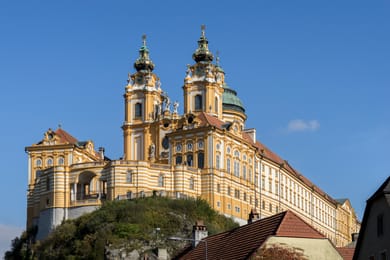
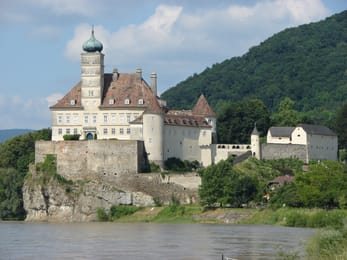
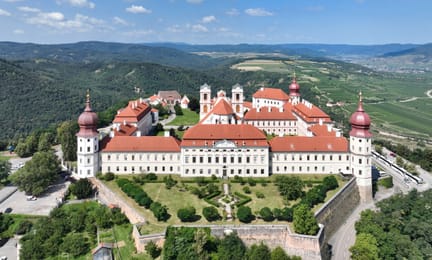
The west front of Melk Abbey, above its rock.
The Wachau’s table
The Wachau is apricot country, and its apricot has a protected designation of origin. You buy it fresh at the roadside in summer, or as jam and as a brandy, Marillenbrand. In restaurants, you eat it as Marillenknödel: a whole apricot wrapped in dough and rolled in breadcrumbs.
The vines mostly give Grüner Veltliner and Riesling, dry whites. They are graded in three categories unique to the valley: Steinfeder, Federspiel and Smaragd, the richest. Smaragd takes its name from a green lizard that suns itself on the stone walls. At a Heuriger, the winemaker serves a cold platter with their own wine; a pine branch above the door shows that it is open.
Loop from Vienna


 +8stops
- 1Krems · Minoritenkirche (Stein an der Donau) · Dürnstein
- 2Weißenkirchen in der Wachau · Spitz · Venus von Willendorf · Benediktinerstift Melk
- 3Schloss Schönbühel · Burgruine Aggstein · Stift Göttweig · Naturhistorisches Museum
Free, no account needed — start from its places and make it yours.
Also worth reading
Wide open spaces
The Salzkammergut, from Salzburg to Hallstatt
Green and turquoise lakes at the foot of the mountains, villages on the water’s edge and salt mines worked since prehistory. A five-day loop from Salzburg, through Bad Ischl, Hallstatt, the Dachstein and the Traunsee.
Experiences
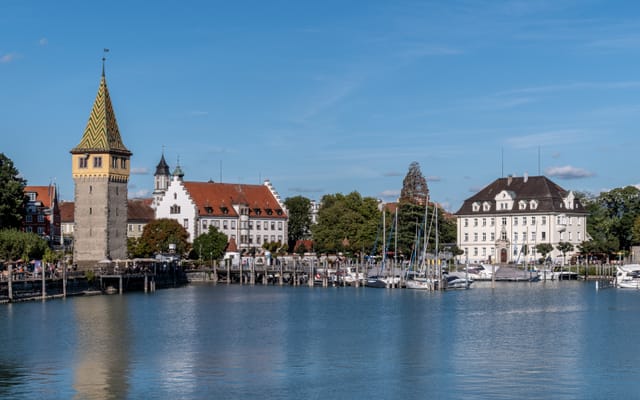
Lake Constance, a tour of three countries
Lake Constance is shared between Germany, Austria and Switzerland. This trip goes all the way round it in five days from Konstanz, from the islands of Reichenau and Mainau to the Rhine Falls.
Mountains and passes
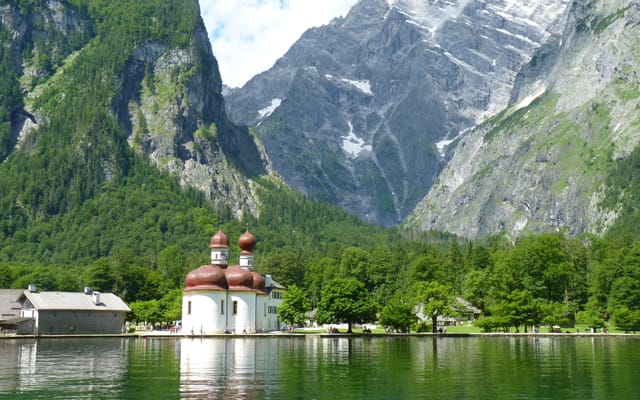
The Bavarian Alps, from the Zugspitze to the Königssee
The castles of Ludwig II, about ten lakes and the highest peak in Germany. A nine-day loop from Munich, from Neuschwanstein to the Königssee, with two short stretches through Tyrol.
A starting point, a few wishes — ViaLooma builds the trip day by day, map, stops and roadbook included.