The Curonian Spit, from Klaipėda to the dunes of Nida
A 98-kilometre strip of sand between the Baltic and a lagoon, covered in pine forest and great dunes. This three-day trip starts in Palanga and Klaipėda, takes the ferry and runs down the spit to Nida.
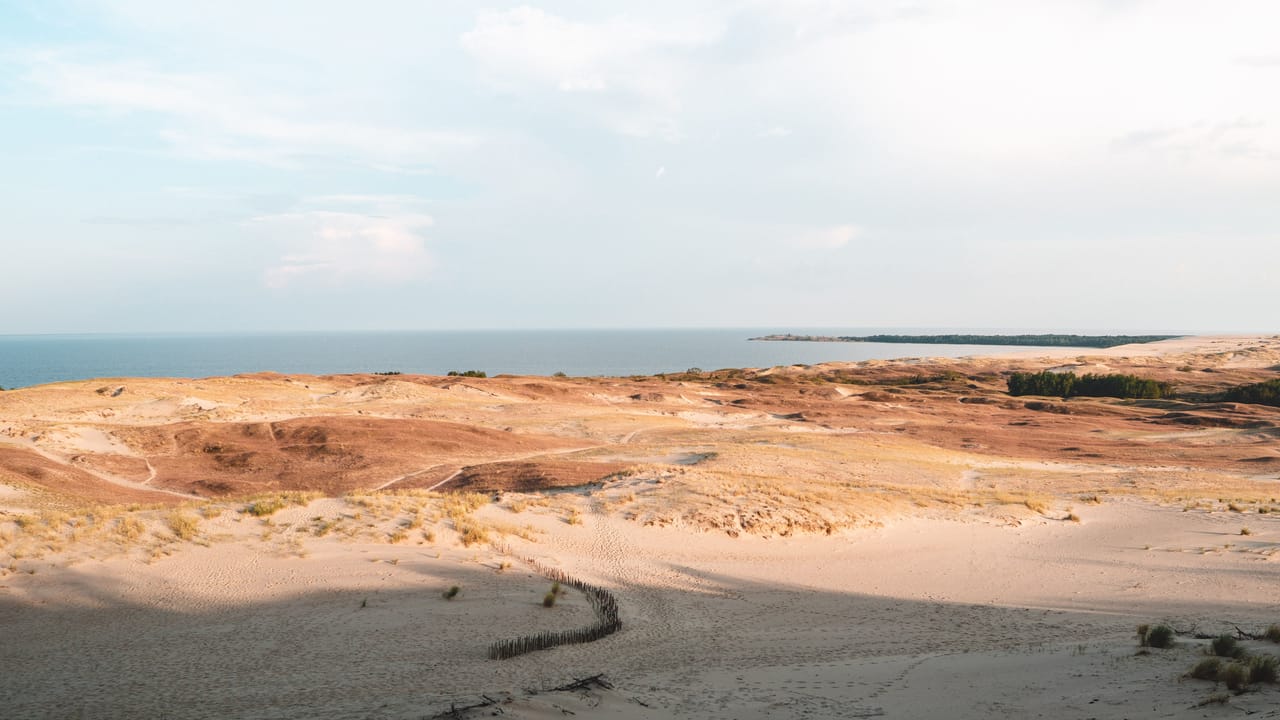
A road between the Baltic and the lagoon
The Curonian Spit is a 98-kilometre strip of sand between the Baltic Sea and the Curonian Lagoon. Its northern part, 52 kilometres long, is Lithuanian. A single road runs along it, through pine forest. To the west, behind the dunes, lie the beaches. To the east, the lagoon is calm.
The trip starts on the mainland, in Palanga, the country’s big seaside resort, then passes through Klaipėda, the former Memel. From there, a car ferry crosses the channel in about ten minutes to Smiltynė, at the tip of the spit. The Maritime Museum sits there, in an old fort.
The road then heads south to Juodkrantė, the great bare dunes of Nagliai, then Pervalka, whose lighthouse stands on an islet. It ends at Nida, the last village before the Russian border, which is closed. In the evening, you climb the Parnidis Dune to watch the sun set over the sea. You come back on the same road and the same ferry.
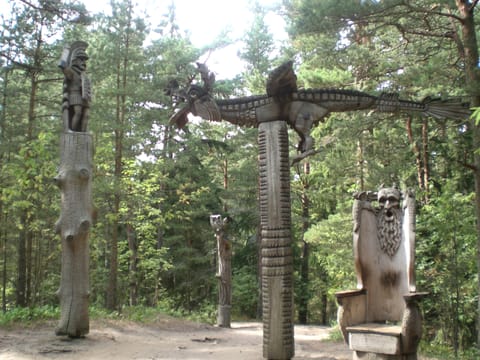
Legends and fishing villages
According to a Lithuanian legend, the spit was made by a young giantess, Neringa. She is said to have carried the sand in her apron to shelter fishermen from storms. Today her name belongs to the municipality that groups the villages of the spit, from Juodkrantė to Nida. In Juodkrantė, the Hill of Witches brings these stories to life: about eighty wooden sculptures of devils, witches and dragons, set in the pine forest since 1979. Before the sculptures, Midsummer was already celebrated there.
These villages lived from fishing in the lagoon, on flat-bottomed boats, the kurėnai. In 1844, the Prussian authorities restricted each boat to its own village’s waters. A weathervane at the top of the mast, the vėtrungė, then showed where it came from. You can see them today along the quay in Nida.
For a long time the spit was German. The Memel region became part of Lithuania in 1923. In 1930, Thomas Mann had a thatched house built in Nida. He spent three summers there and worked on “Joseph and His Brothers”. Germany took the region back in 1939. After 1945, the spit was divided between Soviet Russia and Soviet Lithuania.
You walk above villages that have vanished.
The dunes that buried villages
In the 17th and 18th centuries, the forests of the spit were cut down. Without trees, nothing held the sand: pushed by the wind, the dunes buried whole villages. At Nagliai, four villages disappeared this way between 1675 and 1854. The dunes were fixed, mostly from 1825 onwards, with long-rooted grasses, then with pines. It is this man-made landscape that has been on the UNESCO World Heritage List since 2000, together with the Russian part.
Between Juodkrantė and Pervalka, the Nagliai reserve protects the grey dunes, also called the Dead Dunes. The only way in is a trail of just over a kilometre, partly on boardwalks. You walk above villages that have vanished. Near Nida, the Parnidis Dune rises to 52 metres, compared with over 60 in the past. It is slowly getting lower and moving towards the lagoon.
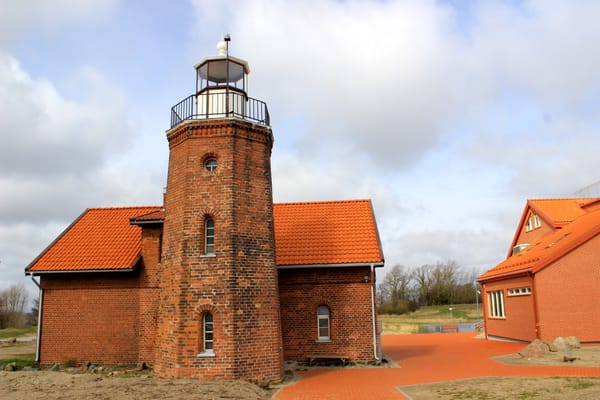
Cape Ventė
On the mainland shore of the lagoon, this cape is a major crossing point for migrating birds. Its bird-ringing station, founded in 1929 at the foot of a brick lighthouse, rings tens of thousands of birds a year.
Practical notes
- When to go
- June to August for the sea, May and September for peace and quiet. Out of season, many restaurants close.
- Getting there
- Klaipėda is about three hours from Vilnius on the A1 motorway. Airport at Palanga.
- Access
- Car ferry from the New Ferry Terminal, south of Klaipėda; the one in the centre only takes foot passengers and bikes. Then a single tarmac road all the way to Nida.
- Sleeping in a van
- Wild camping is banned throughout the national park: you sleep at a campsite, in Nida in particular.
- Worth knowing
- Entry fee at the Alksnynė checkpoint, much higher from 20 June to 20 August. Walking on the dunes off the trails is forbidden.
- Allow
- Three days, plus half a day for Cape Ventė.
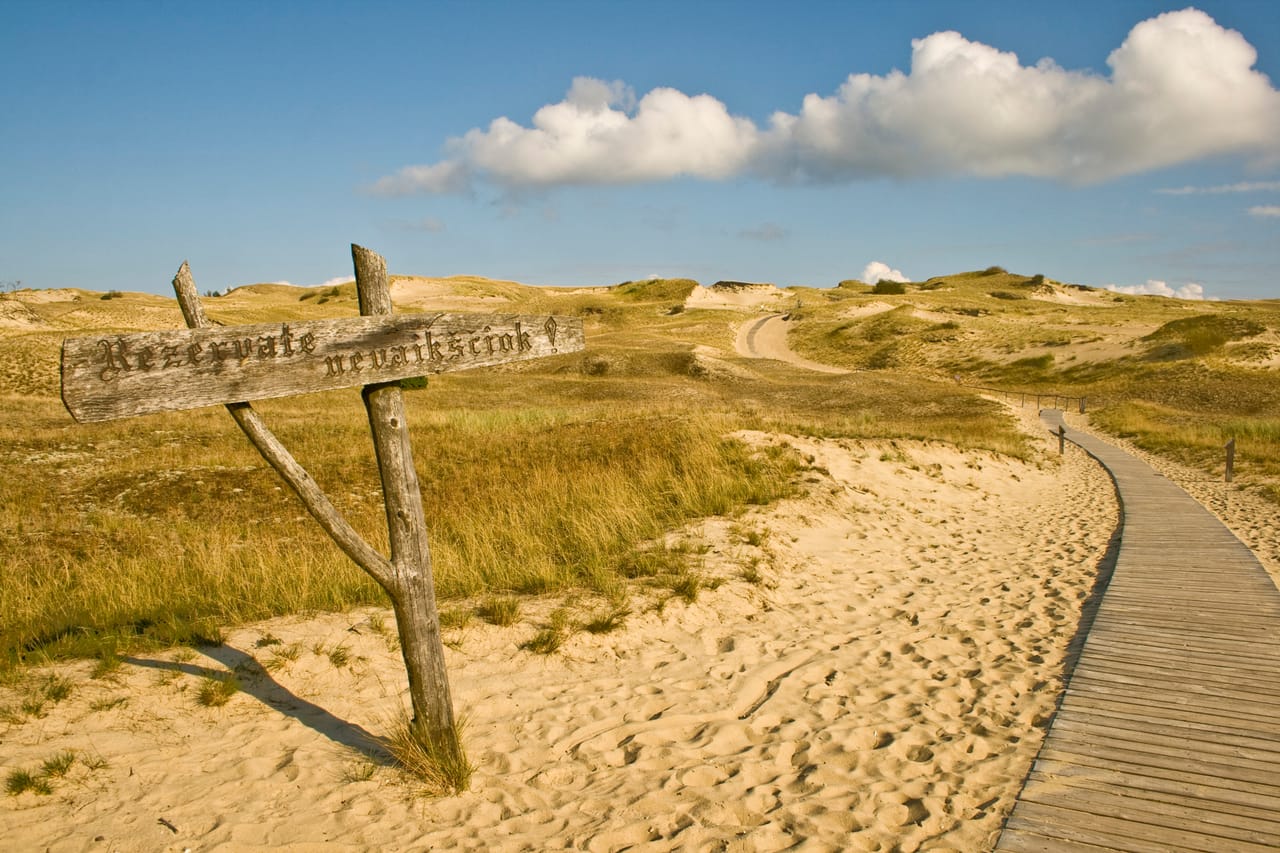
What not to miss
- 1The Parnidis DuneA giant sundial at the top, and dunes stretching away towards the Russian border.
- 2Thomas Mann’s houseHe compared the view from his hill to an Italian landscape.
- 3The cormorants of JuodkrantėA platform beside a colony of cormorants and herons, in a forest killed by their droppings.
- 4The Palanga Amber MuseumThe palace of the Tyszkiewicz counts, built in 1897, in the middle of a large park.
- 5Theatre Square in KlaipėdaIts fountain, with the statue of Ännchen von Tharau, honours the poet Simon Dach, born in Memel in 1605.
- 6The Dutchman’s CapA 24-metre cliff above the beach, between Klaipėda and Palanga.
The Curonian Spit in pictures
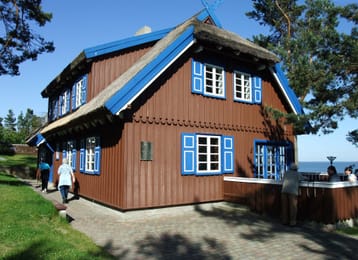
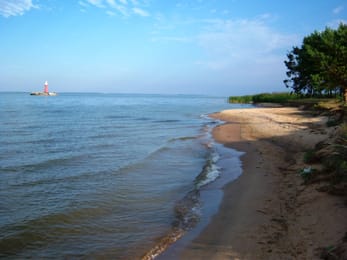
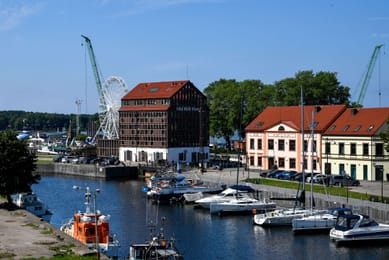
Thomas Mann’s summer house in Nida, with its thatched roof and blue shutters.
The Curonian Spit table
On the spit, the first thing you eat is smoked fish from the lagoon: bream, pike-perch or eel, straight from the smokehouses of Juodkrantė, Pervalka and Nida. People often buy it directly at the smokehouse.
You also eat the Lithuanian classics: cepelinai, large potato dumplings stuffed with meat, and in summer šaltibarščiai, a bright pink cold beetroot soup made with kefir. To drink, a Švyturys beer, brewed in Klaipėda since 1784.
Klaipėda → Nida


 +8stops
- 1Palangos tiltas · Palangos gintaro muziejus · Olando kepurė · Klaipėdos pilis · Taravos Anikė
- 2Lietuvos jūrų muziejus · Raganų kalnas · Naglių rezervatas
- 3Žirgų ragas · Tomo Mano namelis · Parnidžio kopa
Free, no account needed — start from its places and make it yours.
Also worth reading
Wide open spaces
The Pacific Northwest, from the Olympic Peninsula to the Cascade volcanoes
Rainforests, a coast of headlands and lighthouses, redwoods and two active volcanoes. A two-week loop from Seattle, by way of the Olympic Peninsula, the Oregon coast and Mount Rainier.
Wide open spaces
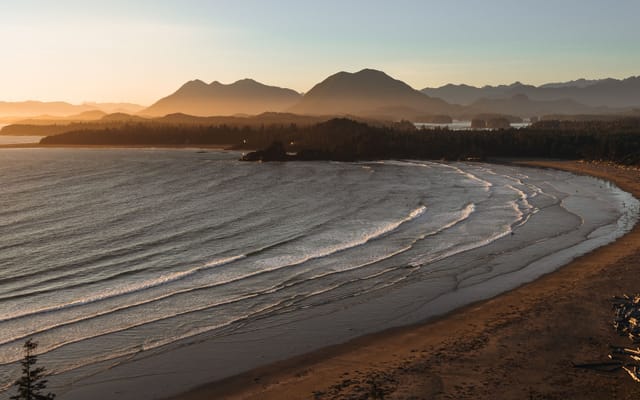
Vancouver Island, from Victoria to the beaches of Tofino
An island of giant forests, beaches pounded by the Pacific and small harbours where boats leave to see orcas. Nine days on a loop from Victoria, from Port Renfrew to Tofino and up to Telegraph Cove.
Wide open spaces
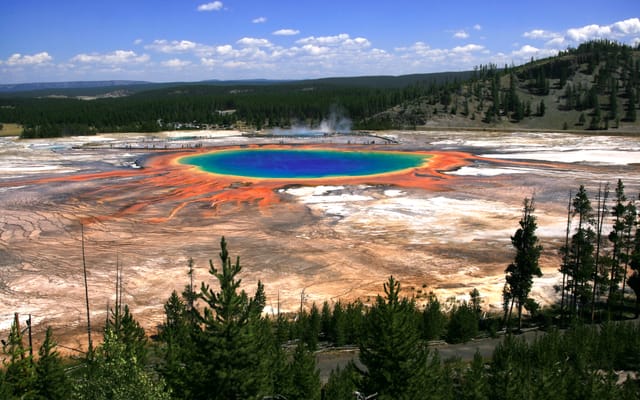
Yellowstone, Grand Teton and Glacier: the great Rockies road trip
Three national parks on one road, from the Tetons to the glaciers of Montana, by way of the geysers of Yellowstone. Twelve days from Jackson to Kalispell, with bison by the roadside and two great mountain roads.
A starting point, a few wishes — ViaLooma builds the trip day by day, map, stops and roadbook included.