Mainland Greece, from Athens to Meteora
A temple above the sea, the oracle of Delphi on the slopes of Parnassus and monasteries perched on rocks. A week-long loop from Athens, by way of Delphi, Meteora and Thermopylae.
From Athens to Meteora, by way of Delphi
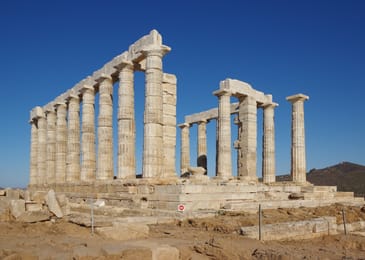
The trip begins by the sea. South of Athens, the road follows the Saronic Gulf and Lake Vouliagmeni, a brackish lake at the foot of a rock face, where you can swim. It leads to Cape Sounion, where the Temple of Poseidon, built in the mid-5th century BC, stands nearly 60 metres above the sea. People come here for the sunset.
The road then crosses the plain of the former Lake Copais, drained for good in 1931, and climbs through the olive trees towards Parnassus. Arachova is built on a ridge, at 970 metres, ten kilometres from Delphi. Below Delphi, the olive groves of Amphissa run down to the Gulf of Corinth, near the port of Galaxidi.
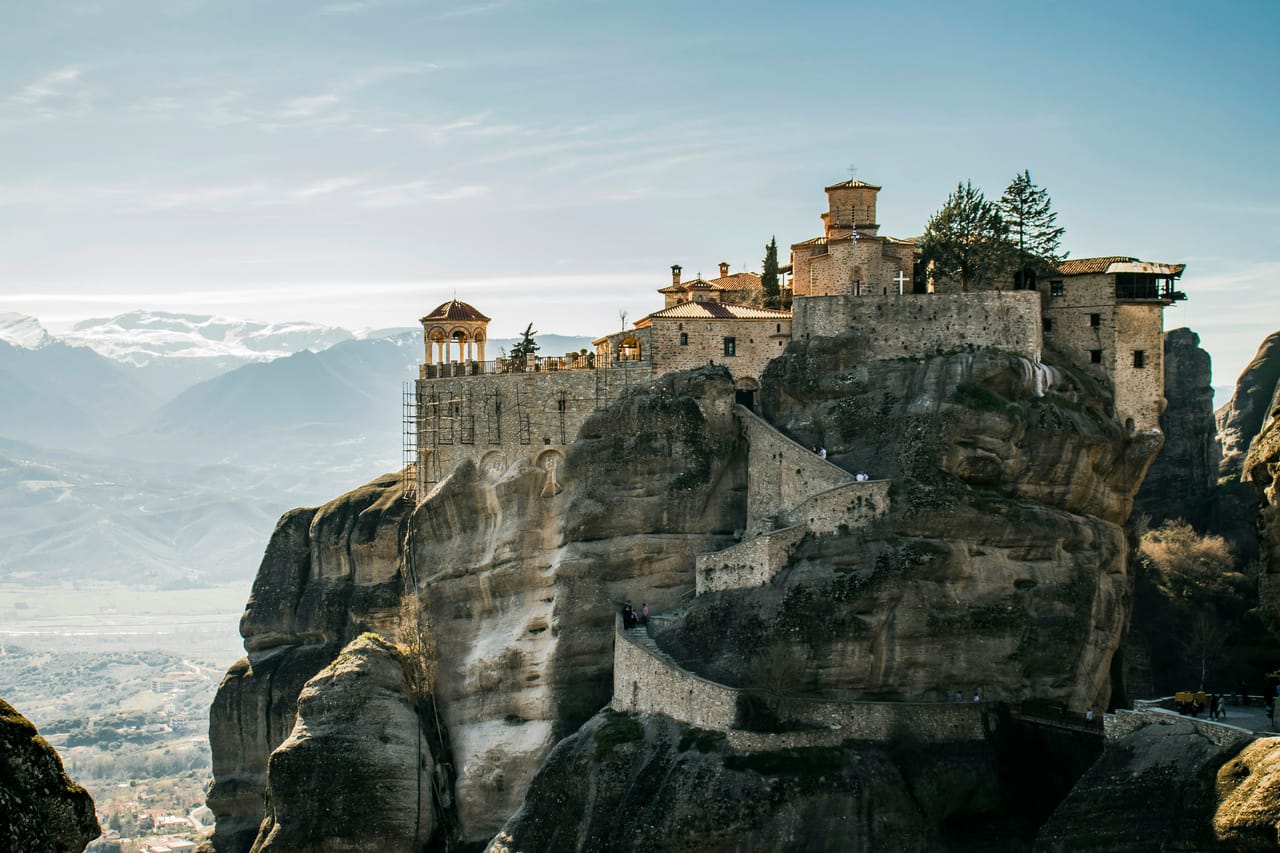
Further north, the motorway crosses the plain of Thessaly. Meteora appears above Kalambaka: grey rocks, some of them topped by a monastery. On the way back, you stop at Thermopylae and Thebes.
Delphi, on the slopes of Parnassus
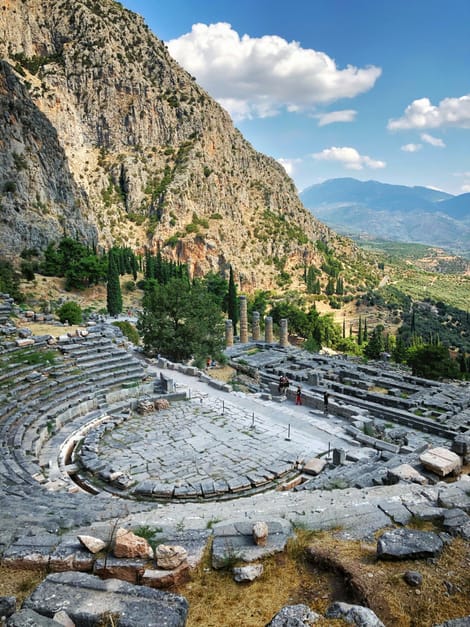
Delphi is built in terraces on the slopes of Parnassus, above the Pleistos valley. According to legend, Zeus released two eagles from the two ends of the world. They met here, and a stone, the omphalos, marked this centre of the world. People came from all over Greece to consult the Pythia, the priestess of Apollo. Before the main sanctuary, the road passes close to the Castalian Spring and the sanctuary of Athena Pronaia, with its tholos, a round building from the 4th century BC.
For centuries, the village of Kastri covered the site. It had to be moved before the French School at Athens could begin the ‘great excavation’ in 1892. The site has been on the UNESCO World Heritage List since 1987.
You walk up the Sacred Way between the treasuries of the city-states, to the Temple of Apollo, the theatre and the stadium. In the museum, the Charioteer of Delphi, a bronze chariot driver, dates from around 470 BC. It is best to arrive at opening time, before the heat and the groups.
People came from all over Greece to consult the Pythia, the priestess of Apollo.
Meteora, monasteries on the rocks
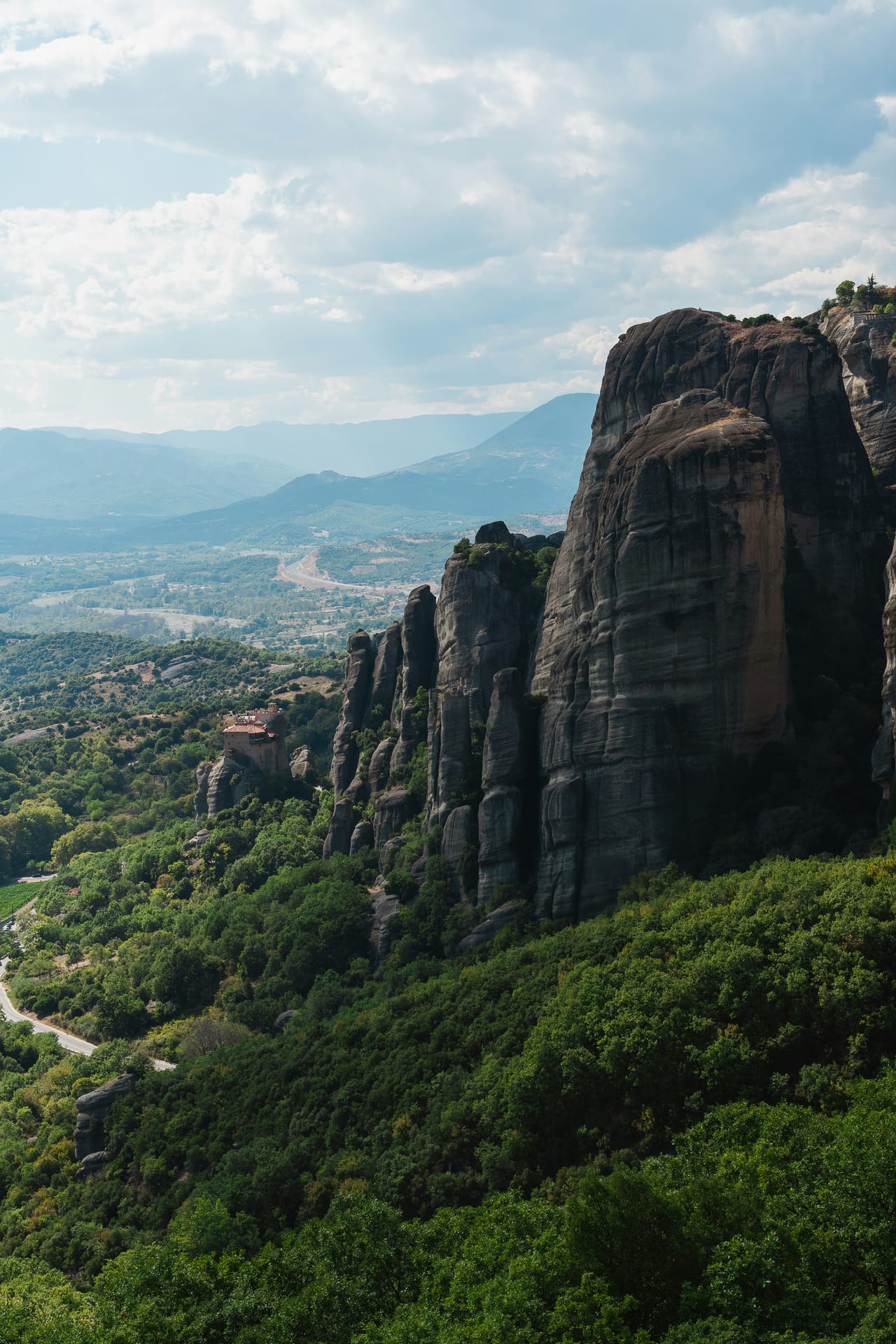
The Meteora rocks are pillars of sandstone and conglomerate (pebbles bound together by sand), carved out by erosion. By the 11th century, hermits were living in their caves. The Great Meteoron was founded in the 14th century by Athanasios, a monk from Mount Athos. At one time there were as many as twenty-four monasteries. People climbed up by ladders, or were hauled up in nets on a rope. The steps date from the 1920s. The site has been on the World Heritage List since 1988.
Six monasteries can still be visited, including two convents of nuns, St Stephen’s and Roussanou. Shoulders and legs must be covered; skirts are lent at the entrance. In the evening, you watch the sun set over Kastraki.
The archaeological site of Eleusis
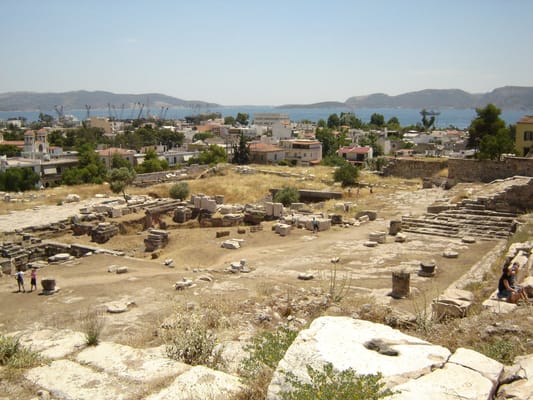
At the end of the Sacred Way from Athens, the sanctuary of Demeter and Kore was home to the Eleusinian Mysteries, a secret cult. You can see the Telesterion, the hall of initiation, and a small museum. On the way, you pass the Daphni monastery, on the UNESCO list together with Hosios Loukas.
Practical notes
- When to go
- April–June and September–October. Summer is hot and crowded. From November, the sites close earlier.
- Getting there
- Athens airport is about thirty kilometres from the city centre. Ferries link Italy with Patras and Igoumenitsa.
- Access
- Toll motorways between Athens, Lamia and Kalambaka. Narrow streets in Arachova, in Kastraki and on the harbour at Galaxidi.
- Sleeping in a van
- Wild camping is forbidden in Greece. Campsites in Kastraki, around Delphi and on the Attica coast. No overnight stays in the monastery car parks.
- Worth knowing
- The Acropolis is visited in time slots, best booked online. An odd-even traffic scheme (the ‘Daktylios’) applies on weekdays in central Athens, usually from October to July. At Meteora, each monastery has its own closing days, more of them from November to March; the Great Meteoron is closed on Tuesdays.
- Allow
- A week for the loop, plus a day or two in Athens. Two or three more days for the Peloponnese: Mycenae, Epidaurus, Nafplio.
What not to miss
- 1The Acropolis and its museumThe Parthenon early in the morning, then the original sculptures in the museum, at the foot of the rock.
- 2Cape SounionThe Temple of Poseidon above the sea; Lord Byron, so they say, carved his name on one of its columns.
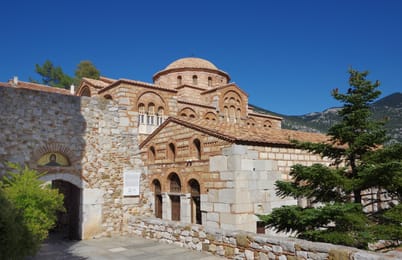
- 3Hosios LoukasA Byzantine monastery founded in the 10th century, on the UNESCO list, with some of the best-preserved mosaics of their time.
- 4GalaxidiA former shipowners’ port with sea captains’ houses, whose fleet was the second largest in Greece after Syros around 1870.
- 5ThermopylaeThe pass where Leonidas and his Spartans held off the Persians in 480 BC; the sea has moved back several kilometres since then.
- 6The National Archaeological MuseumThe gold mask known as the Mask of Agamemnon, the great Artemision Bronze and the Antikythera mechanism.
Mainland Greece in pictures
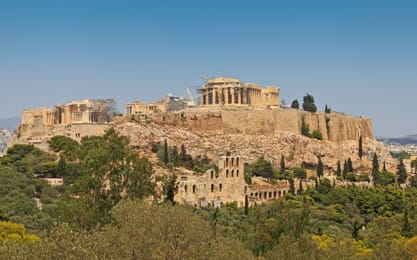
The Acropolis from Philopappos Hill, above the Odeon of Herodes Atticus.
The table of mainland Greece
In Arachova, try formaela, a hard cheese served grilled. Amphissa’s table olives, the konservolia, have their own designation of origin. On the harbour at Galaxidi, the tavernas serve grilled fish.
In Thessaly, order a tsipouro, a spirit made from grape pomace, served with a few meze dishes. In Athens, grab a souvlaki on the go and, in the morning, a koulouri, a sesame bread ring sold in the street.
Loop from Athens


 +20stops
- 1Ακρόπολη · Μουσείο Ακρόπολης · Λίμνη Βουλιαγμένης · Temple of Poseidon
- 2Κάστρο Λειβαδιάς · Μονή Οσίου Λουκά Βοιωτίας
- 3Αράχωβα Βοιωτίας · Δελφοί · Αρχαιολογικό Μουσείο Δελφών · Γαλαξίδι Φωκίδας
Free, no account needed — start from its places and make it yours.
Also worth reading
Coast and islands
Thessaloniki, Mount Olympus and Halkidiki
A great Byzantine city, the tombs of the kings of Macedon, the highest mountain in Greece and three peninsulas on the Aegean Sea. A six-day loop from Thessaloniki, from Pella to Mount Athos.
Coast and islands
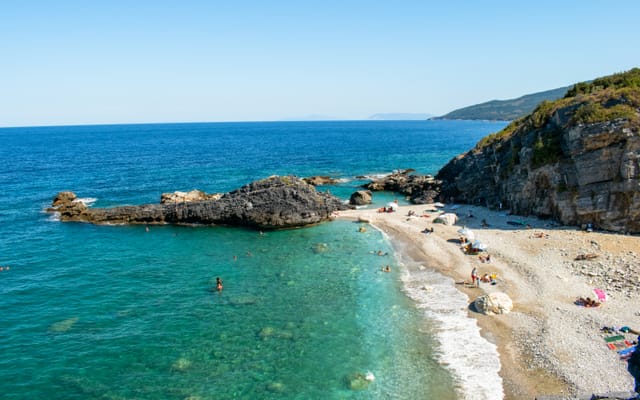
Pelion, between the Gulf of Volos and the Aegean
Pelion is a forested mountain that sits between a calm gulf and the Aegean Sea. This trip takes five days to loop around it from Volos, through its stone villages, its pebble coves and its winding roads.
Wide open spaces
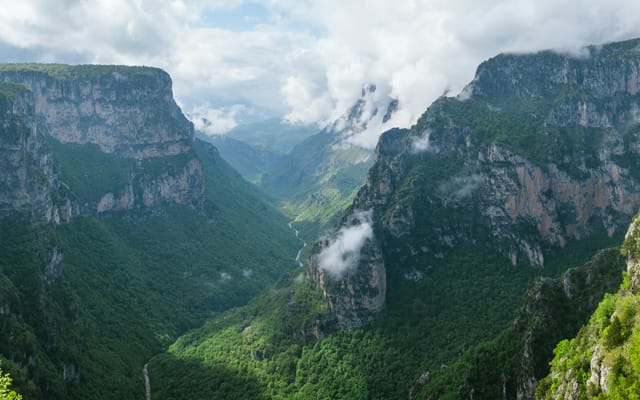
Epirus, from Zagori to the Bay of Parga
Stone villages above the Vikos Gorge, arched bridges, the Pindus, then the Ionian Sea. A six-day loop from Ioannina, in north-west Greece.
A starting point, a few wishes — ViaLooma builds the trip day by day, map, stops and roadbook included.