The Romantic Road, from Würzburg to Neuschwanstein
The Romantic Road crosses southern Germany, from the vineyards of the Main to the foot of the Alps. It passes through walled towns and baroque churches, and ends at the castles of Ludwig II.
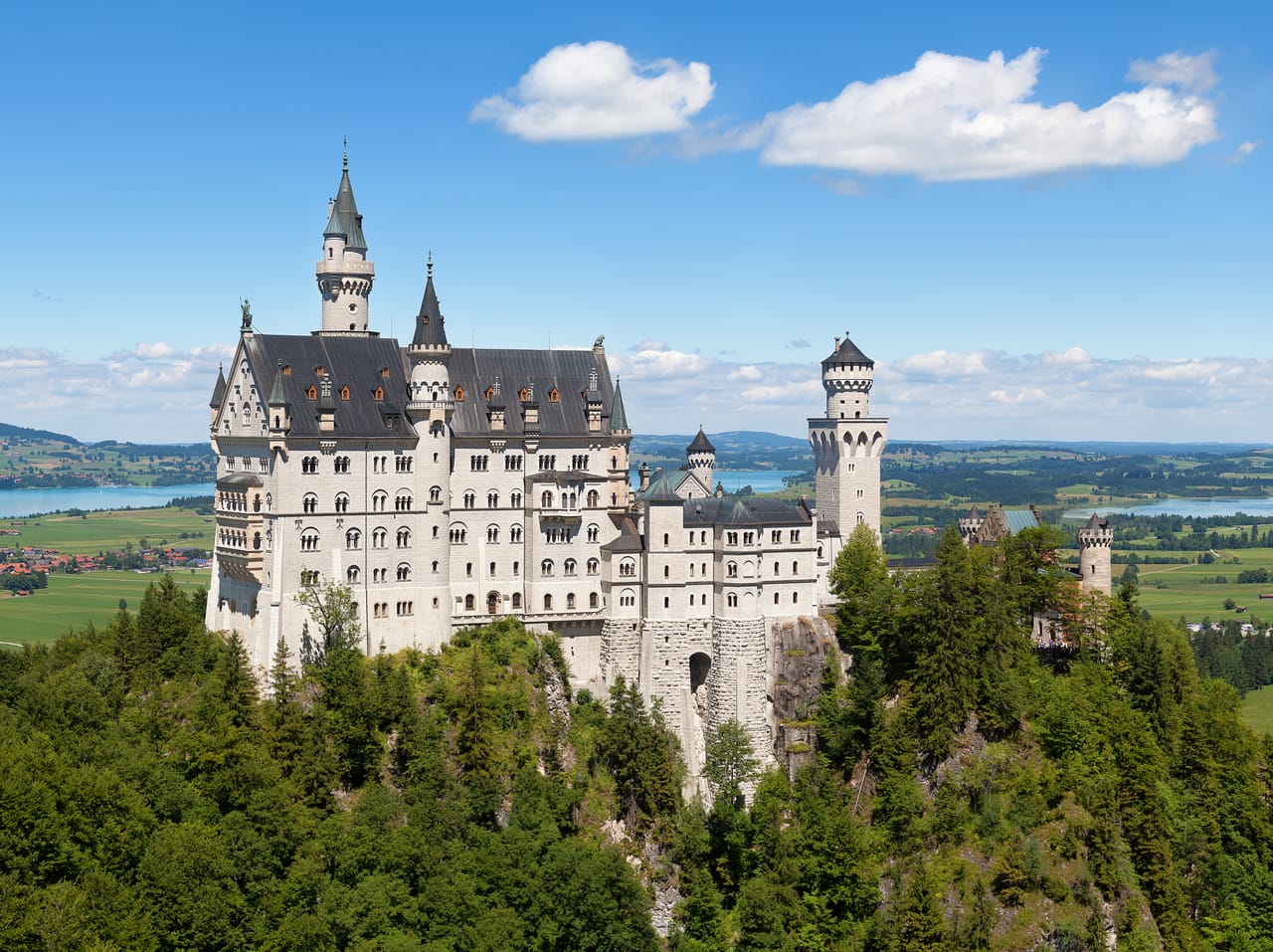
From the Main to the Alps
The Romantic Road links Würzburg, on the Main, with Füssen, at the foot of the Alps. It keeps off the motorway and goes from one walled town to the next, often entering through a gate in the ramparts. Brown signs mark it from end to end, sometimes with a Japanese translation.
The landscape changes little by little. First the vineyards of the Main, then the green valley of the Tauber and its castles. Then wheat fields and the Ries, a round, flat plain ringed by hills: it is a meteorite crater about 25 kilometres across. After Augsburg, the road follows the Lech to the meadows and onion-domed church towers of the Pfaffenwinkel. Soon after Schongau, the Alps appear on the horizon.
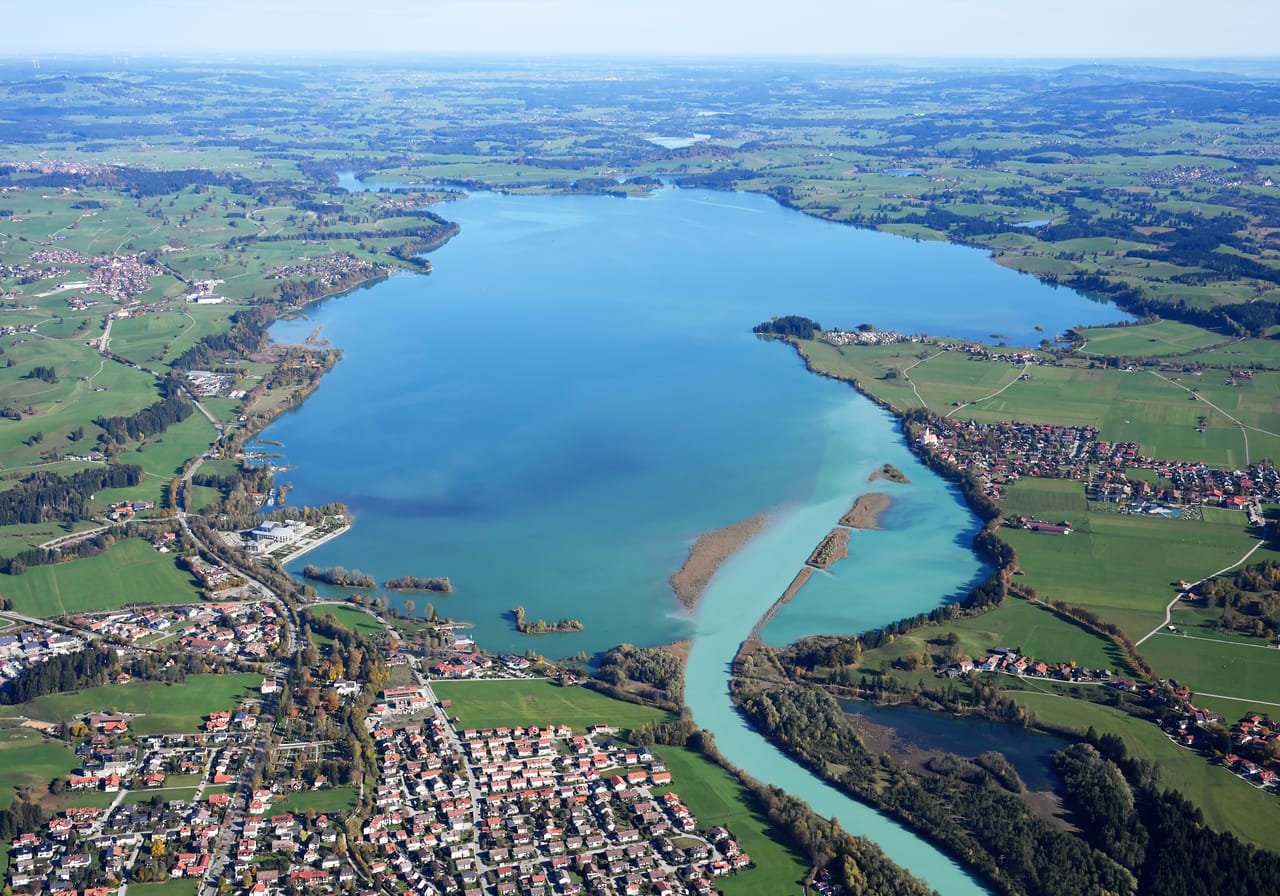
In Rothenburg, you walk the covered wall walk, and in the evening you follow the night watchman on his rounds. At the end of the road, you take the cable car to the top of the Tegelberg to see the Forggensee.
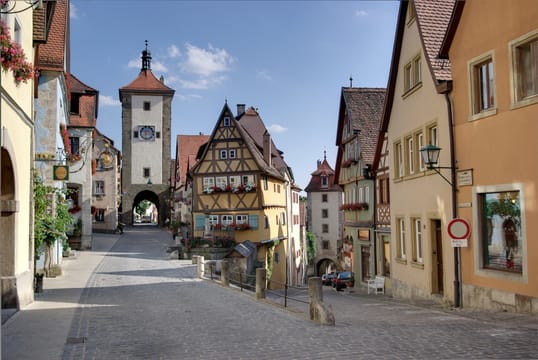
The free imperial cities
Rothenburg ob der Tauber, Dinkelsbühl and Nördlingen were free imperial cities: they answered only to the emperor, not to a prince. Rich in the Middle Ages, they were ruined by the Thirty Years’ War. This is often given as the reason for how they look today: with no money, they neither pulled down their walls nor modernised their houses. In Rothenburg, the Plönlein, a small sloping square between two gate towers, is the best-known corner of the town.
Rothenburg and Dinkelsbühl re-enact their legend every year. In Rothenburg, tradition has it that the former mayor Georg Nusch emptied a tankard of more than three litres of wine in one go, in 1631, so that General Tilly would spare the town. This is the Meistertrunk, performed every year at Whitsun. In Dinkelsbühl, the Kinderzeche in July tells how children are said to have softened the hearts of the Swedes, in 1632.
Nördlingen is built in the Ries crater, formed nearly 15 million years ago. Its church, St. Georg, is built partly of suevite, a rock created by the impact. In 1970, the Apollo 14 astronauts came to train in the crater before leaving for the Moon.
Rothenburg and Dinkelsbühl re-enact their legend every year.
Ludwig II and his castles
Ludwig II of Bavaria grew up at Hohenschwangau, the yellow castle that his father, Maximilian II, had rebuilt above the Alpsee. Once king, he had Neuschwanstein built just opposite, from 1869: a dream of a medieval castle, decorated with scenes from Wagner’s operas. He lived there for only a few months. The king died in June 1886 in Lake Starnberg, in circumstances that have never been explained. The castle, still unfinished, opened to visitors a few weeks later.
The classic view of Neuschwanstein is from the Marienbrücke, a footbridge over the Pöllat gorge. Since 2025, the castle has been a UNESCO World Heritage Site, together with three of the king’s other creations: Linderhof, Herrenchiemsee and the King’s House on the Schachen.
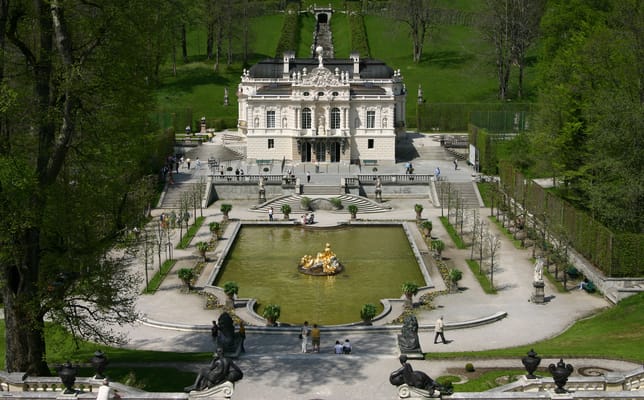
Linderhof Palace
The only one of Ludwig II’s palaces finished in his lifetime, and the one where he lived longest: a rococo villa, terraced gardens, a cascade. The Venus Grotto, restored, reopened in 2025. The pavilions in the park close from mid-October to mid-April.
Practical notes
- When to go
- May to October. Summer is very busy; autumn is grape-harvest time in Franconia.
- Getting there
- Würzburg is about an hour and a quarter from Frankfurt. Füssen is less than two hours from Munich.
- Access
- Everything is tarmac and toll-free. The old towns have little parking, and the centre of Rothenburg is for residents only: park outside the walls. Augsburg requires the green sticker (low-emission zone), to be ordered before you set off.
- Sleeping in a van
- Motorhome aires at Rothenburg, Füssen and Schwangau, and campsites around the Forggensee.
- Worth knowing
- Neuschwanstein can only be visited on a guided tour; tickets are best booked online. You go up on foot (40 minutes), by shuttle bus or by horse-drawn carriage. The Marienbrücke closes in snow or ice.
- Allow
- Six days for the road, one more for Linderhof and Oberammergau.
What not to miss
- 1The Würzburg ResidenceThe palace of the prince-bishops and its staircase, beneath Tiepolo’s fresco, one of the largest in the world.
- 2The Creglingen altarpieceIn the Herrgottskirche, Tilman Riemenschneider’s Altar of the Virgin, carved in limewood and left unpainted.
- 3The Daniel towerAbout 350 steps to the top of Nördlingen’s church tower, to see the round town and the crater.
- 4The FuggereiIn Augsburg, the oldest social housing estate still lived in, founded in 1521.
- 5The WieskircheA rococo pilgrimage church, white and gold, alone in the middle of the meadows.
- 6Harburg CastleA very well-preserved fortress, on its rock above the Wörnitz.
The Romantic Road in pictures
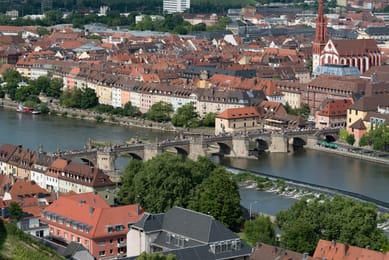
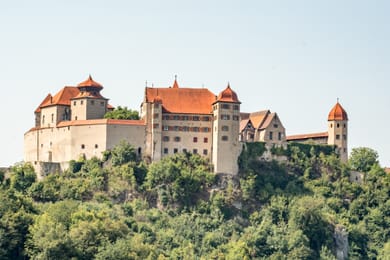
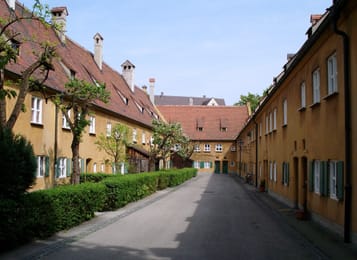
Würzburg, the Main and the old bridge with its statues.
The Romantic Road table
In Franconia, people drink Silvaner, a dry white wine, sold in the Bocksbeutel, a round, flat bottle. In Würzburg, you taste it in the cellars of the old hospitals, or glass in hand on the Old Main Bridge. In Rothenburg, the pastry shops sell Schneeballen, balls of fried pastry covered in sugar.
In Swabia, Spätzle, fresh egg noodles, often come with the main dishes. In the Allgäu, they are eaten as Kässpatzen, with melted mountain cheese and fried onions. In Upper Bavaria, tradition says that Weißwurst, white sausages, are eaten before noon.
Würzburg → Füssen


 +19stops
- 1Würzburger Residenz · Alte Mainbrücke · Festung Marienberg
- 2Schloss Mergentheim · Schloss Weikersheim · Herrgottskirche · Rothenburg ob der Tauber
- 3Dinkelsbühl · St. Georg (Nördlingen) · Rieskratermuseum · Burg Harburg
Free, no account needed — start from its places and make it yours.
Also worth reading
Experiences
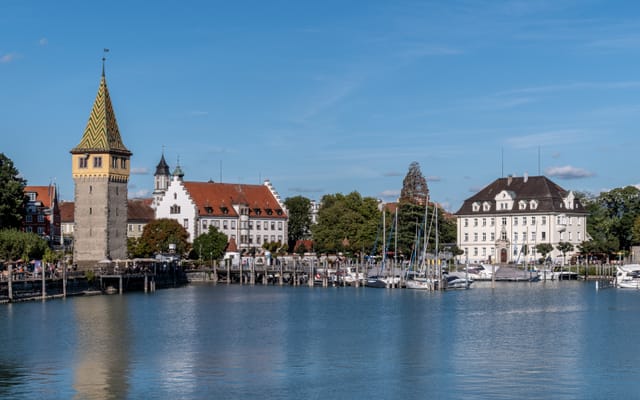
Lake Constance, a tour of three countries
Lake Constance is shared between Germany, Austria and Switzerland. This trip goes all the way round it in five days from Konstanz, from the islands of Reichenau and Mainau to the Rhine Falls.
Wide open spaces
Saxon Switzerland, from Dresden to the rocks of the Elbe
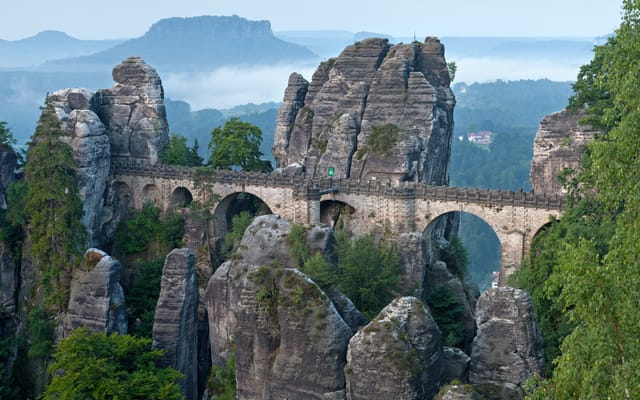
Half an hour from Dresden, the Elbe flows between sandstone towers, beech forests and fortresses on the heights. This trip takes four days to go round the region, from the Bastei to the Schrammsteine and on to Königstein.
Mountains and passes
The Bavarian Alps, from the Zugspitze to the Königssee
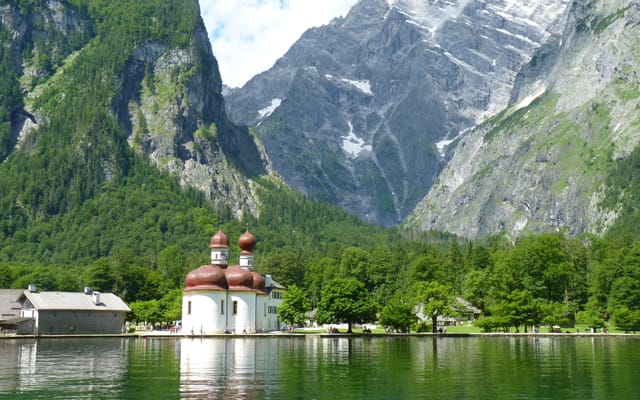
The castles of Ludwig II, about ten lakes and the highest peak in Germany. A nine-day loop from Munich, from Neuschwanstein to the Königssee, with two short stretches through Tyrol.
A starting point, a few wishes — ViaLooma builds the trip day by day, map, stops and roadbook included.