Mostar and Herzegovina
Ottoman bridges over a green river, stone plateaus and waterfalls you can swim under. A five-day loop from Mostar, from the upper Neretva to Trebinje.
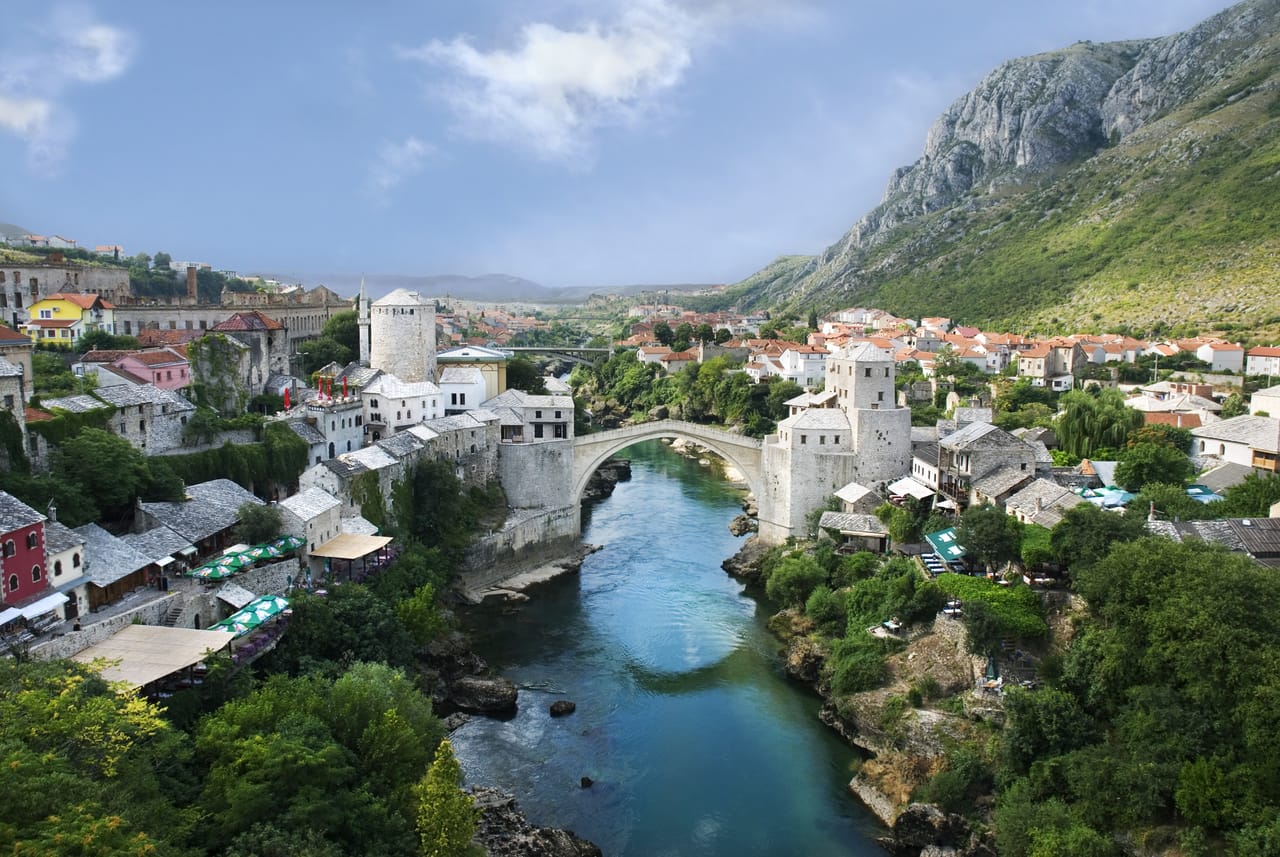
The Neretva, the karst and the bridges
Herzegovina is the southern part of Bosnia and Herzegovina. The Neretva, an emerald-green river, flows through it. North of Mostar, the road climbs up its gorge between limestone cliffs, then runs along a reservoir to Konjic and its old bridge.
Mostar is best seen on foot, between the Stari Most, the mosques and the old bazaar. Further south, you pass through Međugorje, where six young people said they saw the Virgin Mary in 1981, then swim at the foot of the Kravica waterfalls.
To the east, the road crosses plateaus of white stone and half-empty villages, then drops down to Trebinje, with its plane trees and Ottoman bridge. The town is in Republika Srpska, the country’s other entity: no checks, but road signs in Cyrillic.
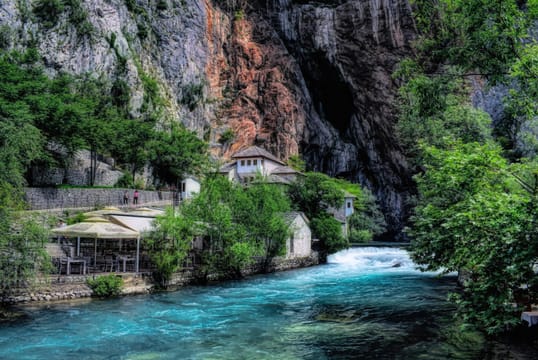
The Ottoman legacy
At Blagaj, twenty minutes from Mostar, the tekke stands on the bank of the Buna. This white house from the 16th century is a place of prayer and retreat for dervishes, the mystics of Sufi Islam. The river flows out of a cave, at the foot of a cliff. It is one of the largest springs in Europe: about 24 cubic metres per second on average. Above, a path climbs in about an hour to the ruins of the fortress.
The Ottomans held Herzegovina from the 15th century until 1878. They left mosques, baths and, above all, bridges. Mostar’s Stari Most was completed in 1566 by Mimar Hayruddin, a pupil of the great architect Sinan. On 9 November 1993, it collapsed under fire from Bosnian Croat forces. Rebuilt with the same local stone, it reopened in 2004 and UNESCO listed it in 2005. In summer, young people dive from its arch, some twenty metres above the water.
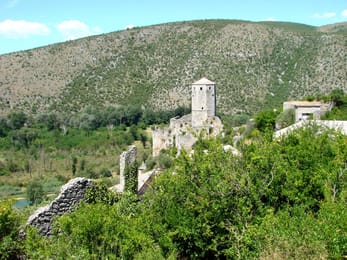
The Konjic bridge dates from 1682. Blown up by the Germans in 1945, it was rebuilt in 2009. Trebinje’s Arslanagić Bridge is said to date from 1574. Because of a dam, it was taken down stone by stone and rebuilt in the town in 1972. Počitelj, a fortified village above the Neretva, got its mosque and tower back after the war.
They left mosques, baths and, above all, bridges.
The karst of Herzegovina
Here, the ground beneath is karst: limestone where water seeps in and flows underground. On the surface, you see stony plateaus and poljes, enclosed plains with fertile soil, such as Popovo polje. On its edge, Vjetrenica Cave, at Zavala, has been a World Heritage Site since 2024. More than 200 species have been recorded there. Its name means “the cave of the wind”: in summer, a draught of cold air blows out of the entrance.
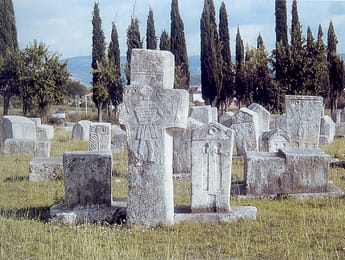
In the Middle Ages, this limestone was carved into stećci, large tombstones found only in Bosnia and Herzegovina and its neighbours. Twenty-eight necropolises have been on the UNESCO list since 2016, twenty of them in the country. At Radimlja, near Stolac, you can see hunters, round dances and a man raising an oversized hand.
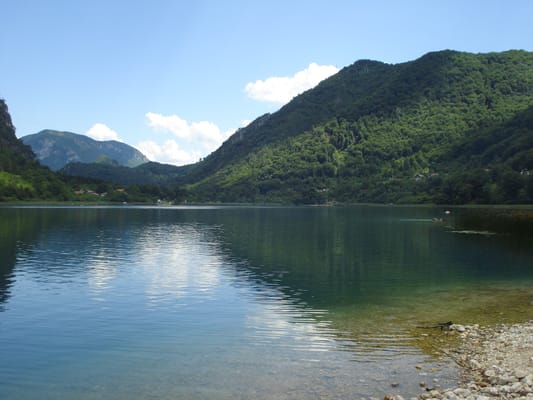
Lake Borak
A glacial lake at 397 metres, surrounded by forest, at the foot of Mount Prenj. In summer, you swim in cool water, far from the crowds at Kravica.
Practical notes
- When to go
- May–June and September. In spring, the waterfalls are at their fullest; summer is very hot in Mostar. Winter tyres from 15 November to 15 April.
- Getting there
- Mostar is about three hours from Split and from Dubrovnik. A car registered in the EU or in Switzerland is insured without a Green Card; a car hired in Croatia needs the rental company’s written consent.
- Access
- Tarmac roads, but slow and winding, and narrow towards Zavala and Lake Borak. Dipped headlights on during the day too.
- Sleeping in a van
- Campsites at Blagaj, near Kravica, at Međugorje and at Lake Borak. Some minefields are still marked: no wild camping on waste ground.
- Worth knowing
- You pay in convertible marks, often in cash. Vjetrenica is visited with a guide, at about 11 °C: bring a jacket.
- Allow
- Five days for the loop, plus half a day for Lake Borak.
What not to miss
- 1The minaret of the Koski Mehmed Pasha MosqueOne of the finest views of the Stari Most.
- 2KujundžilukThe cobbled street of the old bazaar and its copper workshops.
- 3The Partisan CemeteryA memorial of stone terraces by Bogdan Bogdanović, from 1965, long left to decay.
- 4The Jablanica bridgeAn iron bridge blown up in 1968 for the film The Battle of Neretva.
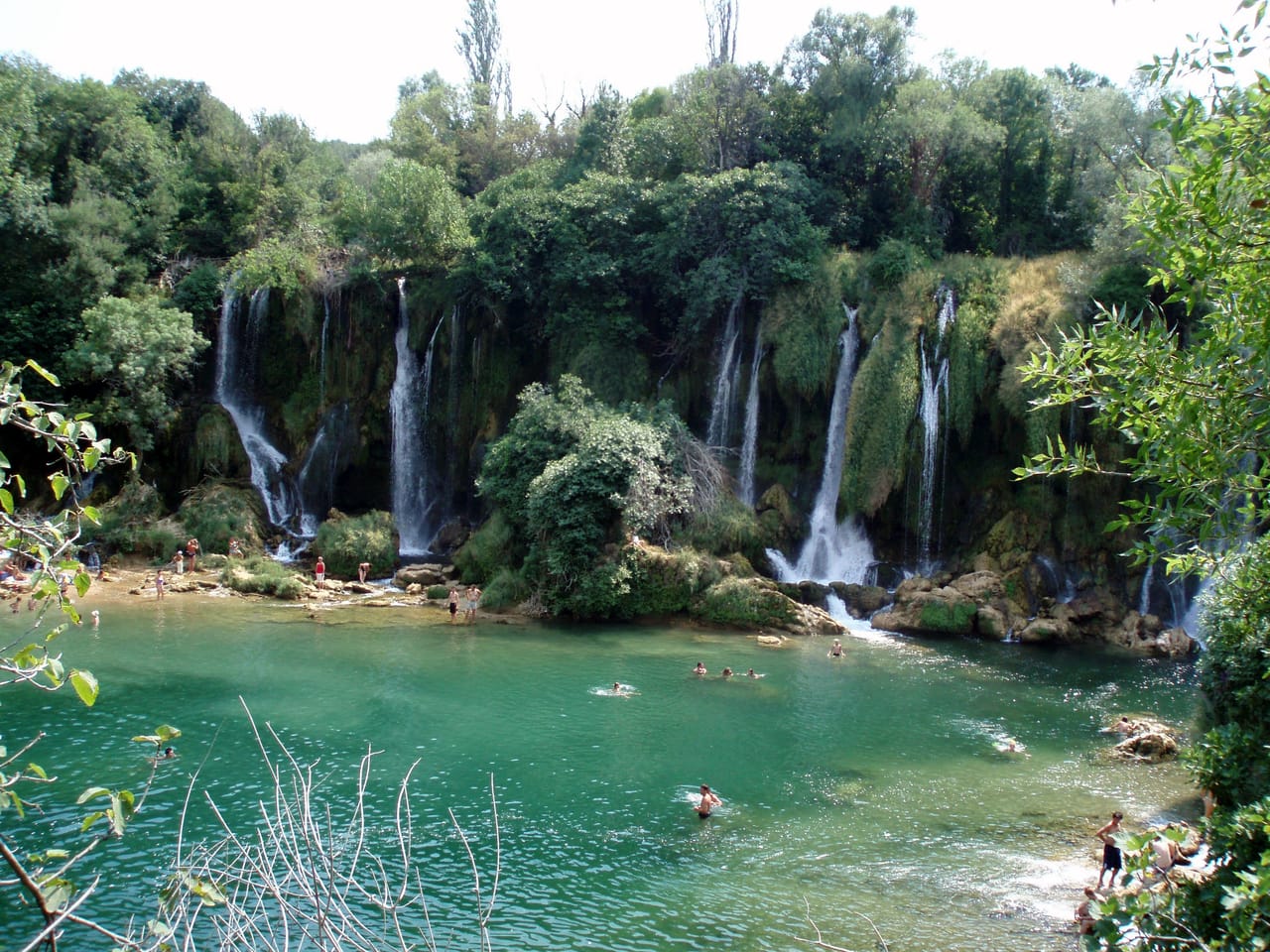
- 5The Kravica waterfallsFalls of about 28 metres and a pool for swimming.
- 6Hercegovačka GračanicaThe church where the poet Jovan Dučić is buried, above Trebinje, best seen at sunset.
Mostar and Herzegovina in pictures
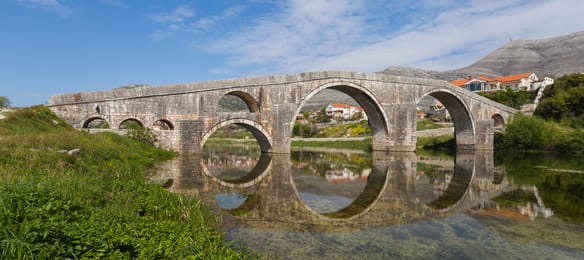
The Arslanagić Bridge and its arches over the Trebišnjica, in Trebinje.
The Herzegovinian table
The food is that of the Ottoman Balkans: ćevapi, small grilled sausages served in a flatbread with onion; stuffed vine leaves and vegetables. At Blagaj, you eat trout beside the Buna. Bosnian coffee comes in a small copper pot, with a piece of Turkish delight.
For wine, this is the country’s main region. The white is called žilavka, the reds blatina and vranac. Near Trebinje, Tvrdoš monastery keeps its wine in a cellar that partly dates back to the 15th century. In autumn, figs and pomegranates are sold by the roadside around Čapljina.
Loop from Mostar


 +13stops
- 1Stari most · Koski Mehmed-pašina džamija · Karađoz-begova džamija · Partizansko groblje u Mostaru
- 2Most u Jablanici · Stari most (Konjic) · Tekija na Buni
- 3Vjetrenica · Манастир Тврдош · Arslanagića ćuprija · Херцеговачка Грачаница
Free, no account needed — start from its places and make it yours.
Also worth reading
Wide open spaces
Bosnia, from the Una to Sarajevo
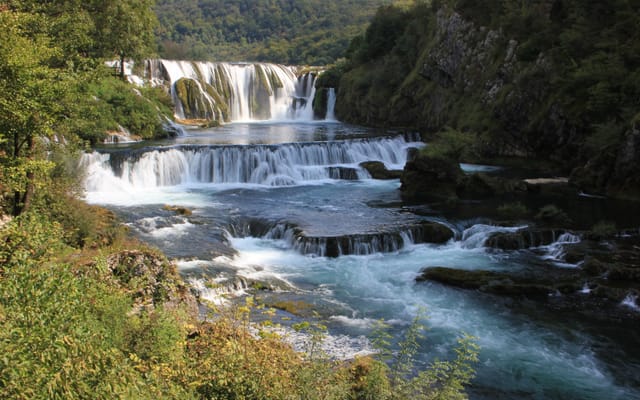
Bosnia is a land of green rivers, waterfalls and old Ottoman towns. This trip crosses it in five days, from Bihać and Una National Park to Sarajevo, by way of Jajce and Travnik.
Coast and islands
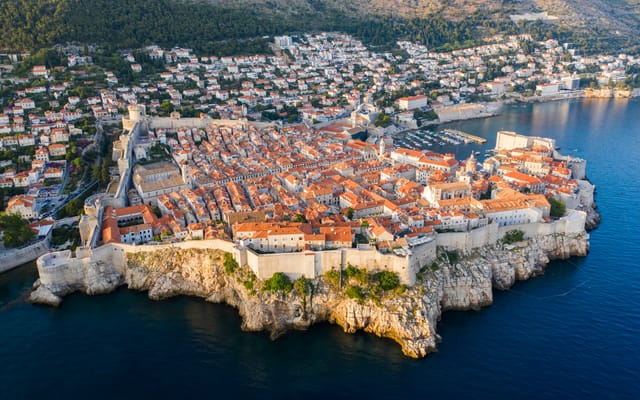
Dubrovnik, Mostar and Kotor: a loop through Croatia, Bosnia and Montenegro
A week on a loop from Dubrovnik, through three countries, two of them outside the European Union. The Croatian coast, the karst of Herzegovina and the Bay of Kotor, with three old towns on the UNESCO list.
Wide open spaces
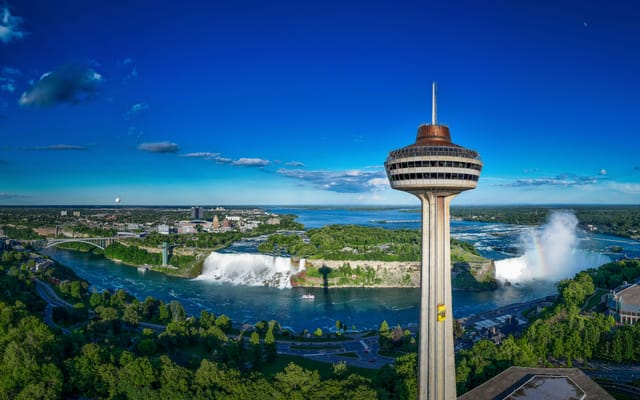
Eastern Canada, from Toronto to Quebec City
From Niagara Falls to the walls of Quebec City, the best way to see Eastern Canada is to follow the water. Eleven days on the road, through the Thousand Islands, the Rideau Canal, Ottawa, Montreal and the lakes of the Mauricie.
A starting point, a few wishes — ViaLooma builds the trip day by day, map, stops and roadbook included.