Tallinn and Lahemaa National Park
A Hanseatic old town on the Unesco list, then a coast of forests, bogs and fishing villages. A four-day loop from Tallinn, out to the manor houses of Lahemaa National Park.
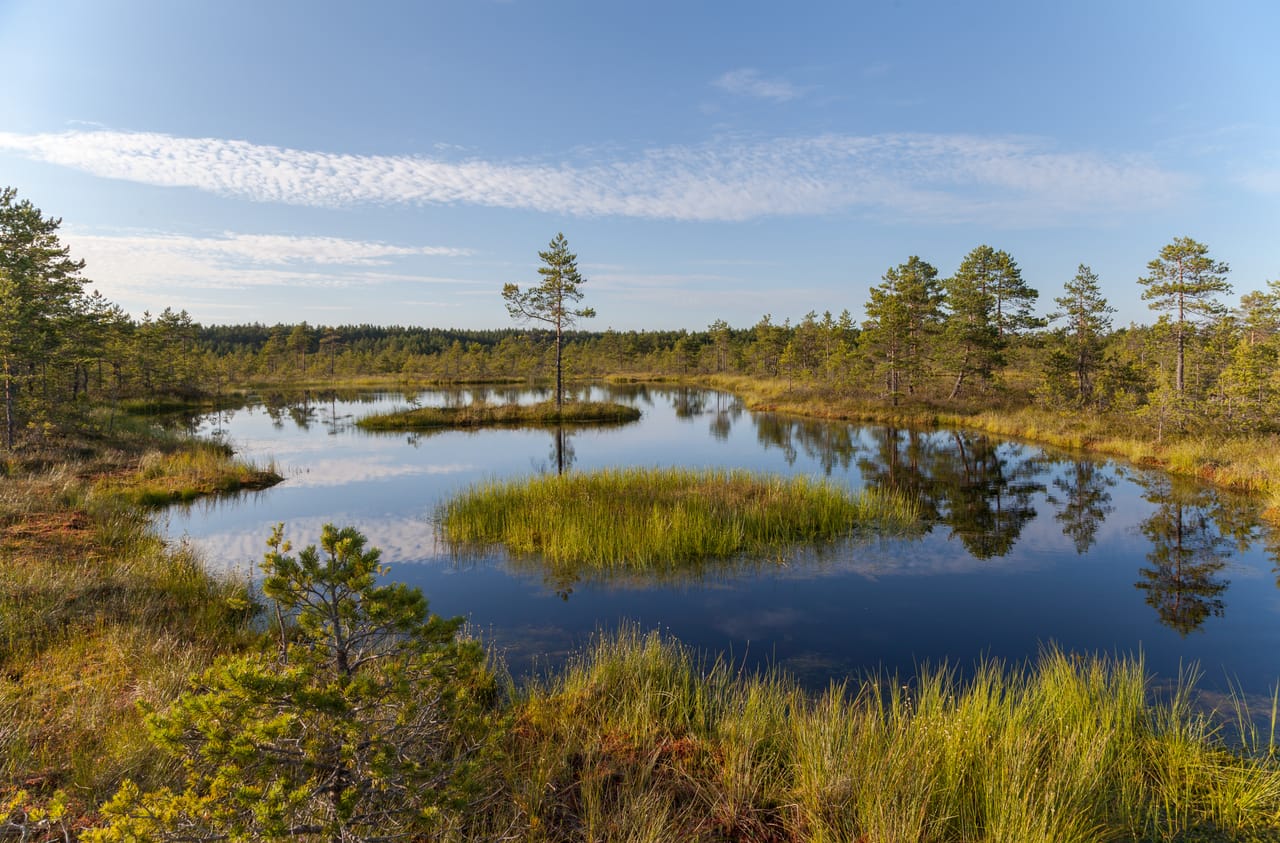
From Tallinn to the bays of Lahemaa
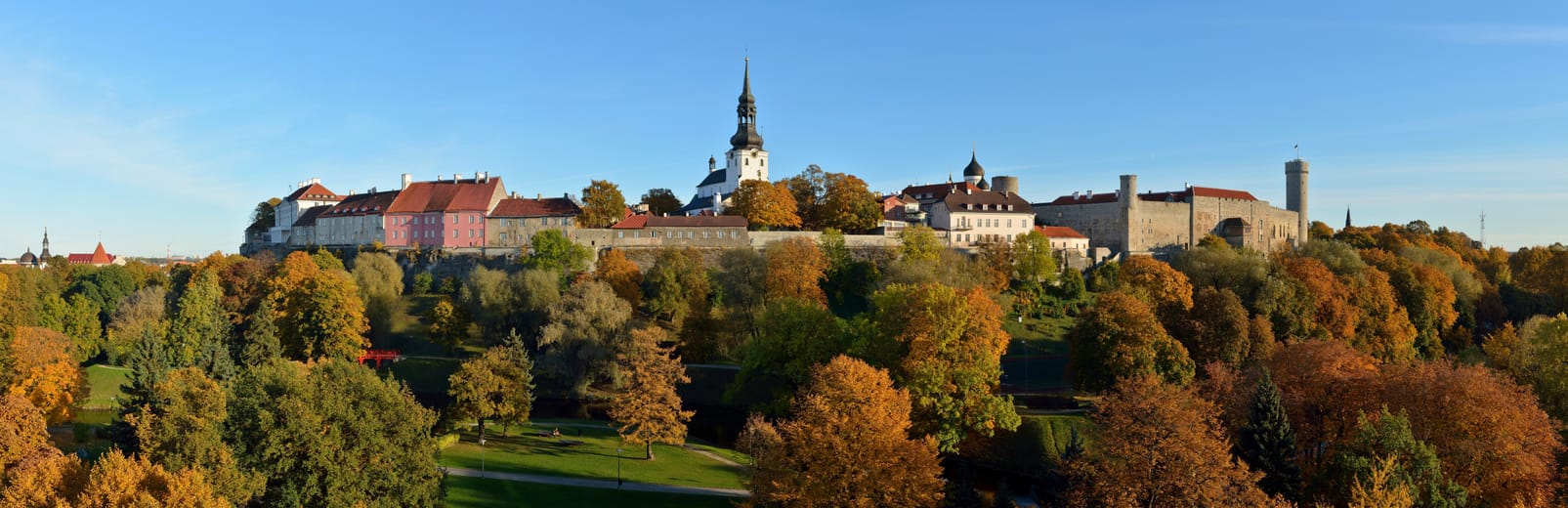
The journey starts in Tallinn, a capital you explore on foot. The old town spreads across a hill and the streets at its foot: walls, towers, churches and merchants’ houses. You go up to the viewpoints of Toompea, which look out over the red roofs and the port.
To the east, the E20 runs through pines and birches to Lahemaa National Park, an hour from Tallinn. Lahemaa means “land of bays”: four peninsulas reach out into the Gulf of Finland. You drive from village to village, with granite boulders on the shore on one side and forest on the other.
On the way, Jägala Falls drops about 8 metres across a width of some fifty metres. Further on, a 3.5-kilometre boardwalk crosses Viru Bog, between moss, dark pools and dwarf pines. From an observation tower, you can see the bog stretching to the horizon. In the evening, you stop at Võsu, on a sandy beach lined with pines.
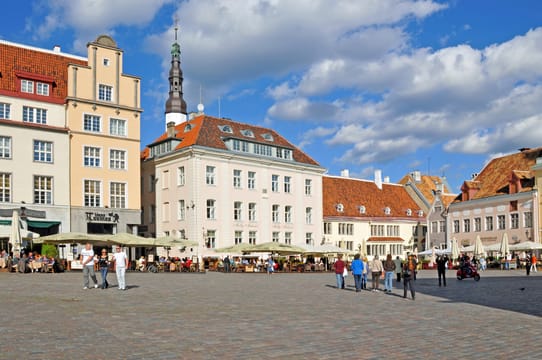
Tallinn’s old town
In the Middle Ages, Tallinn was called Reval and belonged to the Hanseatic League, the league of merchant towns of northern Europe. The lower town was the merchants’ town. It is still laid out around Raekoja plats, the town hall square. On the spire of this Gothic building, a weathervane shows Old Thomas, a soldier who became the symbol of the city. Opposite, the Raeapteek is recorded as early as 1422: it is one of the oldest pharmacies in Europe still open. The old town has been a World Heritage Site since 1997.
Above it, on Toompea hill, lived the knights and the bishop. For a long time the upper town and the lower town were two separate towns, each with its own laws. The hill holds the castle, seat of the Parliament, and two cathedrals, one of them the Orthodox Alexander Nevsky Cathedral.
In the lower town, St Olaf’s Church rises to 124 metres. In the Middle Ages, its spire was taller. According to a source from the time, the church would then have been the tallest building in the world. Historians doubt it. At the port, Lennusadam, a set of former seaplane hangars under concrete domes, houses the maritime museum and the Lembit submarine. West of the city, the open-air museum at Rocca al Mare brings together farms and windmills from all over the country.
In Soviet times, the coast was a closed border zone.
The manors and the national park
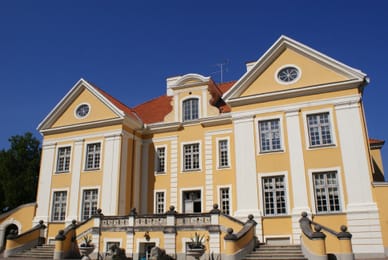
For centuries, Estonian land belonged to a German-speaking nobility, the Baltic Germans. Their manor houses are dotted across Lahemaa. Palmse belonged to the von der Pahlen family from 1677 to 1919; its outbuildings house the park’s visitor centre. Sagadi, the estate of the von Fock family, is one of the best-preserved ensembles in the country. Kolga, long held by the Stenbocks, is partly derelict. Vihula, on the banks of the Mustoja, has become a hotel.
On 1 July 1971, Lahemaa became the first national park in the Soviet Union. In Soviet times, the coast was a closed border zone. At Hara, by the bay, you can see the ruins of a Soviet base. Submarine hulls were demagnetised there.
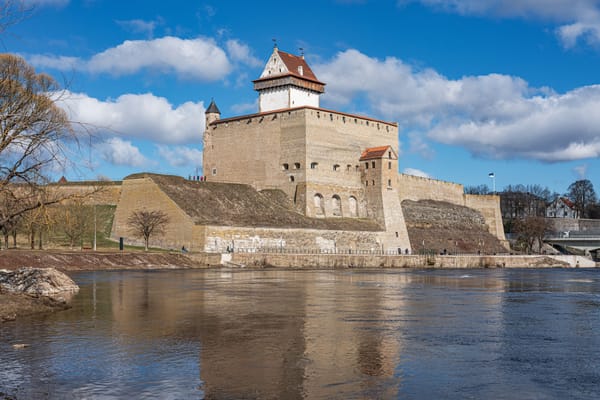
Narva Castle
Hermann Castle faces the Russian fortress of Ivangorod across the river. The river marks the border with Russia. The border crossing has been closed to cars since 2024. Narva, rebuilt after 1944 and mostly Russian-speaking, shows another side of Estonia.
Practical notes
- When to go
- June to August, for the sea and the very long days. In winter, Jägala Falls freezes.
- Getting there
- Tallinn is two hours by ferry from Helsinki and four hours by road from Riga.
- Access
- Everything is tarmac, apart from a few roads out to the capes. No tolls for vehicles under 3.5 tonnes.
- Sleeping in a van
- The RMK, the state forest agency, maintains free campsites in Lahemaa. In Tallinn, park outside the old town.
- Worth knowing
- Tallinn’s old town is almost entirely pedestrianised. For Viru, check the state of the boardwalk on the RMK website before you set off.
- Allow
- Four days for the loop, one more day for Narva.
What not to miss
- 1The tower of St Olaf’sA platform 60 metres up, looking down over the old town and the port.
- 2Kadriorg PalaceThe Baroque palace built from 1718 for Catherine, wife of Peter the Great. Next to it, Kumu, the museum of Estonian art.
- 3Palmse manorA restored manor house and its park.
- 4KäsmuThe captains’ village, its wooden houses and its maritime museum.
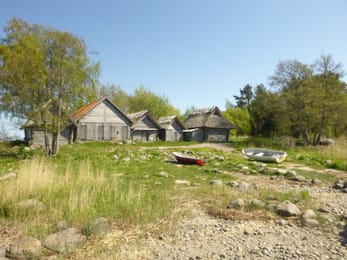
- 5AltjaWooden net sheds by the sea and a village tavern.
- 6Rakvere CastleA castle founded by the Danes, then held by the Livonian Order, with Tarvas, a bronze aurochs, at its foot.
Tallinn and Lahemaa in pictures
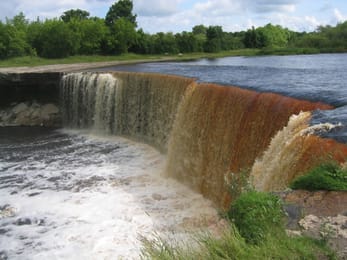
Jägala Falls and its curtain of amber water.
The Estonian table
The staple is black rye bread. Kama, a flour of roasted grains and peas, is eaten with kefir. On the coast, people eat kilu, a sprat marinated in spices, on black bread with an egg.
In village taverns, like the one in Altja, they serve fish soup and sült, meat in aspic. Take home a bottle of Vana Tallinn, a dark rum-based liqueur with spices.
Loop from Tallinn


 +11stops
- 1Toompea · Raekoja plats · Oleviste kirik · Lennusadam
- 2Jägala juga · Viru raba · Kolga mõis · Käsmu
- 3Palmse mõis · Sagadi mõis · Altja · Vihula mõis
Free, no account needed — start from its places and make it yours.
Also worth reading
Wide open spaces
The Pacific Northwest, from the Olympic Peninsula to the Cascade volcanoes
Rainforests, a coast of headlands and lighthouses, redwoods and two active volcanoes. A two-week loop from Seattle, by way of the Olympic Peninsula, the Oregon coast and Mount Rainier.
Wide open spaces
Vancouver Island, from Victoria to the beaches of Tofino
An island of giant forests, beaches pounded by the Pacific and small harbours where boats leave to see orcas. Nine days on a loop from Victoria, from Port Renfrew to Tofino and up to Telegraph Cove.
Wide open spaces
Yellowstone, Grand Teton and Glacier: the great Rockies road trip
Three national parks on one road, from the Tetons to the glaciers of Montana, by way of the geysers of Yellowstone. Twelve days from Jackson to Kalispell, with bison by the roadside and two great mountain roads.
A starting point, a few wishes — ViaLooma builds the trip day by day, map, stops and roadbook included.