Bohemian Switzerland, from Děčín to Pravčická brána
In the north of the Czech Republic, the Elbe runs through a sandstone massif cut into towers, gorges and arches. This trip goes round it in four days from Děčín, taking in Pravčická brána, the Kamenice gorges and the basalt “organ pipes”.
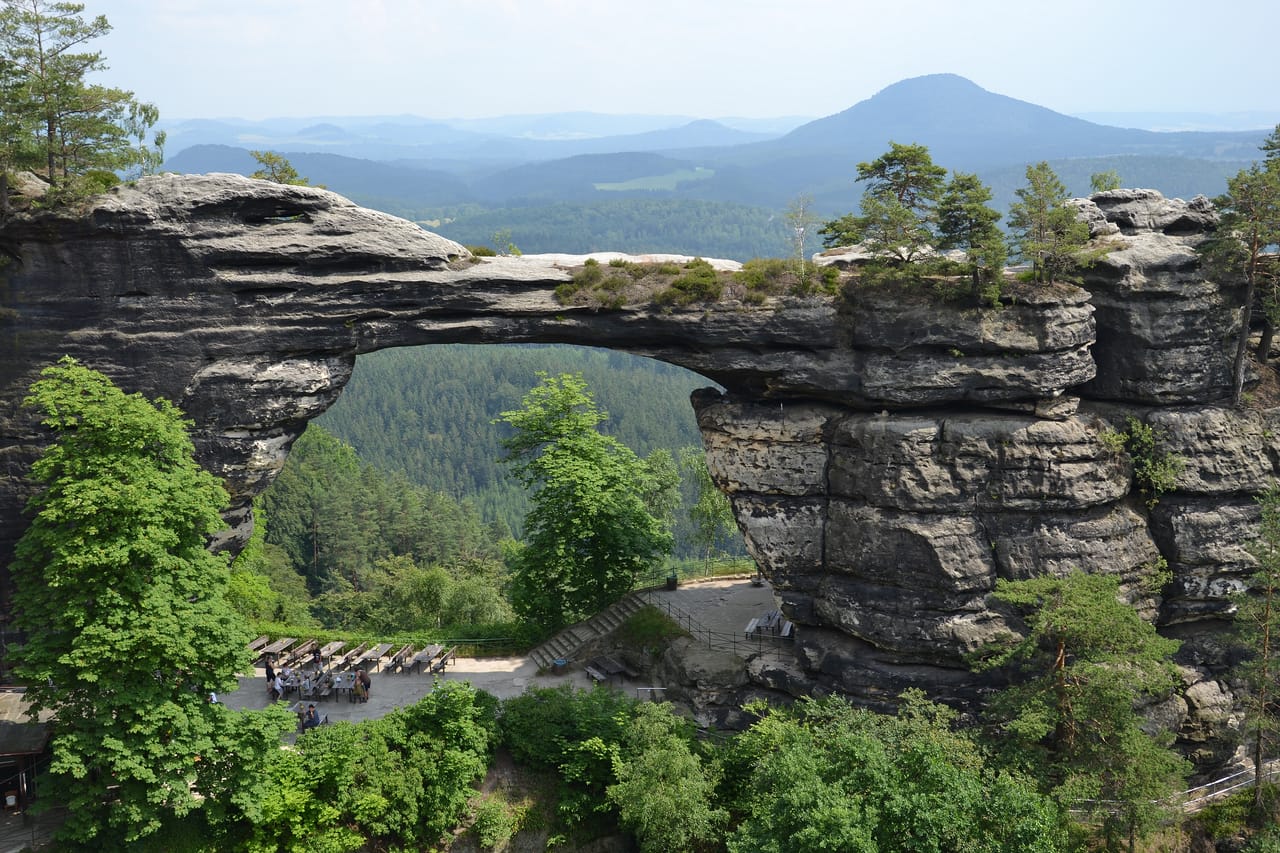
A sandstone massif on the Elbe
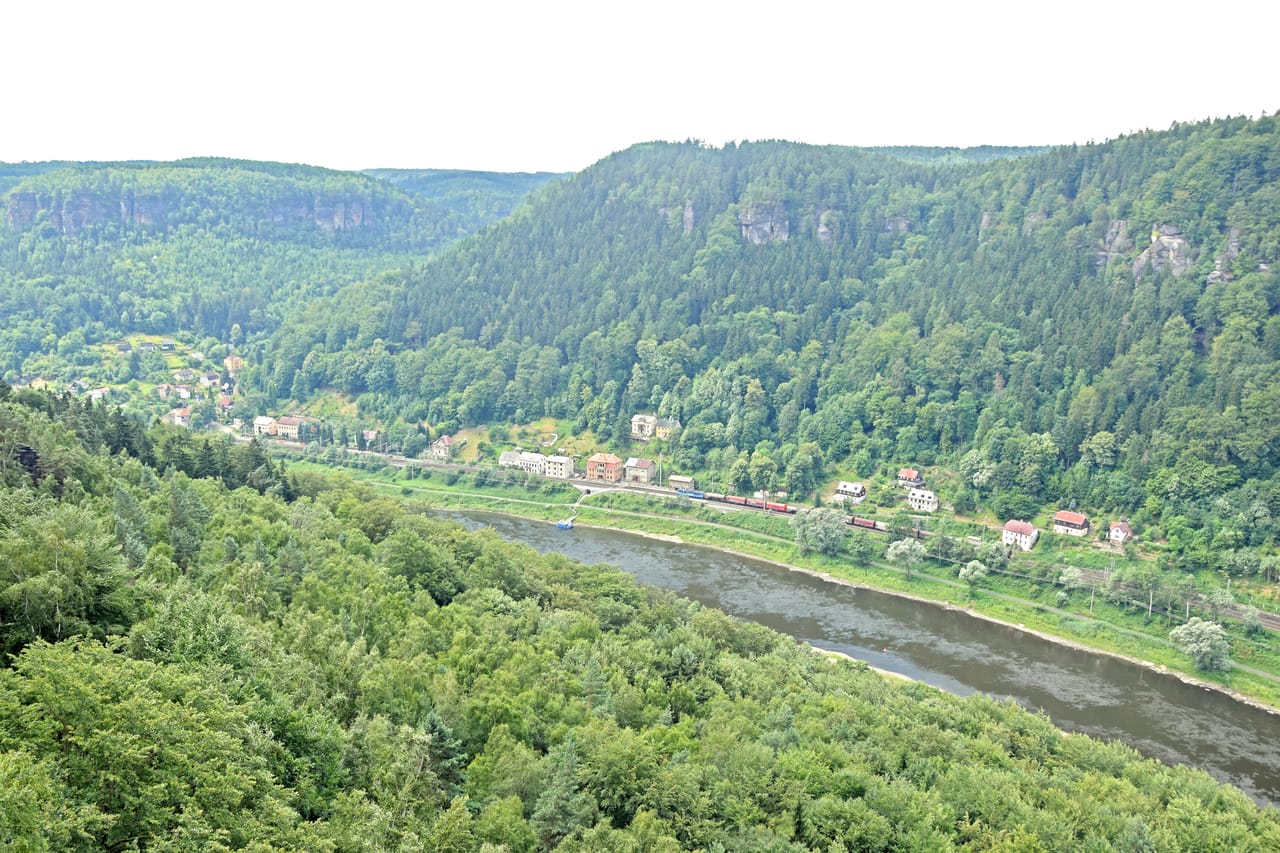
From Děčín to Hřensko, the road follows the Elbe along the bottom of a sandstone canyon about 300 metres deep. The slopes are wooded, with cliffs at the top. At the far end of Hřensko, Germany begins. The Elbe leaves the Czech Republic there at 115 metres above sea level: it is the lowest point in the country.
From Hřensko, a narrow road climbs to the car park at Tři prameny. From there, you walk about two kilometres to Pravčická brána, a sandstone arch on the edge of a cliff. Up on the plateau, small roads link Mezní Louka, Vysoká Lípa and Jetřichovice, through clearings and forest.
Distances are short and the days are spent on foot. You park the car, climb to a viewpoint on steps cut into the rock, then come back down. In the Kamenice gorges, part of the way is done by boat. In autumn, the beeches turn yellow and the summer crowds have gone.
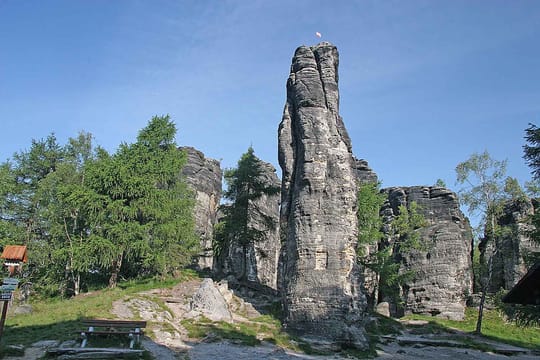
Sandstone and basalt
About 90 million years ago, a sea covered the region. The sand laid down on its floor became sandstone, which water and frost then split and hollowed out. What is left are plateaus, gorges and lone towers. At Tiské stěny, above the village of Tisá, towers several tens of metres high form a small maze.
Pravčická brána is the largest natural sandstone arch in Europe: 26.5 metres long and 16 metres high. Cracks have been found in the vault. Since 1982, no one has been allowed to walk on the arch.
In places, lava pushed up through the sandstone about 30 million years ago. As it cooled, the basalt split into regular columns, which quarries later brought to light. At Panská skála, they are called the “organ pipes”, and a small pond fills the floor of the old quarry. On Zlatý vrch, they reach 30 metres high in places.
Since 1982, no one has been allowed to walk on the arch.
Princes, painters and the border
The name “Switzerland” comes from two Swiss painters at the Dresden Academy, Adrian Zingg and Anton Graff: in the 18th century, these rocks reminded them of home. In the 19th century, the families who owned the estates opened the area to visitors. The Clary-Aldringen family fitted out the Kamenice gorges with footbridges and boats. In 1882, they opened a hotel at the foot of the arch, the Sokolí hnízdo. The Kinsky family put viewpoints on the rocks around Jetřichovice.
Until 1945, the region was German-speaking. After the war, its German inhabitants were expelled and many villages emptied. Doubice had 846 inhabitants in 1930; fewer than a hundred are left. The national park was created in 2000. In July 2022, the largest forest fire in the country’s modern history burned more than 1,000 hectares there. The park lets the forest grow back on its own.
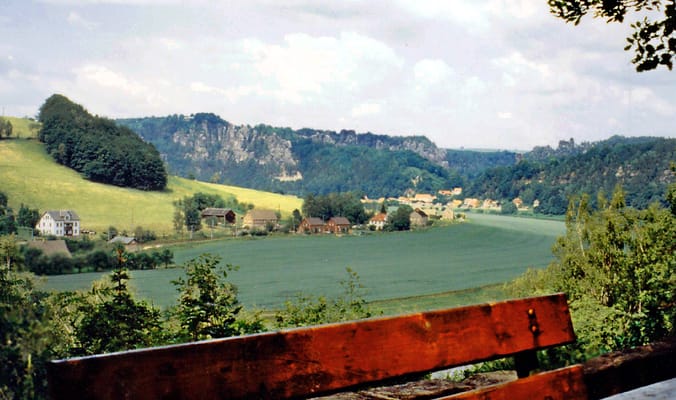
The Bastei
The same sandstone massif, on the German side. A stone bridge from 1851 links its rock pinnacles, nearly 200 metres above the Elbe. After the storm of 31 July 2026, some trails around Rathen were closed: check before you go.
Practical notes
- When to go
- May to October. In summer, Hřensko and the arch are very busy. The boats usually run from April to 1 November.
- Getting there
- Děčín is an hour and a half from Prague on the D8 motorway, which needs an electronic vignette, and an hour from Dresden.
- Access
- Everything is tarmac. The roads to Tři prameny and the Belvedér are narrow and not well suited to large motorhomes. In Hřensko, the car parks are full in summer.
- Sleeping in a van
- Wild camping is not allowed in the national park. Campsites at Mezní Louka, on the edge of the park, and at Děčín.
- Worth knowing
- Keep a few koruna in cash for the small ticket booths. Edmund’s Gorge, on the Kamenice, can be visited on a guided group tour from Hřensko. Some trails are still closed after the fires: check them on the park’s website before you set off.
- Allow
- Four days, one more for neighbouring Saxon Switzerland.
What not to miss
- 1Děčín CastleA 292-metre Baroque ramp; Chopin wrote a waltz here in 1835.
- 2Děčínský SněžníkA sandstone plateau at 724 metres, with its stone tower from 1864.
- 3The Belvedér at Labská StráňAn early 18th-century terrace, about 130 metres above the Elbe.
- 4Mariina vyhlídkaA wooden pavilion on a rock, at the top of a long staircase.
- 5Kamenický hradThe ruins of a 15th-century castle, and a wooden tower for the view.
- 6The Kyjov valleyA sandstone valley along the Křinice, which you follow from a small dam.
Bohemian Switzerland in pictures
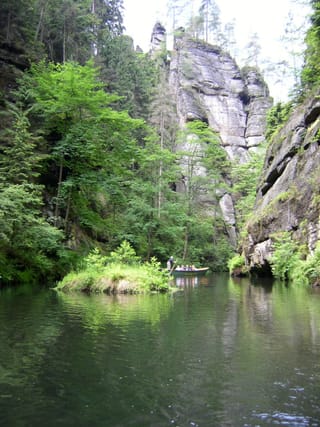
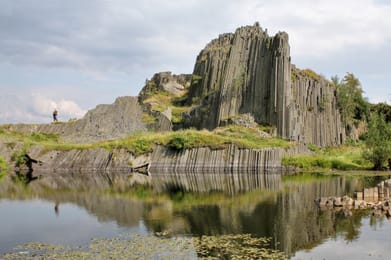
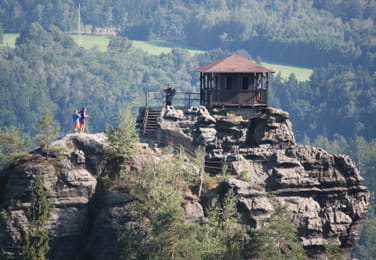
A boat on the green water of the Kamenice, at the foot of the sandstone walls.
The North Bohemian table
The food is the same as in the rest of Bohemia. The best-known dish is svíčková, beef in a cream and vegetable sauce, served with knedlíky, slices of steamed bread. The inns also serve game and trout.
In Česká Kamenice, a small local brewery serves its own beer. In cafés, people eat koláče, small round pastries filled with curd cheese, poppy seed or jam.
Loop from Děčín


 +12stops
- 1Zámek Děčín · Pastýřská stěna · Tiské stěny · Děčínský Sněžník
- 2Kaňon Labe · Belvedér · Hřensko · NPP Pravčická brána
- 3Soutěsky Kamenice · Jetřichovice · Mariina vyhlídka
Free, no account needed — start from its places and make it yours.
Also worth reading
Wide open spaces
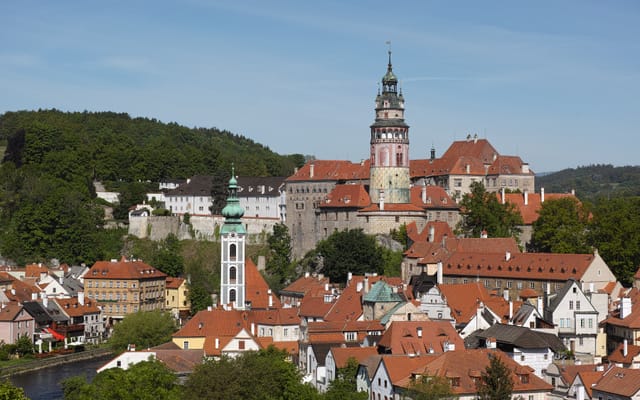
South Bohemia: Český Krumlov, Telč and the land of fishponds
Castles by the water, Renaissance towns with arcades and hundreds of carp ponds. Five days on a loop from České Budějovice, from the Vltava valley to Telč, in Moravia.
Wide open spaces
The Pacific Northwest, from the Olympic Peninsula to the Cascade volcanoes
Rainforests, a coast of headlands and lighthouses, redwoods and two active volcanoes. A two-week loop from Seattle, by way of the Olympic Peninsula, the Oregon coast and Mount Rainier.
Wide open spaces
Vancouver Island, from Victoria to the beaches of Tofino
An island of giant forests, beaches pounded by the Pacific and small harbours where boats leave to see orcas. Nine days on a loop from Victoria, from Port Renfrew to Tofino and up to Telegraph Cove.
A starting point, a few wishes — ViaLooma builds the trip day by day, map, stops and roadbook included.