Ohrid and Prespa, the two lakes of North Macedonia
Two mountain lakes in the south-west of North Macedonia, separated by the Galičica massif and linked underground. A five-day loop from Ohrid, taking in frescoed churches, lakeside monasteries and ancient ruins near Bitola.
Around Lakes Ohrid and Prespa
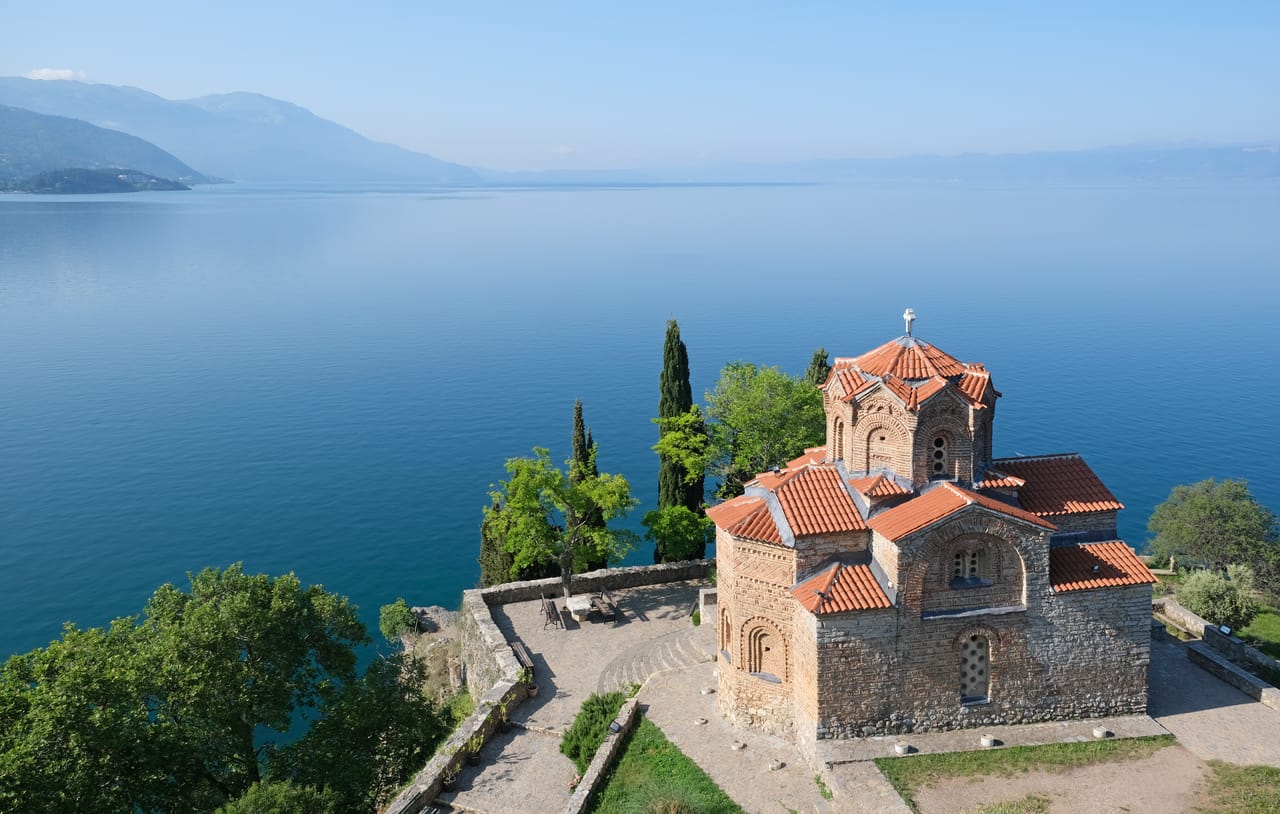
Lake Ohrid is explored one shore at a time. To the west, the road follows the water to Struga, where the Black Drin flows out of the lake, then passes below two churches cut into the cliff, at Kališta and Radožda. To the east, it runs past the beaches of Peštani and the fishing village of Trpejca to the monastery of St Naum, at the far end of the lake.
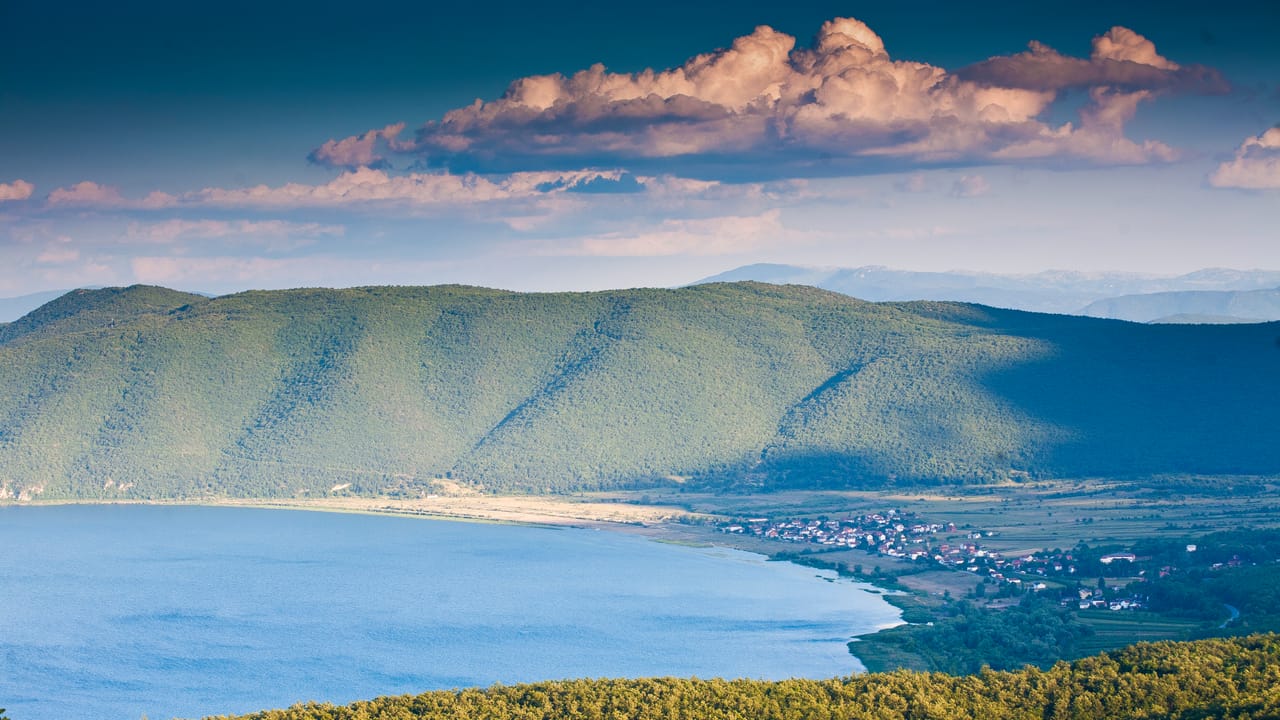
Above the east shore, a mountain road crosses Galičica National Park. It climbs in hairpin bends to just over 1,560 metres. From the pass, you can see both lakes at once: Ohrid on one side, Prespa on the other. Prespa, shared with Albania and Greece, is quieter, with few big hotels. From Konjsko, boats go out to Golem Grad, the island of snakes, with its ruins and churches.
North of Prespa, apple orchards surround Resen. A pass road then drops down to the plain of Bitola, at the foot of Mount Pelister. The town has kept its long pedestrian street, the Širok Sokak, and its old bazaar. Just to the south, the ruins of Heraclea Lyncestis still have mosaics from the 6th century.
Ohrid, the town of churches
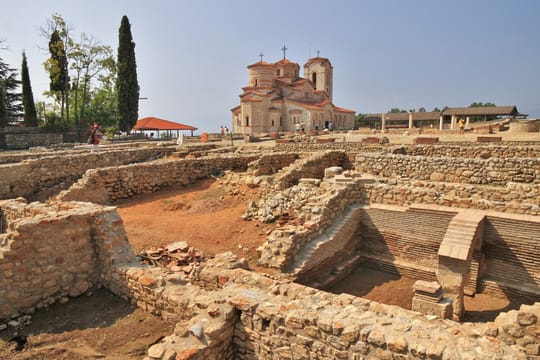
Above the old harbour, Plaošnik hill is linked to the beginnings of Slavic writing. At the end of the 9th century, Clement of Ohrid, a disciple of Cyril and Methodius, founded a monastery and a school there. He is buried in the monastery church, St Clement and Panteleimon. The church you visit today was rebuilt in the early 2000s on the old foundations. His companion Naum founded the monastery that bears his name in 905, at the far end of the lake.
At the end of the 10th century, Tsar Samuel made Ohrid his capital; the fortress above the town bears his name. St Sophia, the former cathedral of the Archbishopric of Ohrid, has frescoes from the 11th to the 14th century. The Ottomans turned it into a mosque.
In 1295, the church of the Holy Mother of God Peribleptos was painted by Michael Astrapas and Eutychios. The two painters slipped their names into the frescoes, on the sword and cloaks of soldier saints. Just below the church, an ancient theatre recalls that Ohrid was once called Lychnidos. It is said that the town once had 365 churches, one for each day of the year.
So the two lakes are connected under the mountain.
Two lakes linked under the mountain
Lake Ohrid is one of the oldest in Europe: its sediments go back more than a million years. It is 288 metres deep and is home to more than 200 endemic species. Prespa, at 853 metres above sea level, has no river flowing out of it. Its water seeps into the limestone of Galičica and comes out as springs on the Ohrid shore, 160 metres lower down. So the two lakes are connected under the mountain.
The Ohrid region has been on the Unesco World Heritage List since 1979 for its nature and since 1980 for its cultural heritage. Building along the shores threatens it. In 2026, according to the press, Unesco once again put off adding the region to the List of World Heritage in Danger. North Macedonia and Albania have until 2030 to act.
Pelister National Park
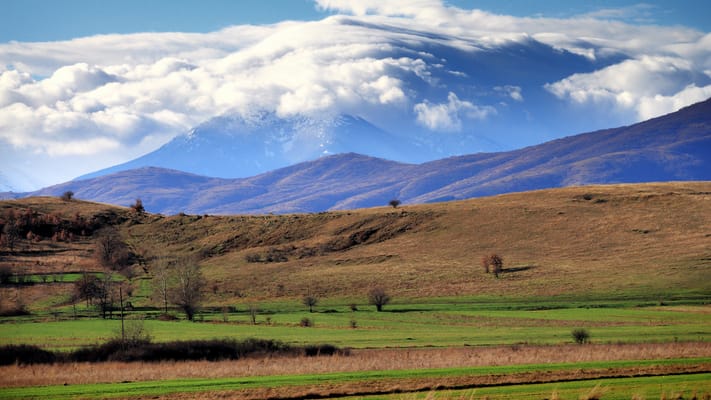
Founded in 1948, it is the country’s first national park. Its forests of molika, a Balkan pine, cover the slopes. Higher up, two glacial lakes can only be reached on foot; the summit reaches 2,601 metres.
Practical notes
- When to go
- June and September. July and August are hot and busy. Snow can block the Galičica pass in winter and spring. To drive over it, plan on late May to October.
- Getting there
- Ohrid is less than three hours’ drive from Skopje. You can hire a car at Ohrid airport.
- Access
- Everything is tarmac. The Galičica road is narrow and full of hairpin bends. Ohrid’s old town and the centre of Bitola are pedestrianised: park around the edges.
- Sleeping in a van
- Campsites on the east shore of Lake Ohrid and beside Lake Prespa. Wild camping is banned in the national parks.
- Worth knowing
- Dipped headlights are compulsory during the day. To cross into Albania in a hire car, you need the rental company’s permission and a Green Card.
- Allow
- Five days for the loop, one more to walk on Pelister.
What not to miss
- 1St John at KaneoA small church, probably from the 13th century, on a rock above the lake.
- 2The Ohrid Icon GalleryByzantine icons, on display next to the Peribleptos church.
- 3The springs of St NaumA boat trip over the springs, then the peacocks in the monastery courtyard.
- 4The Bay of BonesA Bronze and Iron Age village on stilts, rebuilt above the water.
- 5St George at KurbinovoFrescoes begun in 1191; the church is often locked.
- 6RadoždaA church cut into the cliff above the lake, at the top of a long flight of steps.
Ohrid and Prespa in pictures
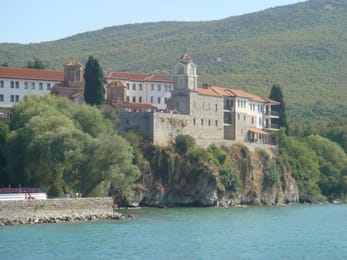
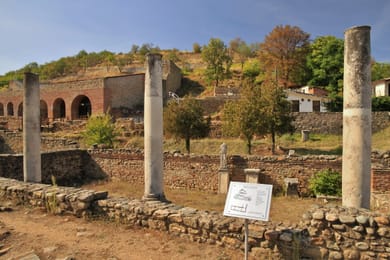
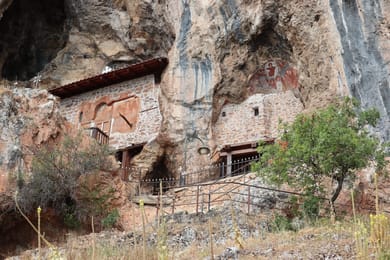
The monastery of St Naum on its cliff, beside the turquoise water.
Food in Ohrid and Prespa
By the lake, people eat fish. As Ohrid trout is endangered, it is worth asking where the one on your plate comes from. Everywhere you will find tavče gravče, beans baked in the oven, and ajvar, a purée of roasted peppers.
Around Resen, Prespa apples are sold by the roadside in autumn. The red wine comes mainly from Tikveš, in the centre of the country. In Ohrid, you will also find the Ohrid pearl on sale, made from the scales of a small fish from the lake.
Loop from Ohrid


 +13stops
- 1Црква „Пресвета Богородица Перивлептос“ - Охрид · Самуилова тврдина · Плаошник · Црква „Св. Јован Канео“ - Охрид
- 2Црква „Св. Ѓорѓи“ - Струга · Калишки манастир · Св. Архангел Михаил
- 3Залив на коските · Манастир „Св. Наум“ - Охрид · Национален парк Галичица · Стење
Free, no account needed — start from its places and make it yours.
Also worth reading
Wide open spaces
The Pacific Northwest, from the Olympic Peninsula to the Cascade volcanoes
Rainforests, a coast of headlands and lighthouses, redwoods and two active volcanoes. A two-week loop from Seattle, by way of the Olympic Peninsula, the Oregon coast and Mount Rainier.
Wide open spaces
Vancouver Island, from Victoria to the beaches of Tofino
An island of giant forests, beaches pounded by the Pacific and small harbours where boats leave to see orcas. Nine days on a loop from Victoria, from Port Renfrew to Tofino and up to Telegraph Cove.
Wide open spaces
Yellowstone, Grand Teton and Glacier: the great Rockies road trip
Three national parks on one road, from the Tetons to the glaciers of Montana, by way of the geysers of Yellowstone. Twelve days from Jackson to Kalispell, with bison by the roadside and two great mountain roads.
A starting point, a few wishes — ViaLooma builds the trip day by day, map, stops and roadbook included.