The Balkan Mountains and the Rose Valley
In the middle of Bulgaria, the road runs along the Balkan Mountains, passes through the rose fields and crosses the range at the Shipka Pass. A week from Sofia to Veliko Tarnovo, among timber villages and Thracian tombs.
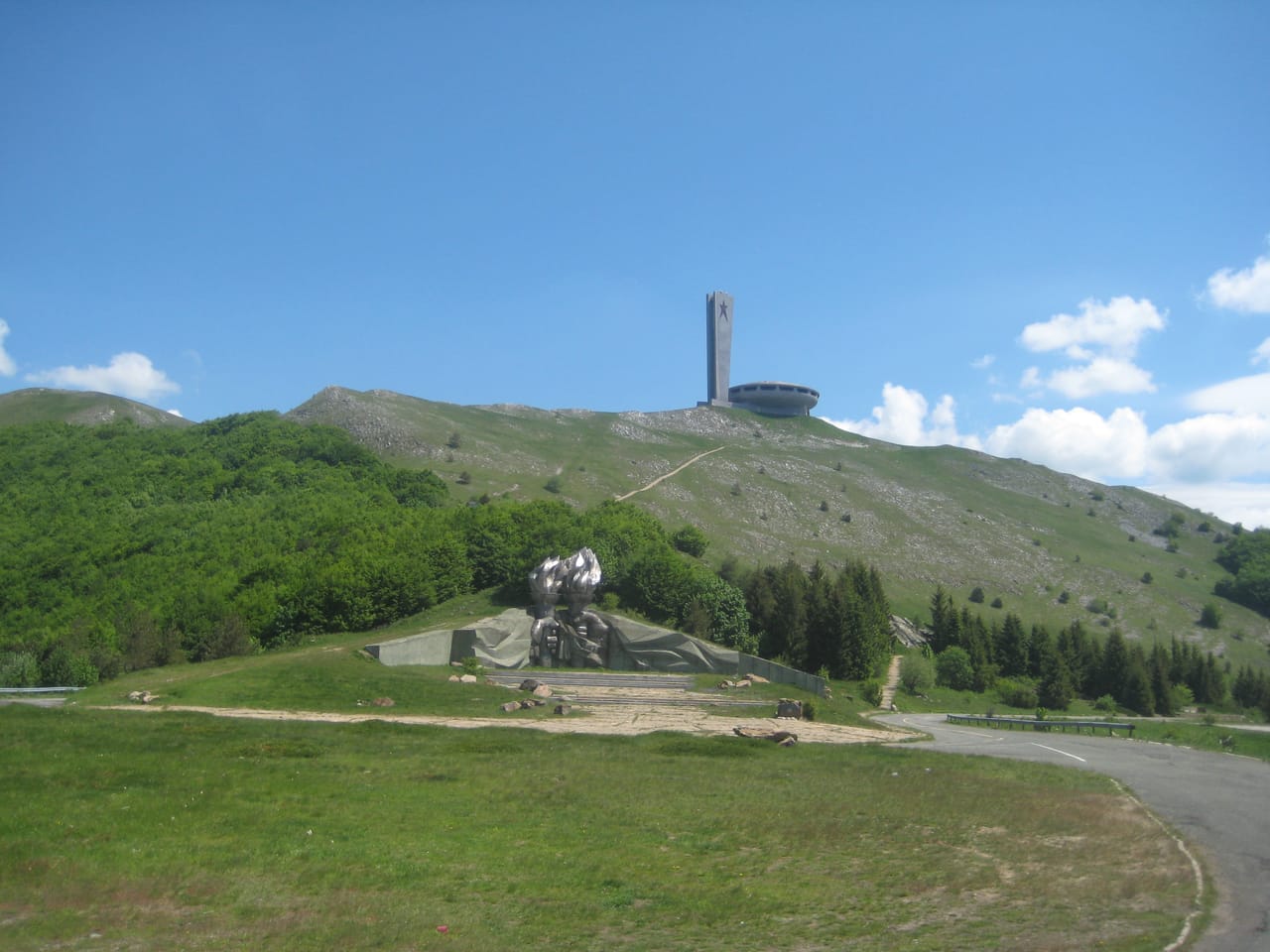
The road along the Balkan Mountains
East of Sofia, the road reaches the Sredna Gora, the range south of the Balkan Mountains. Koprivshtitsa, at 1,030 metres, is a small town of cobbled streets and old houses. Then, from Sopot to Kazanlak, you drive along the foot of the Balkan Mountains. In May and June, roses bloom along the road.
Above Kazanlak, hairpin bends climb towards the Shipka Pass, at nearly 1,200 metres. A ridge road leads to Buzludzha, a communist building shaped like a saucer, 70 metres high with its tower. Opened in 1981 and abandoned after 1989, it is fragile: the inside is closed, and you walk round the outside.
Then the road moves from the central to the eastern Balkan Mountains, through small towns. From Tryavna to Elena, then on towards Kotel, the roads are slow. In Zheravna, there are more than 200 timber houses.
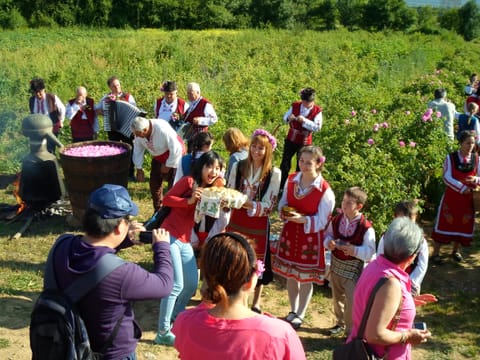
The rose and the Thracian tombs
The Rose Valley lies south of the Balkan Mountains, around Karlovo and Kazanlak. It is said to supply nearly half of the world’s rose oil, made from the Damask rose. The flowers are picked by hand, from May to June. The date moves: in 2024, flowering began nearly a month earlier than usual. Kazanlak’s Rose Festival takes place in early June.
Outside the flowering season, there is still the Rose Museum in Kazanlak and the Damascena distillery in Skobelevo.
The valley also has many Thracian tombs. The Thracian Tomb of Kazanlak, from the 4th century BC, is on the UNESCO World Heritage List. Its paintings show a couple at a funeral banquet and a chariot race. The tomb is closed to protect them: you visit a full-size replica. The Golyama Kosmatka mound, excavated in 2004, is attributed to King Seuthes III. A bronze helmet and two silver vessels, all bearing his name, were found there.
In 1878, part of Bulgaria became free.
From April 1876 to the Shipka Pass
The route passes through Karlovo, the birthplace of the revolutionary Vasil Levski. In April 1876, the Bulgarians rose up against the Ottoman Empire. According to tradition, the first shot was fired from the Kalachev Bridge in Koprivshtitsa. The repression outraged Europe, and Russia went to war with the Ottomans in 1877. In 1878, part of Bulgaria became free.
In August 1877, about 7,500 Russians and Bulgarian volunteers held the Shipka Pass against nearly 30,000 Ottoman soldiers. The Freedom Monument, opened in 1934, has been closed to visitors since 3 September 2026 for restoration, in principle until the end of August 2029. The surrounding area remains open, subject to safety rules. So you come for the pass and the battlefield.
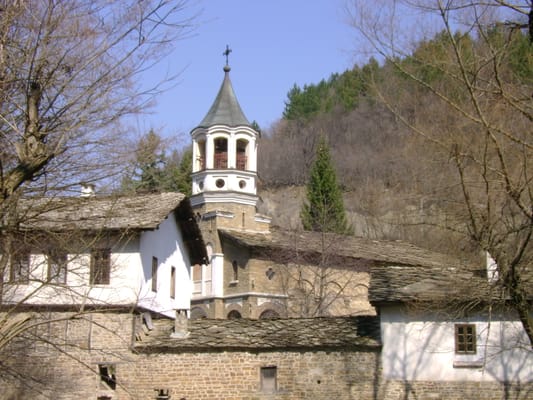
Dryanovo Monastery and Bacho Kiro Cave
In 1876, about 200 insurgents held out here against the Ottoman army for nine days. 300 metres from the monastery, Bacho Kiro Cave has yielded remains of Homo sapiens dated to about 46,000 years ago; 700 metres of it are open to visitors.
Practical notes
- When to go
- May–June for the roses, but check the flowering, which comes early in some years. In winter, snow can close the high roads.
- Getting there
- Start from Sofia and its airport. Return to Sofia from Veliko Tarnovo: about three hours’ drive.
- Access
- The ridge road between Buzludzha and the Shipka Pass is closed all winter: you then go up by the south side and come back the same way. The pass is closed to lorries over 12 tonnes and can close in snow: see api.bg. Tryavna–Elena, 46 km, takes about an hour and a half.
- Sleeping in a van
- It is best to aim for campsites and aires: the rules for sleeping elsewhere are unclear, and wild camping is banned in national and nature parks, such as Bulgarka near Etar. Veliko Tarnovo has a car park with 16 motorhome spaces near Tsarevets.
- Worth knowing
- E-vignette required up to 3.5 tonnes; above that, see bgtoll.bg. To check: Sofia’s low-emission zone, from December to February, and the opening times of the Rose Museum, Damascena and the tombs.
- Allow
- A week from Sofia to Veliko Tarnovo, half a day more for Dryanovo.
What not to miss
- 1EtarAn open-air museum opened in 1964 near Gabrovo, with about twenty artisan trades.
- 2BozhentsiA village of cobbled streets and stone roofs, protected since 1964.
- 3TryavnaThe Daskalov House, from 1808, and its carved ceilings, born, they say, of a bet between a master and his apprentice.
- 4ZheravnaThe birthplace of the writer Yordan Yovkov, where coloured rugs hang from the façades.
- 5ArbanasiA village of wealthy merchants of the past, four kilometres from Veliko Tarnovo.
- 6TsarevetsThe great fortress of the Second Bulgarian Empire, which fell in 1393, above Veliko Tarnovo.
The Balkan Mountains and the Rose Valley in pictures
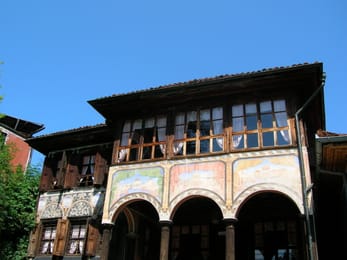
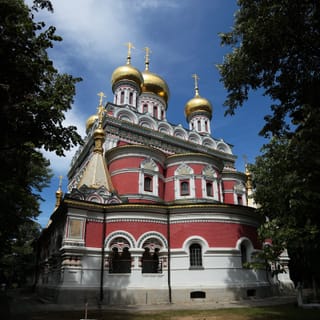
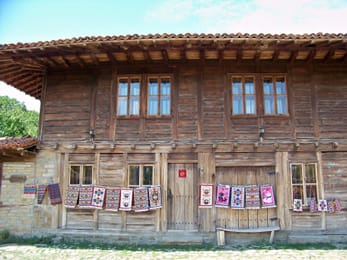
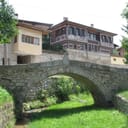
The Oslekov House in Koprivshtitsa, with its columns and painted façade.
The Balkan Mountains table
The rose also turns up at the table, as jam and as a spirit. For the rest, you eat banitsa, a cheese pastry, kavarma, a meat stew, and yoghurt. You drink rakia, a spirit.
In Elena, the speciality is elenski but, a ham salted then dried in the mountain air. South of the Balkan Mountains, the vineyards mostly make dry and medium-dry whites, muscat and riesling.
Sofia → Veliko Tarnovo
 +20stops
- 1Панагюрище · Копривщица · Калъчев мост
- 2Къща музей „Иван Вазов“ (Сопот) · Карлово · Калофер · Етнографски комплекс Дамасцена
- 3Розова долина · Музей на розата · Казанлъшка гробница · Голяма Косматка
You start from this trip’s places and make it your own.
Also worth reading
Mountains and passes
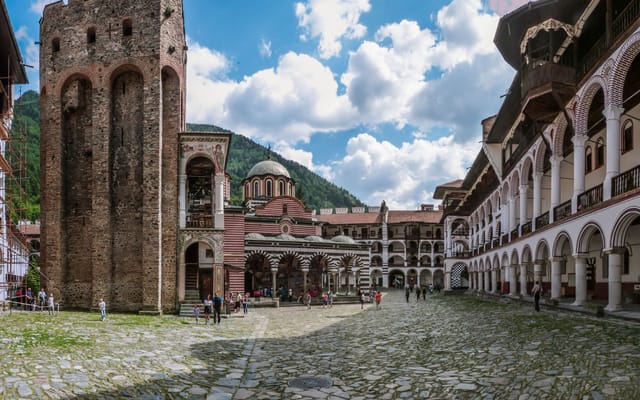
Rila and Pirin, from Rila Monastery to Melnik
South of Sofia, Bulgaria’s two highest mountain ranges, with Rila Monastery, Bansko, villages with stone roofs and the sand cliffs of Melnik. Six days on a loop from Sofia, on mountain roads that are often slow.
Wide open spaces
The Rhodopes, from Plovdiv to Perperikon
A mountain range covered in forest, with marble gorges and sanctuaries carved into the rock, in the south of Bulgaria. A week on a loop from Plovdiv, from the caves of Trigrad to Perperikon.
Heritage and culture
Classic Bulgaria, from Sofia to Veliko Tarnovo
Mountain monasteries, Thracian tombs, a Roman theatre and the capital of the tsars. Eight days on a loop from Sofia, crossing the Balkan Mountains twice.
A starting point, a few wishes — ViaLooma builds the trip day by day, map, stops and roadbook included.